The post Strengthening improvement work by identifying and addressing adaptive challenges appeared first on StriveTogether.
]]>Through improvement science, that vision can be reality. I’m not saying that using continuous improvement tools and techniques is easy. Over past four years, I’ve worked with communities across the country to apply StriveTogether’s collaborative improvement approach — our unique take on continuous improvement. I’ve come to realize that to succeed and sustain improvement in education systems, you must look beyond the simple or (dare I say) easy fixes.
Instead, you must understand the adaptive — or, as I think of it, human — elements of the challenges. These challenges necessitate that people change what they do or how they work to solve them.
This week, I presented with StriveTogether team member Davida Casey at the Carnegie Foundation Summit on Improvement in Education, where we shared strategies for uncovering adaptive challenges and how to make sure they don’t get in the way of your work to get more equitable results for kids and families.
Taking a moment to consider what adaptive challenges are impacting your work can yield significant results. I recently saw this firsthand through one of my improvement teams in a community working to improve home visitation programs for children ages zero to 3. These programs offer a range of services to young children and their families from a trained service provider in a home environment.
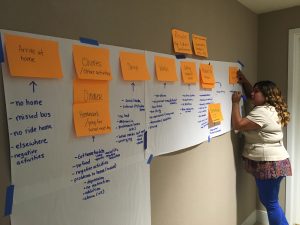
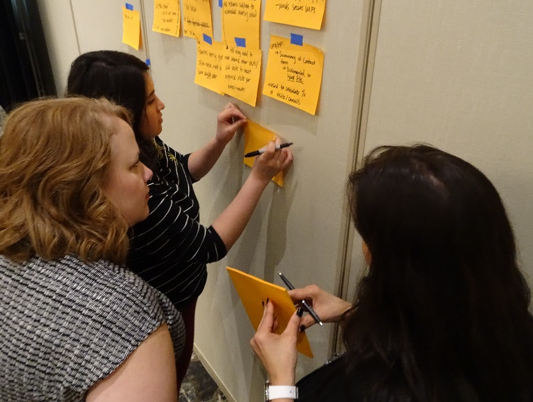 To better understand what was working and what needed to work better, the team outlined the steps for families to enroll in a program and to complete their first home visit. After mapping the process, they identified the challenges at each step preventing families from moving forward. Early on, the team identified form completion as a challenge. Editing a form sounds like an easy correction to make. But instead of creating a quick solution to ensure parents completed the forms, the team dug deeper. They considered what adaptive challenges parents might face that would keep them from finishing the forms. Simply put, they asked, “Why aren’t parents completing the forms?”
The answers they uncovered pointed to a lack of trust — trust for outside providers and the program itself. Many parents also felt conflicted — they wanted to best for their children but believed that they knew how to best support their son or daughter. With this information, the team created a very different set of strategies around how to talk with and engage parents in the early phases of home visiting. The team focused on building trust and working through the internal conflict parents were feeling. As a result, these parents not only completed the forms, they were much more engaged and more easily supported by service providers.
Applying an adaptive lens to improvement work requires considering what changes or losses might be experienced by the population you’re working to support. This perspective allows you to understand the deepest causes behind the challenge (like trust, loss of expertise or loss of funding) and to identify the adaptive elements that need to be addressed. By developing strategies for adaptive challenges, improvement teams and communities can see more change that lasts, leading to better outcomes for every child, from cradle to career.
The post Strengthening improvement work by identifying and addressing adaptive challenges appeared first on StriveTogether.
]]>The post 6 principles for working toward collaborative improvement appeared first on StriveTogether.
]]>The story started two years ago when too many students were missing too many days of class, and United Way of Salt Lake asked StriveTogether to convene an impact and improvement network to tackle the issue. Using collaborative improvement — StriveTogether’s unique approach to continuous improvement — the network’s efforts led to some remarkable results, including a 14% drop in absence rates for chronically absent first-graders at one elementary school.
From this experience, Tyler and I have several lessons about working toward improvement across a community. Here are our top six insights:
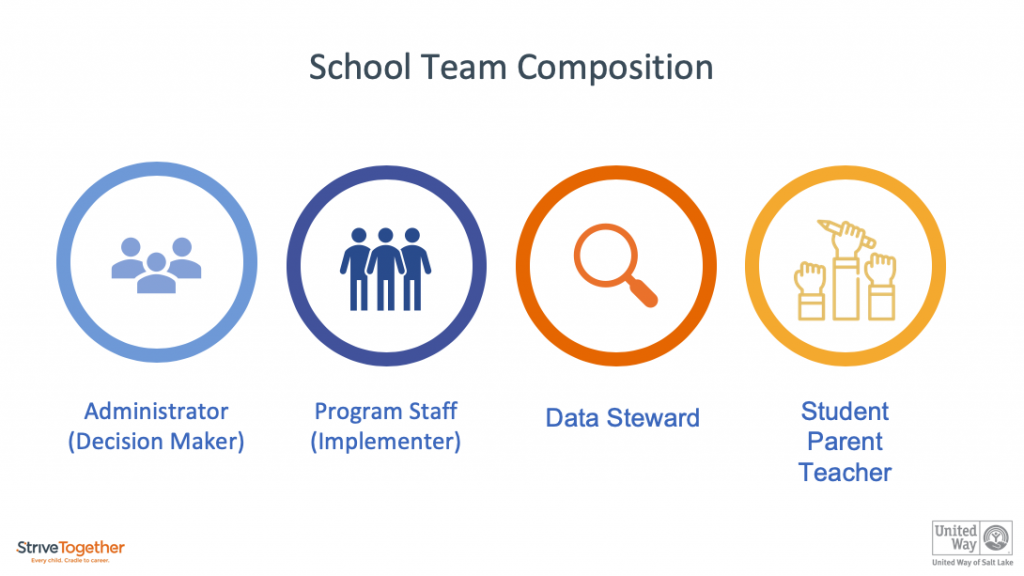 Make sure the right people are on board. The composition of your team and network will determine if you can reach your target students and scale successful strategies. Take time to think deeply about who needs to be engaged and what they will contribute. And, to truly understand the community’s challenges and possible solutions, include students and parents of the population you are trying to support.
- Walk the talk. Leading improvement work means that you must model effective improvement strategies in your own work. The quicker you and your organization start using continuous improvement tools and methods, the quicker others around you will take on the same approach.
- Get support for the work at all levels. Collaborative improvement requires people to shift their priorities. Be willing to try new processes and ways of working. Organization leaders also must use their authority to ensure staff members have time and space to do this work. Others will join your efforts as they see success.
- Be patient — change is hard. Improvement work often requires people to change how they act every day. Give team members time to adjust and find ways to support them as they take on new habits. Building a culture of continuous improvement doesn’t happen overnight. Celebrating early wins and providing coaching can be the keys to success.
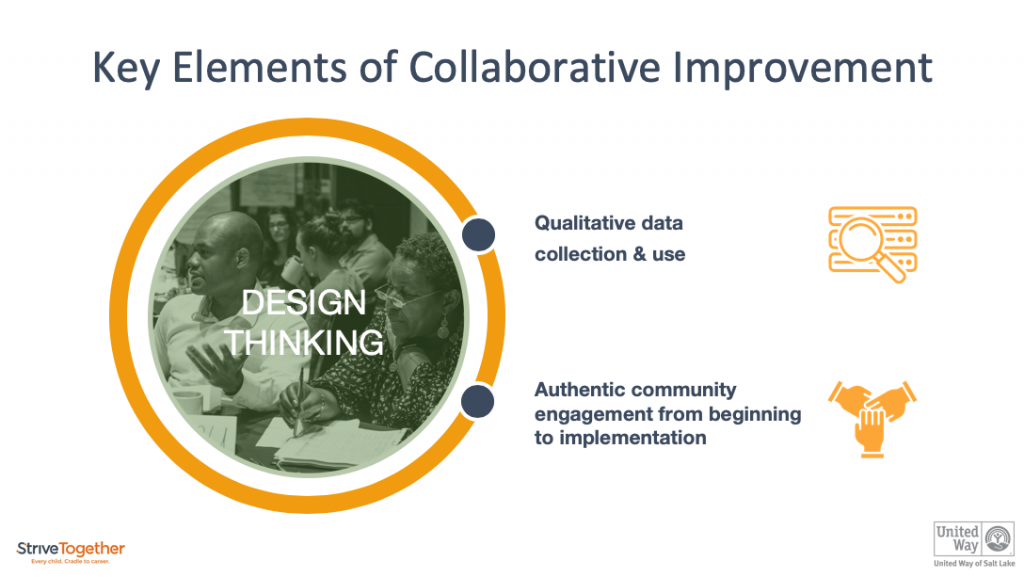 Kids are more than just numbers. Using quantitative data is essential throughout the continuous improvement process, but it does not tell you the full story. Integrating qualitative data allows you to uncover the why behind the numbers, providing a stronger understanding of community challenges and a clearer direction for the work.
- To solve systemic challenges, go beyond technical tools and solutions. Continuous improvement work involves a lot of tools and templates, but obstacles can’t be overcome by just filling out a worksheet. In reality, before you begin to create solutions, you must dig below the surface to understand root causes of problems — often a result of the systemic inequities that must be addressed. The Salt Lake City team uses collaborative improvement to share strategies, track data and build connections so that every kid in Salt Lake City has every chance to succeed.
In addition to improving attendance, United Way of Salt Lake City used StriveTogether’s collaborative improvement strategies across the community, including improving access to a local food pantry and increasing mental health screenings at a free clinic. The organizations’ partnership was one of six examples chosen as a 2018 Carnegie Foundation Spotlight on Quality in Continuous Improvement. Learn more about this recognition.
The post 6 principles for working toward collaborative improvement appeared first on StriveTogether.
]]>The post Ensuring every child receives a successful start appeared first on StriveTogether.
]]>I was quickly put on bedrest and told that if I made it to 32 weeks of pregnancy, I would be hospitalized, and if I made it to 34 weeks of pregnancy, my twin girls would be delivered via a planned Caesarean section. I was not allowed to have contractions or go into labor at all. In fact, even if I was in the hospital and went into labor, my doctors told me that they could not guarantee that Baby A would be delivered alive. It was an extremely harrowing and stressful time for my husband and me.
Because I had access to the best high-risk maternal-fetal doctors in Cincinnati, my twin daughters, Helen and Elizabeth, were born healthy at exactly 34 weeks. They weighed about 4.5 pounds at birth and were immediately admitted to the neonatal intensive care unit (NICU), where they stayed for the next 16 days.
 My daughters’ premature birth and NICU stay qualified them for support services to ensure they hit the appropriate developmental milestones. These optional screenings are every six months until my girls reach 3 years old. Although this is a standard practice for children born prematurely, it only was mentioned to me in an offhand comment a day or two before my daughters were discharged from the NICU.
Having been alerted to these special screenings, I kept a lookout for the invitation letter in the mail. Only one of my girls was sent the invitation to participate. After several calls and voicemails, I finally got in touch with someone to schedule appointments for them both. The times were limited to four-hour afternoon blocks only on two days of the week. If I hadn’t known about the importance of early intervention through my work, and if I hadn’t had a flexible workplace that allowed me to take time off, I would not have been able to take my daughters to their appointments.
After their 18-month developmental screening, my girls both qualified for early intervention supports: occupational therapy (Helen), physical therapy (Elizabeth) and speech therapy (both). At the time, I remember being overwhelmed by the additional appointments, but by the time of their final developmental screening around 28 months, both girls were at or above the developmental milestones for their age and graduated from being monitored. Today, weeks away from their third birthday, Helen and Elizabeth are thriving, and I’m happy to say they are meeting or exceeding all developmental benchmarks.
This personal experience makes me all the more thankful and excited about an opportunity that Pritzker Children’s Initiative (PCI) has provided StriveTogether by funding an important project in the prenatal-to-age-3 space to ensure that every child, regardless of race or zip code, can receive the support needed to have the best possible start to life. With PCI’s support and in partnership with the National Institute for Children’s Health Quality (NICHQ), we have launched a national impact and improvement network focused on improving prenatal-to-age-3 milestones with teams from six StriveTogether Cradle to Career Network communities:
- Albuquerque, New Mexico (Mission: Graduate)
- Memphis, Tennessee (Seeding Success)
- Norwalk, Connecticut (Norwalk Acts)
- Salt Lake City, Utah (Promise Partnerships of the United Way of Salt Lake)
- Spartanburg County, South Carolina (Spartanburg Academic Movement)
- Tucson, Arizona (Cradle to Career Partnership)
 These teams will work over the next 15 months to apply StriveTogether’s continuous improvement methodology to improving milestones for children from birth to age 3 in their community. And hopefully, like other impact and improvement network teams, we will identify best practices by the end of the network in June 2019.
I look forward to working with these partnerships in the Cradle to Career Network and hearing about the impact these communities have on improving milestones for our youngest, most vulnerable children. As this impact and improvement network takes shape, we will share their progress, lessons and successful results with the StriveTogether network and the field to ensure that every child receives the best start to life, just like my girls did.
The post Ensuring every child receives a successful start appeared first on StriveTogether.
]]>The post StriveTogether’s next national Impact and Improvement Network will focus on prenatal to age 3 milestones appeared first on StriveTogether.
]]>
Thanks to generous funding from the Pritzker Children’s Initiative, StriveTogether has partnered with the National Institute for Children’s Health Quality (NICHQ) to support the work of Cradle to Career Network members to improve kindergarten readiness by focusing on child development from prenatal to age 3. NICHQ uses a similar continuous improvement approach in its work and will provide much-needed data expertise in the prenatal to age 3 space from past and current work in this area.
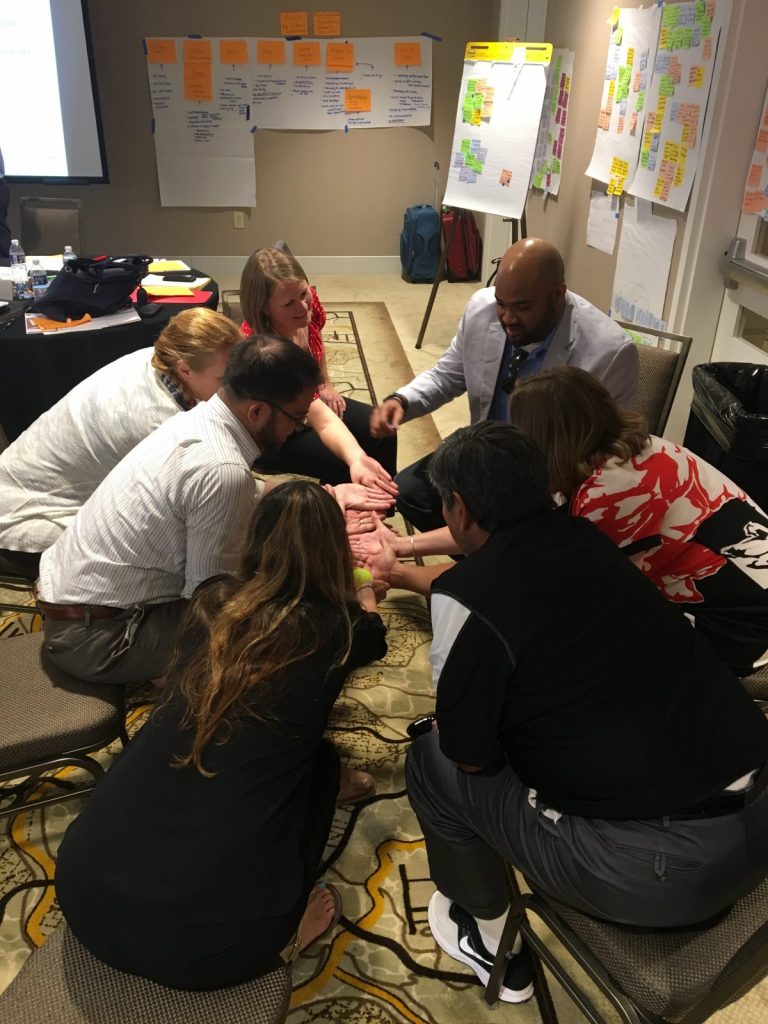
The Prenatal (PN) to Age 3 Impact and Improvement Network offers StriveTogether network members the opportunity to focus on and improve the number of children meeting key prenatal to age 3 milestones in their community. PN – 3 Impact and Improvement teams will build on their current work and accelerate progress using Results Count techniques, disaggregated data, peer-to-peer learning, coaching and training in continuous improvement (using data to inform decisions and improve strategies) and design thinking (using empathy and engagement strategies to involve people impacted by the problem in creating the solution). Over the course of 16 months, partnership teams will identify essential milestones and the key factors impacting them, as well as implement strategies to improve those milestones.
To be eligible for the PN – 3 Impact and Improvement Network, a partnership must:
- Be a StriveTogether Cradle to Career Network member operating in the Sustaining Gateway or higher.
- Have a Collaborative Action Network and/or have convened partners to focus on the
prenatal to age 3 milestones. - Have a relationship with at least one partner working directly with parents of and/or prenatal to age 3 children who is willing to participate and provide data regarding prenatal to age 3 milestones (e.g. home visitation, well-child visits, development evaluation, early intervention work).
- Have a memorandum of understanding or other formal data-sharing agreement with at least one provider working directly with parents of and/or prenatal to age 3 children that allows the partnership to regularly collect disaggregated data at the parent/child level.
- Able to regularly collect/access and analyze disaggregated prenatal to age 3 data that can be used in a rapid cycle continuous improvement process.
Interested in learning more? Join the PN-3 Impact and Improvement Network Interest webinar on Tuesday, December 5, 2017, from 2 – 3 p.m. ET. During the webinar, StriveTogether staff will provide an overview of the PN – 3 Impact and Improvement Network, share recommendations and insights on completing the application and answer questions. Register for the webinar here.
Interested in applying? Download the PN – 3 Impact and Improvement Network application. Application deadline is Friday, January 12, 2018.
This work is part of a partnership among five national organizations to improve kindergarten readiness for children from prenatal to age 3.
The post StriveTogether’s next national Impact and Improvement Network will focus on prenatal to age 3 milestones appeared first on StriveTogether.
]]>The post Building a culture of continuous improvement takes collaboration, knowledge and tools appeared first on StriveTogether.
]]>But building a culture of continuous improvement across multiple organizations and throughout a community is much easier said than done. Fortunately for us, failing forward is something we’ve embraced over the years and has allowed us not only to learn a lot about what works, but helped us develop a continuous improvement methodology that is getting results for community partnerships.
In our early days, we were lucky enough to receive support from Six Sigma Black Belts. These Black Belts took time away from their private sector work to help us apply Six Sigma’s DMAIC (define, measure, analyze, improve and control) process in education with the hope of seeing systems-level changes. This process worked well sometimes but often hit barriers that significantly slowed or stopped the work before any improvements could be made. Over time, themes began to emerge about challenges our network communities were experiencing:
- Data: Communities struggled to collect data and disaggregate it. There were often long lags in getting data that was often only released on a yearly basis. On top of those challenges, many people believed that children were more than just numbers and that qualitative data needed to be included in the work to best understand root causes.
- Accountability: Working collaboratively and across multiple organizations can be extremely challenging. This is especially true when no formal authority exists, but people are expected to share and contribute to the work equally. Often deadlines were missed and people did not follow through on what they said they would do.
- Trust: It’s extremely difficult to build trust in the education sector when different organizations are constantly being compared, assessed and evaluated. To do the work our local partnerships are asking people in their communities to do, it was essential to build enough trust amongst partners to have improvement-focused conversations.
- Community engagement: Six Sigma is based on the voice of the customer. We knew that engaging the children, families, caregivers and direct service providers was necessary, but many of our partners struggled with how to engage these groups and how to collect and use the information they provided.
- Rigid processes: DMAIC and other improvement processes were meant to be run within one organization, within a very controlled and data-rich environment very different from what our partnerships were working in. Data and accountability challenges only made using these processes more challenging or stopped any progress, because groups could not move from one step to the next. Too much was missing or the work wasn’t getting done.
In 2014, two significant opportunities allowed us to make significant shifts in our work and directly impacted our continuous improvement work. First, Cincinnati Children’s Hospital Medical Center allowed several of our staff members to attend their continuous improvement training programs, which was based off of the work of the Institute for Healthcare Improvement (IHI) and focused mainly on the use of plan-do-study-act (PDSA) cycles. Second, The Annie E. Casey Foundation partnered with us to build our staff’s and our partnerships’ competency in results-based leadership (RBL).
Both opportunities were game changing. Combining a simpler continuous improvement process with customized leadership skills to manage the challenges of collaborative, systems-change work led to the development of the StriveTogether collaborative continuous improvement methodology.
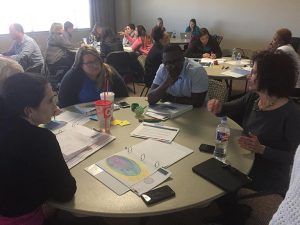
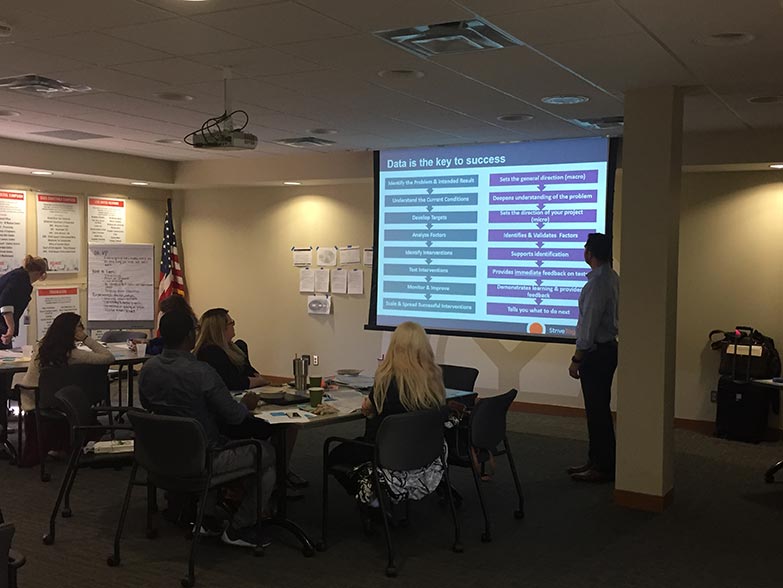
StriveTogether’s collaborative continuous improvement methodology integrates tools and techniques from continuous improvement, results-based leadership and design thinking, while also supporting people to identify, target and eliminate local disparities. This unique combination removes common barriers and arms cradle-to-career communities with knowledge and tools that get results and allow them to improve outcomes for every child.
- PDSA-centered continuous improvement: The simplicity and effectiveness of Plan-Do-Study-Act cycles gives our partners the flexibility they need when working collaboratively and across systems in a community. PDSA cycles have also been a proven and effective tool for educators.
- Addressing adaptive challenges using RBL: Results-based leadership has accelerated the progress in many communities by providing the language, tools and techniques to improve accountability, trust and all the other challenges that come into play when you are trying to achieve systems-level change.
- Human-centered design: Design thinking concepts have enriched our continuous improvement process by providing our partners with thoughtful and mutually beneficial ways to directly engage with the children and families they are trying to better support. It also has helped us better integrate qualitative data into our process and ensure that we see the full picture ¬¬ the root causes hiding behind the numbers.
- Intentional efforts to address disparities: Eliminating local disparities is a cornerstone of our work at StriveTogether. Threaded throughout our continuous improvement methodology is an intentional effort to identify, target and eliminate educational disparities.
It’s not easy to build a culture of continuous improvement across a community. At StriveTogether, we believe that our new approach to collaborative continuous improvement will help support communities in our Cradle to Career Network as they work to improve outcomes for every child, cradle to career.
The post Building a culture of continuous improvement takes collaboration, knowledge and tools appeared first on StriveTogether.
]]>The post 10 effective strategies to increase FAFSA completion in your community appeared first on StriveTogether.
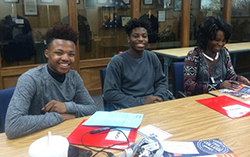
]]>
1. Implement in-class interventions.
In most states, FAFSA completion work can be used to meet state curriculum standards. Partnering with high school economics or social studies teachers to have students complete FAFSA as a class or homework assignment provides them with the opportunity and support needed to complete the FAFSA.
2. Use student-level and/or school-level data.
In most states, school districts have the ability to track FAFSA completion at the school- and/or student-level. Using school-level or, better yet, the student-level data helps to identify the students who are or are not completing the FAFSA. This allows school districts and their partners to focus their work on the specific students or schools needing the most support.
3. Build a school- or campus-based FAFSA team.
School- or campus-based FAFSA teams improve staff awareness about the importance of FAFSA completion and how they can help. Convening a team (assistant principal, guidance counselor, central office staff, Gear Up partners, etc.) on a monthly basis allows its members to review the data and discuss strategies for how to reach students who have yet to complete the FAFSA.
4. Host FAFSA-only events.
The most successful FAFSA events, like a FAFSA completion night, were the ones that just focused on FAFSA because it created the space and time for students and families to focus. Identifying a champion for each event helped determine the best time of day for the event to ensure the best attendance possible.
5. Assign appointment times.
Assigning students an appointment time to complete the FAFSA, either during a completion event or the school day, makes the meeting or event seem mandatory. The appointment times were not strictly enforced and there was no penalty for missing an appointment, but the assumed accountability associated with the appointment time dramatically increased completion rates.
6. Frequently monitor data.
Most school districts across the country have the ability to access weekly or bi-weekly FAFSA completion data either from their state’s department of education or the U.S. Department of Education. Monitoring completion rates either weekly or bi-weekly allows school district staff and community partners to get quick feedback on the effectiveness of their FAFSA completion work and helps keep FAFSA completion at the front of everyone’s mind.
7. Partner with local postsecondary institutions.
Partnering with local postsecondary institutions can help significantly with FAFSA completion. Financial aid staff are experts in their field and can provide additional capacity and support during FAFSA completion efforts. Additionally, financial aid staff can provide insight on what is specifically preventing students from getting the financial aid they have applied for — often times it’s a simple as a missing Social Security number or mismatched identification numbers.
8. Connect work to its impact with run charts.
Run charts, or time series charts, can be used to connect FAFSA completion work with the result (the number of FAFSAs completed during the work period). As a result, run charts are incredibly powerful tools for partnerships that want to understand the impact their work is having on students.
9. Create a FAFSA phone bank.
Having a scheduled event where parents, guardians and students can call in to ask questions about completing the FAFSA was a very successful way to reach families who didn’t want or need to attend a completion event.
10. Test small before going big.
All of our teams intent on FAFSA completion selected a specific high school or population of students as the focus of their initial work. Each intervention allowed the teams to learn what worked well and what could be improved before scaling the work across multiple high schools or districts.
The post 10 effective strategies to increase FAFSA completion in your community appeared first on StriveTogether.
]]>