The post Art Inspires scholarship calls for interpretation of spoken word poems appeared first on StriveTogether.
]]>There is an overused idiom often said about art: “A picture is worth a thousand words.” While the phrase is cliché, it speaks to the power of the arts to evoke emotion, explain the inexplicable and inspire action.
Last year, StriveTogether launched the Art Inspires scholarship for high school seniors and postsecondary students. Student artists from our 70 Cradle to Career Network communities across the country expressed what community, courage, equity, progress and results (our core values) meant to them. StriveTogether awarded five $1,000 scholarships to the selected artists: Amaia Johnson and Denzel Chase from Memphis, Tenn.; Camille Richmond and Lauren DeMarco from Charleston, S.C.; and Shani Salinas from Racine, Wis. Their winning pieces of art are now exhibited in StriveTogether’s Cincinnati headquarters.
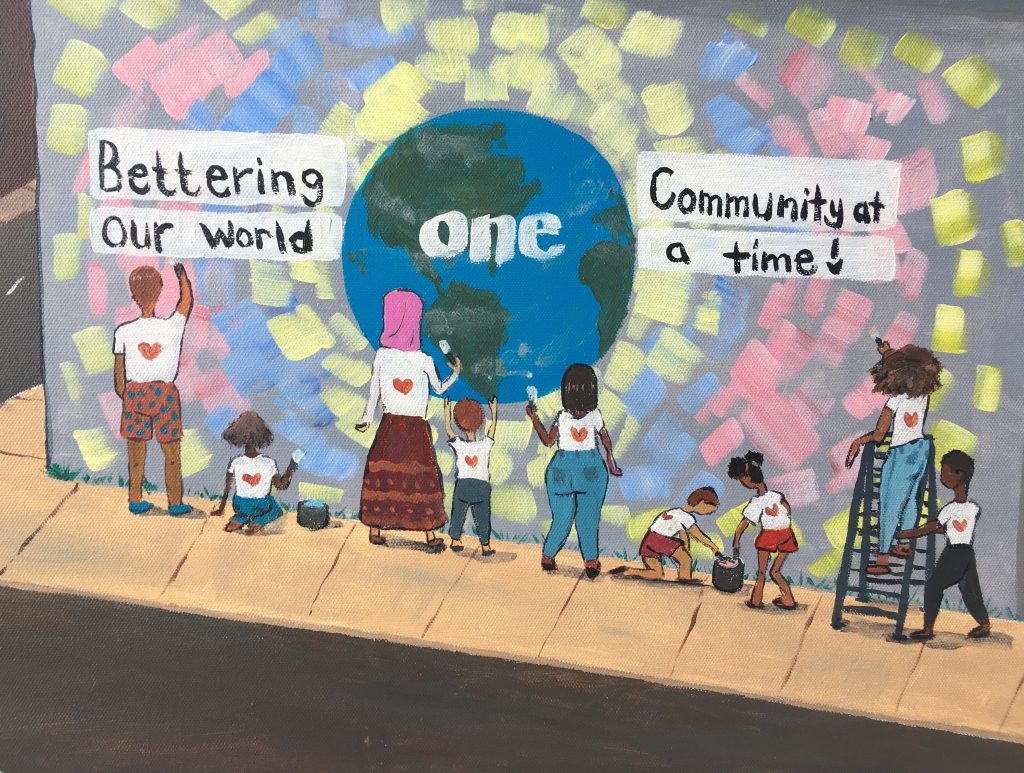 Each of the artworks captured a unique aspect of StriveTogether’s mission and values. I was particularly inspired by the way Amaia visualized the work we do — a community coming together to create a mural. She described her painting by saying,
“I saw children and adults working together to accomplish something… The kids learn that working together is the only way to successfully make a change that is bigger than themselves.”
This year, students will find inspiration for their visual art from two pieces of spoken art. At our national conference in October, Christian Paige, an educator, keynote speaker and spoken word poet who grew up in Tacoma, Wash., performed two poems. The first, “Trees,” describes how a local Tacoma organization empowered Christian and his peers not to only succeed academically but to grow into young leaders and changemakers in their communities. The second, “The Eyes of Your Enemy,” envisions what equitable opportunities look like for every child and challenges communities to come together to make that vision a reality.
To apply for the 2019 Art Inspires scholarship, students should create a work of wall art or a sculpture that expresses their interpretation of “Trees” or “The Eyes of Your Enemy.” Each submission should include a video by the artist that explains the piece’s inspiration and meaning, photos of the artwork, a scholarship application form, and proof of enrollment or intent to enroll in a postsecondary institution.
Applications should be submitted to info@strivetogether.org by May 10, 2019. Scholarship winners will be notified by May 29 and will receive their award upon receipt of the student’s proof of enrollment and submission of their artwork to the local Cradle to Career Network partnership. The 2019 Art Inspires scholarship application is available in English here. La aplicación de la beca El Arte Inspira está disponible en español aquí.
Christian’s poems created a powerful call to action. In “The Eyes of Your Enemy,” he said,
“The only gaps that truly exist are the ones that we allow to persist when we wish instead of move… Dream instead of create. Tomorrow is too late. Our children can’t wait another year to be loved and supported from cradle to career.”
Through his performances at our conference, Christian ignited a sense of urgency and inspired education leaders and practitioners to return home newly invigorated to create change. I can’t wait until May 2019 when 10 more artworks will create new inspiration for StriveTogether’s communities!
The post Art Inspires scholarship calls for interpretation of spoken word poems appeared first on StriveTogether.
]]>The post Choose your team wisely: Lessons from building the capabilities of cross-sector leaders appeared first on StriveTogether.
]]>When I was in fourth grade, we played kickball almost every day at recess. There was a boy named Derek who was always picked first; he could kick the ball the farthest. Ashley was picked next as the fastest runner; then Dan, the precision pitcher. Even as 9-year-olds, we intentionally built our teams to achieve our intended result: to win the game! The same intentionality is needed when bringing together local leaders and other community members to collaboratively improve educational outcomes for kids.
Local partnerships across the StriveTogether Cradle to Career Network work hard to ensure the right individuals and organizations are involved in efforts to advance their result: ensuring every child has the opportunities he or she needs to be successful, from cradle to career. The same process applies when communities participate in StriveTogether programs, such as the StriveTogether Leadership Program or Impact and Improvement Networks, which build the capabilities of cross-sector leaders and practitioners.
StriveTogether uses a team-based approach when strengthening professionals’ skills to get better results for kids. This isn’t professional development where participants spend a day watching a PowerPoint presentation and then put the training binder in the bottom desk drawer. Each community selects a cradle-to-career outcome to work on (what StriveTogether calls the team’s “result”), and team members immediately apply the competencies and skills they are learning to improve that result. The work they do in the leadership program or improvement network is intended to be their “real work,” not a side project. That’s why team composition is so important.
Over the past few years, StriveTogether has seen teams excel or struggle in capability-building programs because of their composition. Here are some initial learnings on how to build the most effective cross-sector team to accelerate results for kids:
Each team member should have a clear connection to the result.
Don’t invite Jim to be a part of the team just because you like Jim or because Jim is always involved. If your result is third-grade reading, be clear on what Jim’s specific contribution to early grade literacy is.
This doesn’t mean your team should only include the “usual suspects,” like teachers or principals. For example, The Road Map Project’s StriveTogether Leadership Program team included a representative from its local housing authority. This employee works on educational programs in the housing complexes that are home to many of the students they are trying to support. Work groups in Austin addressing kindergarten readiness had participants from health and mental health organizations so that they were able to address key factors contributing to a child’s development. Involving multiple sectors and organizations will ensure the team is able to leverage a variety of resources, perspectives and strategies. These individuals can work on how they can best align their actions over the course of the leadership program or improvement network.
Nevertheless, you should be able to say, “We are forming a team to work on (this result), and Jim, we would like you be to on the team because (Jim’s direct connection to the result.)”
The team should include individuals with various levels of authority and closeness to the result.
Often when brainstorming potential team members, the first list of names is a “who’s who” of your local education or nonprofit community, such as school district superintendents, executive directors of nonprofits or prominent funders.
These are all important players who will need to be involved in the work, but StriveTogether has found that the most effective teams have representation of both leaders and practitioners.
The reason this combination works is because the team can tackle the work from multiple angles. Often having direct access to kids, practitioners bring unique perspectives about the challenges that need to be solved and are often best -equipped to test changes on the ground. The leaders on the team can help scale and spread effective practices discovered through those small tests but also are engaged in tackling systemic changes needed to improve the result.
You can check if you have representation from multiple levels of the system with a results at the center chart, a Results CountTM tool developed by the Annie E. Casey Foundation. After placing the result in the center of the chart, communities map which stakeholders are involved, organizing them by sector and how close they are to the result. For example, in a K-12 school district, teachers and counselors may be nearer to the result than superintendents because of the nature of their roles. This visual tool allows communities to see where there may be potential gaps based on sector or proximity to the result.
The team should be authorized by the larger community to do this work but also should be prepared to engage the larger community to make it happen.
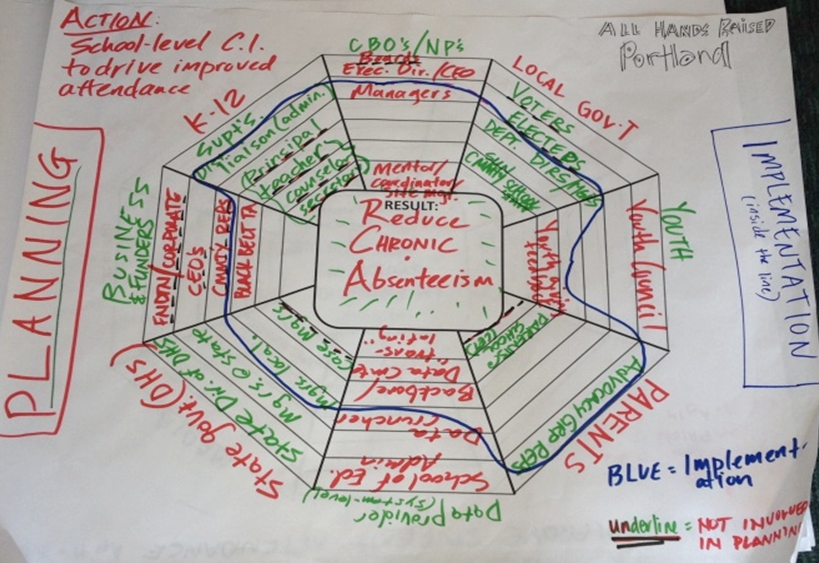
A StriveTogether community maps which stakeholders need to be involved in the planning and implementation of strategies to reduce chronic absence using a results at the center chart.
No one individual can do all that is needed to ensure that every child succeeds from cradle to career, and neither can the four to five individuals who are a part of the leadership program or improvement network team. They will need to build a coalition of changemakers who are ready to work on their result back home, but they also will need approval to be doing the real work in the room during the program or network. It is a tricky balance of ensuring that the broader group of stakeholders are informed and engaged throughout the program while not requiring the team to seek a full committee’s approval on every decision. Have conversations upfront about who really needs to be in the room during program sessions to design solutions versus who will need to authorize the work or give feedback on it along the way. The team must be empowered to lead the charge and trusted to bring the work (as well as competencies and skills) back to the larger community.
The team should be representative of the community it is intended to serve.
StriveTogether believes that efforts to improve educational outcomes must be done with — not for — the children and families being served. The team and the broader coalition should include diverse perspectives and reflect the community in aspects such as race, ethnicity and income. Teams participating in the StriveTogether Leadership Program and Impact and Improvement Networks identify disparity gaps in their communities and set targets for closing them. Achieving those targets requires a deep analysis of what factors are causing the inequities and the thoughtful development of strategies to address them. Having varied backgrounds around the table can combat prevalent assumptions around why disparities exist and spur innovative strategies to create more equitable systems.
Each team member should be motivated to use him or herself as an “instrument of change.”
There is an irony in collective impact that aligned, collaborative action actually requires individuals to make changes that contribute to the result. The team should not perceive themselves as an advisory group that makes a list of things that someone else should do. Each individual team member must be willing to roll up his or her sleeves. That means someone who sounds like they would be a good fit for the team on paper — based on their title or organization — might not be the right candidate if they don’t have the personal motivation to achieve the result. These teams are about moving from talking about the problem to acting on it!
Once the individuals are selected, help them become a team.
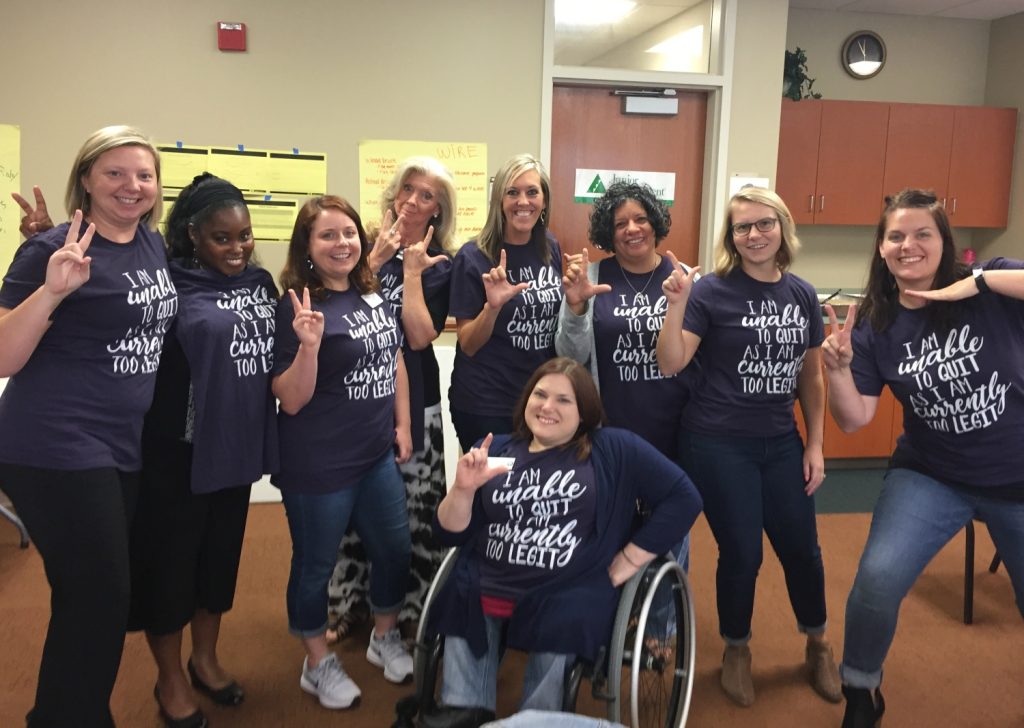
The third-grade reading proficiency Impact and Improvement Network team in Tulsa, Oklahoma, demonstrates team spirit, featuring their team name “2 Legit to Quit.”
Often, the four to five people who are selected to be a part of the leadership program or improvement network team have not worked closely together before. In the first session, they may introduce themselves to other team members. Important steps include ensuring there are opportunities and structures for them to build relationships with one another, set team norms and establish how they will check in with each other and get work done between sessions. One of the first things StriveTogether does in Impact and Improvement Networks is to have each group develop a team name, which requires them to work together and make a decision around a simple task early on and also allows them to form a single, unifying identity.
Building the right team to improve a result for kids sounds straightforward in theory, but in practice, it is often more of an art than a science. Team composition is critical to the success of cross-sector work, because cradle-to-career partnerships are founded on the principle that those who care about a community’s children can accomplish more by working together than by working apart.
The post Choose your team wisely: Lessons from building the capabilities of cross-sector leaders appeared first on StriveTogether.
]]>The post What’s on your next meeting’s mixtape? appeared first on StriveTogether.
]]>For decades, researchers have studied how music affects people’s productivity, mood and brain function as well as student learning. They ask questions such as what impact learning to play a musical instrument has on academic achievement or if incorporating songs can help students learn and retain new concepts. In fact, my mom, who was a kindergarten teacher in Ohio for 40 years, put that research into practice and catalogued educational songs by subjects and skills, creating a musical curriculum for students’ early learning and development.
Over the past few months, I have experimented with the role songs can play in supporting adults who are working to improve student outcomes. I offer no neuroscience or randomized control trials, but rather some anecdotal evidence that an intentionally-constructed playlist can be an integral component of “creating a container to achieve results.”
Money Team Playlist |
| Bills – Lunchmoney Lewis |
| For the Love of Money – The O’Jays |
| Money – Pink Floyd |
| If I Had $1,000,000 – Barenaked Ladies |
| Money (That’s What I Want) – Barrett Strong |
| Take the Money and Run – Steve Miller Band |
| Money, Money, Money – ABBA |
| Gold Digger – Kanye West, Jamie Foxx |
| The Money Song – Dean Martin |
| Billionaire – Travie McCoy feat. Bruno Mars (for an edited version, use the Glee Cast) |
| Can’t Buy Me Love – The Beatles |
What is a ‘container?’
The “container” as it is defined in Results Count is the “infrastructure that supports results-based leaders as they meet to achieve the results they have designated.”
Most meeting participants will think of the container as the physical meeting space — and that’s a big part of it. There is a lot of intentionality behind everything from table configuration to what is posted on the walls. For example, I often know that the container has the right data or posters in the room when participants look over at and gesture toward the walls during a conversation or — even better — when they stand up and bring the data back to their tables while they are working.
But the container goes beyond just the meeting room and the meeting times. It is designed to ensure that participants have the preparation, structure, support and resources to get their work done, from project launch to meeting followup.
The question is: Does including music in the container support leaders in achieving results?
The role music plays in the container: Tests 1 and 2
My exploration of how music can enhance participants’ experience and engagement started at an internal budget meeting. Spreadsheets may be one of a few things guaranteed to make meeting attendees’ eyes glaze over as they subtly reach for their smartphones to check their email. So as the budget committee began to peruse the graphs and charts on the walls, I turned on a carefully-curated “Money Team Playlist” as background.
Call to Action: Changers Playlist |
| Waiting on the World to Change – John Mayer |
| Changes – 2Pac, Talent |
| Change the World – Eric Clapton, Mick Guzauski |
| The Times They Are A-Changin’ – Bob Dylan |
| One Man Can Change the World – Big Sean |
| Changes – David Bowie |
The familiar opening cash register chimes of Pink Floyd’s Money flooded the room and participants cocked their heads. The mood energized as Lunchmoney Lewis sang about the Bills he’s gotta pay, and participants hummed along to If I Were a Rich Man with the Fiddler on the Roof cast. Most importantly, not only did we achieve the meeting results, I had an enthusiastic list of volunteers for the next budget committee who heard how fun the meeting was or who were intrigued by what songs would be included in the Money Team Playlist 2.0. Those budget committee members were treated to a “Call to Action: Changes Playlist” for the next data walk.
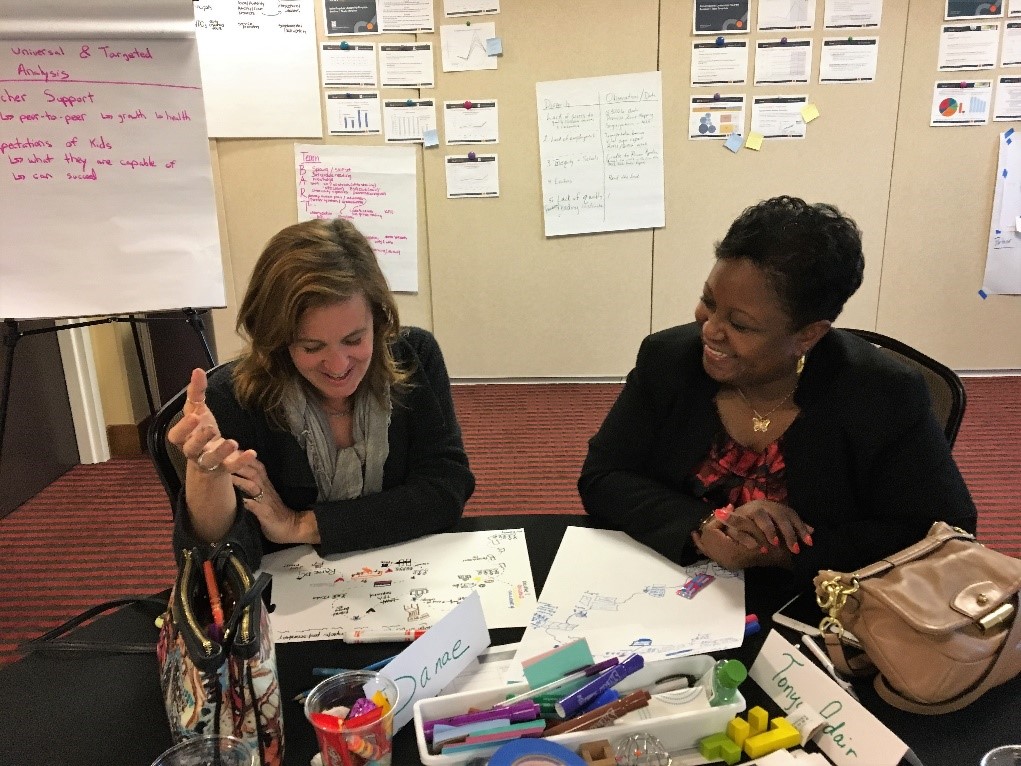
Laurie Wingate, Raise DC executive director, and Tonya Adair, chief innovation and information officer for Milwaukee Public Schools, share their journey maps at the first seminar of the StriveTogether Leadership Program.
Journey Mapping Playlist |
| Man in the Mirror – Michael Jackson |
| Story of My Life – One Direction |
| Born This Way – Lady Gaga |
| Growing Up – Macklemore & Ryan Lewis (feat. Ed Sheeran) |
| 7 Years – Lukas Graham |
| True Colors – Cyndi Lauper |
| 100 Years – Five for Fighting |
My next mixtape was in April at the StriveTogether Leadership Program launch in Charlotte, North Carolina. The participants were given time to reflect on their life experiences and how those experiences influenced their understanding and assumptions about race, class and culture. By increasing one’s own awareness of underlying assumptions, this journey mapping exercise is intended to enable leaders and practitioners to have authentic conversations about what factors impact the disparity gaps in their community and to develop strategies that better address inequities.
As the participants gathered markers and started drawing key life events from birth to present day, Michael Jackson’s Man in the Mirror plays softly from the speaker in the corner of the meeting room. It wasn’t until the second song — One Direction’s Story of My Life — that participants realized the songs were themed to the activity and the room filled with grins. They enthusiastically bobbed their heads to Born this Way while mapping their own journeys and sharing them with others in the room.
Since these first two trials, I have striven to consider what music will aid in setting the container as the agenda is set. Could you have these meetings or do these activities without music? Or with a random Pandora playlist? Absolutely. But I have found that the right music can impact the mood and energy of a room of participants, translating to a greater fervor and enthusiasm for the task at hand — and ideally to achieving the group’s results.
Playlist Inspiration |
| Morning: Rise Up – Andra Day |
| Continuous Improvement: I Wanna Get Better – Bleachers |
| Collaborate: Come Together – The Beatles |
| Leaving for a Break: I Want Candy – Bow Wow Wow |
| Coming Back from a Break: I’m Ready – AJR or Let’s Go – Calvin Harris |
| Going Home: Closing Time – Semisonic, Here I Go Again – Whitesnake or Ready to Run – Dixie Chicks |
How to create your own meeting mixtape
Want to incorporate tunes in your next meeting? Follow these five steps:
- Identify potential times to incorporate music (e.g., as participants are walking in, going on a break or leaving for the day or as background during data walks or work time.)
- Pick a theme. Consider the purpose and topic of the meeting or event.
- Be both literal — and abstract. Some topics (such as money) will have songs that talk explicitly about the subject. Others, like “continuous improvement,” require a bit more creativity. Search on Spotify and Google for key words. An end-of-day playlist, for example, could include both “going home” songs but also tunes about travel/cars/planes or goodbyes. (See some song inspirations on the left.)
- Mix it up. Draw songs from a variety of genres and decades. Ones that are recognizable often work best. “Best of” or “Greatest Hits” albums can be a good place to start.
- Take requests. Any good DJ has his or her ear tuned to what the audience wants and likes.
The post What’s on your next meeting’s mixtape? appeared first on StriveTogether.
]]>The post Navigating the choppy (but not uncharted) waters of data maturity appeared first on StriveTogether.
]]>Before we all held Global Positioning Systems in our hands, we used maps and compasses to navigate from point A to point B. And research shows that we had a better handle on directions when we weren’t reliant on a British woman’s voice providing turn-by-turn directions.
Communities need navigation sometimes too. One of the benefits of being a part of the StriveTogether Cradle to Career Network is that you can use the learnings and support of 70 other partnerships across the country to chart a course to advance your own work. Thirty-nine Network members — from Rochester, New York, to Salt Lake City, Utah — contributed to the development of the StriveTogether Data Maturity Model through a series of surveys, focus groups and site visits conducted by The Impact Lab. The model — intended as a compass, not a roadmap — guides communities through the technical, political and cultural aspects of sharing, connecting and using data to drive change and improvement.
Our theory is that to change systems in a meaningful way for every child across the cradle-to-career spectrum, “student-level data must be accessible and used regularly by relevant partners to inform actions to improve outcomes and narrow disparities.”
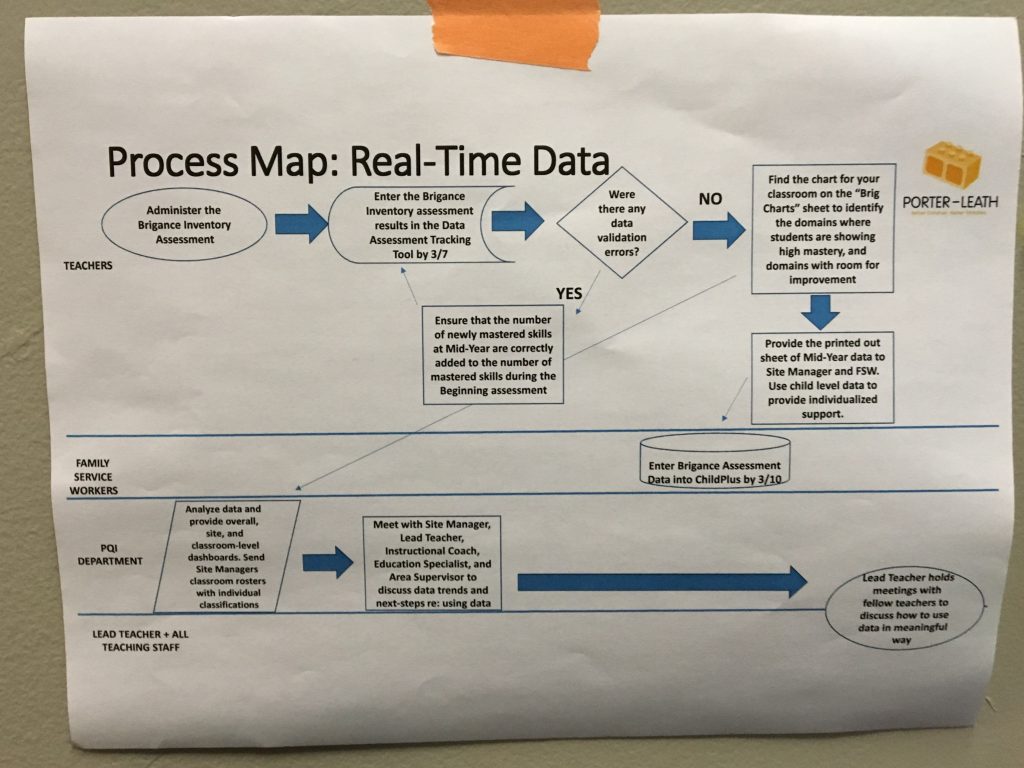
Porter-Leath maps the process to share and access real-time data across key stakeholders to improve kindergarten readiness.
We’ve seen examples of how intentional and consistent use of data across multiple stakeholders can result in better outcomes for kids. For example, at Harlandale Independent School District in San Antonio, teachers, social workers and counselors pulling daily attendance data resulted in 44 percent of students no longer being chronically absent and 72 percent improving their attendance. In Memphis, a community-based nonprofit Porter-Leath built a data culture across its organization over the last year — spreading the use of data from the quality improvement team to teachers, on-the-ground staff and parents. From 2016 to 2017, they saw an increase in kindergarten readiness from 71 percent to 82 percent, which they attribute to teachers having more frequent data to craft interventions earlier and parents being energized by data pep rallies.
And yet, data managers know all too well the roadblocks that prevent education leaders and practitioners from accessing easy-to-digest data to drive decisions: FERPA. Buy-In. Time. Siloed data sets. Trust (or lack thereof.)
The Data Maturity Model allows community partners to self-assess against 14 key aspects of creating a data culture. Those self-assessments can spur conversations amongst relevant stakeholders about potential paths forward in each category, recognizing that there is no single path to data maturity. Each community’s route is shaped by local context and history; it is not necessarily linear and unfortunately no one is going to warn you that there is a traffic jam ahead that will delay your data-sharing agreement by at least three weeks. Rather, the model will show you your true north. If you meet a roadblock, you can return to it to identify alternative routes — but only if at least one of you says in a British accent, “recalculating!”
The post Navigating the choppy (but not uncharted) waters of data maturity appeared first on StriveTogether.
]]>The post How might we get more students to class? appeared first on StriveTogether.
]]>As IDEO’s CEO, Tim Brown, explains in his blog, The Secret Phrase that Sparks Creative Solutions:
“How assumes that solutions exist and provides the creative confidence needed to identify and solve for unmet needs.
Might says that we can put ideas out there that might work or might not — either way, we’ll learn something useful.
We signals that we’re going to collaborate and build on each other’s ideas to find creative solutions together.”
Over the next 12 months, five communities across the U.S. will ask “How might we decrease chronic absenteeism in our school districts?” They’re part of StriveTogether’s second Impact and Improvement Network, which will focus on improving academic outcomes along the kindergarten to 12th grade continuum. And they will work together to understand the causes of chronic absence in their schools and to develop and test interventions to reduce the number of days students miss.
Learning + Action in the K-12 Impact and Improvement Network
Participants in StriveTogether’s Impact and Improvement Networks receive professional development in continuous improvement, equity, and the Annie E. Casey Foundation’s results-based leadership. This Impact and Improvement Network will incorporate aspects of design thinking (also known as human-centered design) to enable communities to better understand the needs of those they serve and involve students and families in the design of creative interventions. “How Might We” is one of many design thinking techniques used to spur innovative solutions.
The training is not conducted in a vacuum. Research indicates, and intuition confirms, that adult learning is most effective when it is applicable and connected to one’s day-to-day work. And at StriveTogether, we have a bias toward actions that are connected to the result you aim to achieve. That’s why the Impact and Improvement Networks pair learning with action.
Each community team has selected a K-12 outcome to apply their learnings toward. San Antonio, Texas (P16 Plus), and Waterbury, Conn. (Bridge to Success), will focus on early grade reading. Albuquerque, N.M. (Mission: Graduate); Austin, Texas (E3 Alliance); and Thornton, Colo. (Adams County Youth Initiative), will hone in on high school graduation. All five communities will work to improve a common factor that contributes to academic success — attendance at school.
Why attendance?
Attendance is a predictive indicator, which means it is an early signal to educators if a student is at-risk of falling behind. Research shows that missing as few as two days of school per month for any reason negatively impacts a student’s academic performance. The five communities in the K-12 Impact & Improvement Network have identified chronic absenteeism as a priority and key driver of student success, particularly for certain subsets of their student population (e.g., special education, low income, pre-K, grade 12, Native American or African American students).
In addition, attendance is an advantageous data point for this kind of national learning network. It is a common metric collected across states, which allows communities to share what they’ve learned and tackle challenges together regardless of geography. More importantly, however, attendance data is available regularly. Schools collect it daily, and it is available for analysis weekly. This allows for “rapid-cycle continuous improvement.” Because you get fresh data often, you can try out an intervention — what we call a small test of change — and see, within a week or two, if that strategy had an impact. You then decide if you want to adopt, adapt or abandon that strategy depending on its effectiveness.
About the K-12 Impact and Improvement Network
The K-12 Impact and Improvement Network launches this week and runs through September 2017.
We are excited to partner with Attendance Works, which will serve as a content expert and coach for our communities, and with Design Impact, who is our thought partner on the integration of design thinking strategies into our continuous improvement process. This work is made possible by the Lumina Foundation.
The post How might we get more students to class? appeared first on StriveTogether.
]]>