The post Key lessons for applying continuous improvement tools to improve educational outcomes at scale appeared first on StriveTogether.
]]>In order to show the true power of collective impact, we are investing in a core group of communities to become demonstration sites or “Proof Points.” One of our key insights thus far from this work is that communities need to create a culture and build the capability to use data not just to prove what works, but to improve how they support children each and every day. There is an entire field built around this practice known as continuous improvement. Most of the lessons and insight are based on all that has been learned from its application in the private sector. Fortunately, the health sector has been working over the last 20 years to help use the science in hospitals, giving us key insights into how continuous improvement can apply in the social sector in general.
We are currently on the cutting edge of understanding how this work can best work in the education sector and across community partners, and we want to capture these lessons and share them rapidly to help raise the bar on quality from the start and avoid the propagation of yet another buzzword in our sector. Back in 2008 when the flagship cradle-to-career partnership was launched in Cincinnati and Northern Kentucky, we worked with GE Aviation to apply one continuous improvement method — Six Sigma — to help partners use data to improve outcomes at scale. We had some significant failing forward experiences that inform our work now with the Network and can inform the field as a whole. These form a baseline of knowledge we have been building on significantly as communities including Dallas, Memphis and Spartanburg continue to test new ways of applying improvement in the field.
A few key lessons have emerged to inform the field as a whole. These include:
- Continuous improvement is not a technical tool but an adaptive process. In the work to apply Six Sigma in Cincinnati and Northern Kentucky, we became overly focused on the process and related tools. We provided traditional classroom lectures and over 100 pages of technical documents. This masked the true challenge of improvement: dealing with the changes in behavior those engaged in the process must consider as they learn more about what does and does not work for those they serve. So using a more simplified process — like the Plan, Do, Study, Act cycle — and applying it in real time to a real-world project is a much more effective way to learn.
- The team doing improvement work matters … a lot! We were often happy just to get participants from different systems to show up at meetings. We did not care who it was or how often they came. We just wanted the institutions represented. It is impossible to make progress with an ever-changing cast of characters. Instead, it is critical to map out exactly who needs to be involved and to make sure they stay consistently engaged based on the role they play. Leaders need to be visible champions and practitioners need to be working to interpret data at least every other week. Without this level of clarity, the significant time invested won’t lead to any significant change.
- New roles and capability are needed to embed and sustain the work in communities. Given the complexity of managing the change process and engaging the right people in the right roles, it is critical to invest in having new roles and building partner skills and capability. Having continuous improvement coaches work arm-in-arm with practitioners to help them gather, analyze and (most importantly) apply learning to their everyday work is simply critical. Simultaneously investing in training to build the capability of partners to model improvement in their organizations, is fundamentally critical to embedding the work in the community long term.
This is only scratching the surface of the lessons StriveTogether is learning to make sure communities not only realize the potential of collective impact, but bring the rigor required to the practice of continuous improvement right from the start. If we focus on quality, we can achieve better results for children and communities — and embed a critical body of work in our everyday practice to improve outcomes for kids … not just create another buzzword.
The post Key lessons for applying continuous improvement tools to improve educational outcomes at scale appeared first on StriveTogether.
]]>The post Success by design, not by chance: Building capability to achieve results at scale appeared first on StriveTogether.
]]>“We see what we do as making sure success — graduating from college — happens by design, not by chance.”
I had to sit with that insight for a bit. Success by design. What would that look like? What does that mean? We know a few things about how to get there — access to data, community ownership, building and sustaining the civic infrastructure that allows for truly personalized learning. But none of this can happen without building the capability of community leaders to drive real change.
Much has been made of the big data movement. As we noted in a recent piece, access to data and analytics is critical, but it is not enough to change how individuals, institutions and systems operate to support the right pathways for all students to reach their full academic and social potential.
Evidence-based decision-making is not sufficient to get to “success by design.” To achieve improvement at scale and create better and more equitable systems, we need a host of partners across sectors working in alignment to meet the unique needs of a child. This can and does happen for a few lucky children. But if we want to reach “every child, cradle to career,” we have to strengthen the connections and partnerships across a community in smarter ways to anticipate needs and respond accordingly, continuously improving and implementing strategies that intentionally accelerate outcomes and narrow disparities.
How can we begin to work together to achieve better results? We have much to learn from the health care sector and specifically the Institute for Healthcare Improvement on how they work with teams to cure diseases. They know how to turn data into actionable information to make better decisions. And they realized that in order to use this data, people require something much more purposeful and intentionally designed than traditional professional development: people need experiential learning and coaching, grounded in real work that can help them to build the necessary skills to get better results.
For the last three years, we have been working to build the capability of leaders across sectors to build and sustain the civic infrastructure required to improve community level outcomes through our Theory of Action. Building on that strong foundation, our big bet at StriveTogether over the next three years is to strengthen the capability of leaders across sectors at all levels to work together to use data to inform actions to change systems to get better results at scale. That will be the heart of all our work with the Cradle to Career Network. We have a learning framework to help develop a common understanding of the capabilities that must be cultivated in leaders working to create better and more equitable systems for every child.
Together, we’re building the muscles needed so every child in every community can achieve success by design, not by chance.
The post Success by design, not by chance: Building capability to achieve results at scale appeared first on StriveTogether.
]]>The post Backbone organization or backbone function? appeared first on StriveTogether.
]]>We are learning that the concept of a single backbone organization may very well be flawed. This has become clear as we worked with an array of different communities looking to navigate the often contentious discussions around where the organization should land. Most of time, the different organizations engaged in these discussions locally bring very different skills, interests and competencies to the table. Sometimes they have a unique leader who could play the central executive director or “cat herder” role effectively. Others, they have the capacity to do the critical data analytics. Still other times, they may really be interested in moving one or two outcomes, say early childhood and early grade reading alone, not the entire continuum of outcomes.
This has led us to the conclusion that what is likely needed is a “backbone function,” not a “backbone organization.” This may simply sound like semantics, but it leads to a completely different way to approaching the staffing of collective impact work. This shift helps us to see that this work is not about a central power center that gets created in a traditional hierarchical paradigm, but instead is about a set of shared roles that need to be played as we look to connect the dots instead of recreate the wheel. These roles, which simply have to be played by a host of organizations since no one new organization can lead collective impact work alone, include:
- Ensuring there is a person who wakes up thinking about how best to act as a servant leader to a broad partnership to achieve a collective goal and move specific outcomes every day.
- Having a core data analytics role that includes the development of an annual dashboard on critical community-level outcomes and comprehensive data management systems, but even more importantly the building of local capacity to use data on a regular basis.
- Facilitating practitioners looking to take what they are learning from the analysis of local data to change how they serve their target population each and every day, building comprehensive action plans around what works to move specific outcomes
- Mobilizing the community to get a diverse array of voices engaged in this work, building shared ownership for improvement and supporting practices that get results.
- Convening investors so they begin to communicate about how to put resources behind what works and consider ways to incent the use of data for continuous improvement.
There are certainly other roles that emerge over time and need to be played, but this is a start. And if we see that a host of organizations working in concert all can contribute to the overall backbone function any community needs to have played, it can and should reduce some of the power struggles that have emerged around this important piece of the work.
We have learned one additional lesson that deserves to be mentioned. It is helpful, especially early in this work, to have all the key staff located in the same place even if they come from different organizations. The importance of these staff sharing what they are learning on a daily basis, helps them practice the type of continuous improvement they are looking to promote across community partners. The simple reality is there will be a need for a fiscal agent and they have to sit somewhere. We recommend communities not create a new 501(c)(3) to house the staff since this work is primarily about leverage existing resources. We term wherever they land as the “anchor entity,” but whatever it is called, it need not cause conflict since it should become clear very quickly that there is joint ownership for the backbone function as a whole.
At our recent convening, we had an outstanding plenary session with stories on how sites have “failed forward.” This feels like an important example of us failing forward, learning and adapting at the national level, just as local leaders do this every day on the ground to achieve better results for children and families. What do you think?
The post Backbone organization or backbone function? appeared first on StriveTogether.
]]>The post The difference between backbones and conveners in collective impact appeared first on StriveTogether.
]]>So how might we think about the different roles organizations looking to take up leadership can play in order to capitalize on all of this interest? We have developed one way to think about this that has helped numerous communities find a way through this challenge. The visual below captures the concept at a high level, but the key is to differentiate between the role of backbone organizations and conveners. The primary difference is that a single backbone entity is needed to help support the overall development of civic infrastructure to have collective impact. Conveners, on the other hand, are focused on working with the relevant partners — practitioners and other interested stakeholders — to build comprehensive and data-driven outcomes around a single outcome along the continuum. See a summary of the roles in the visual below:

The role of the backbone
The key roles of a backbone organization are outlined in detail below. Before going into the roles, it is important to note that while the backbone often is perceived as a position with the most power in a collective impact effort, it is most effectively played by an entity that embraces the principles of servant leadership. In essence, the backbone needs to play a very quiet and behind-the-scenes role, lifting up others who are doing the work so they get the well-deserved credit for the data-driven work they are doing on the ground to support children. In the end, an entity willing to take this servant-oriented stance, instead of being more visible, will be able to play the following roles much more effectively as partners across all sectors and at all levels will feel respected for the contributions to the partnership vision:
- Connect and support leaders: The core function of the backbone is to ensure leaders at all levels playing a variety of roles within the community keep the vision, mission and outcomes of the partnership front and center when making major decisions. This takes regular meetings with any and all key stakeholders who contribute to the vision so they feel supported by the work of the partnership instead of threatened. This also means addressing political fires that that regularly emerge when partners are struggling to communicate or unexpected drama emerges in the press.
- Establish the data management infrastructure: At an early meeting in a community we have partnered with to take on this work, one of the funders in the core group of leaders was almost in a state of shock at the end of the civic infrastructure overview. It turned out she was worried that she and her peers were going to be asked to pay for data experts and systems to work in each and every individual nonprofit and related partner in town. But she quickly realized the backbone enables you to avoid such an expense by centralizing the development of the data management system and supporting partners to help collect, manage and report data effectively.
- Advocate for technical support: As practitioners work together to build action plans, invariable challenges emerge related to items such as engaging key partners, getting access to data and other key resources, and communicating the work. The backbone can help advocate with leaders to help address the issues or offer technical support like facilitation or experts from the business community to help overcome what can seem like small, yet show-stopping hurdles.
- Marshal investments: When StrivePartnership was started in Cincinnati, we heard from directors of nonprofits who many spent over 90 percent of their time fundraising. Over time, as action plans emerge from practitioners to improve specific outcomes, the backbone can help reduce this burden on individual providers by advocating with public and private investors to support comprehensive and cohesive action plans where each partner plays a clearly defined role.
The role of the convener
The convener, on the other hand, plays a much more specific and frequently more visible role in building action plans. Because practitioners are looking to bring attention to their work, the convener can be out front with the work they do to help develop comprehensive action plans because it will invariably raise awareness both for the importance of the work and the contributions of the partners. So entities looking to be more visible and play a leadership role may very well be better positioned to become a convener to do the following:
- Engage practitioners. Practitioners have more than enough work to do on a daily basis; adding the work of a network initially can be burdensome. The convener can focus more on the specific needs of practitioners to actively engage in this work, while ensuring they are willing and able to use data to shape their individual and collective action plans. In the end, the convener is focused on making it as easy as possible for partners to actively engage, helping them to overcome specific obstacles and ensuring the necessary incentives are in place to make this worth their while.
- Facilitate multi-sector networks. Once networks are formed with practitioners and other relevant stakeholders to focus on a specific outcome, expert facilitation is needed to ensure the partners use data to build an action plan that is focused on scaling what works. Conveners help to ensure this support is in place, often in the form of expert facilitation, so the network stays focused and develops an action plan the full partnership can advocate for among a host of critical local and national stakeholders.
- Update action plans. Once the action plan is completed, it can’t just sit on a shelf. It is critical to update the plan every time new data becomes available to inform decisions around what is working to improve the outcomes the partnership has embraced. It is this continuous improvement of action plans that leads to the long-term, disciplined use of data at the heart of making civic infrastructure valuable.
It is important to note that in each of these roles, the backbone and the convener, the entities in question must be a) un-biased toward specific partners or strategies; b) willing to use data to drive decisions and navigate the many challenges that come with such a role; and c) have resources to fund the basic staffing roles needed to do the work. This often can narrow the pool of potential players to fill these roles. But if partners can meet these criteria, they can find a way to lead. Not everyone has to be the backbone. In the end, given the state of the outcomes most communities hope to move, there are plenty of leadership roles to play to realize the improvements we all so desire.
[1] See definition in “Collective Impact” by Kania and Kramer at http://www.ssireview.org/articles/entry/collective_impact/
The post The difference between backbones and conveners in collective impact appeared first on StriveTogether.
]]>The post The difference between collaboration and collective impact appeared first on StriveTogether.
]]>Based on these conversations, we have been able to identify the most critical differences between the historical definition of collaboration and the emerging understanding of collective impact. The diagram below outlines the differences as simply as possible.
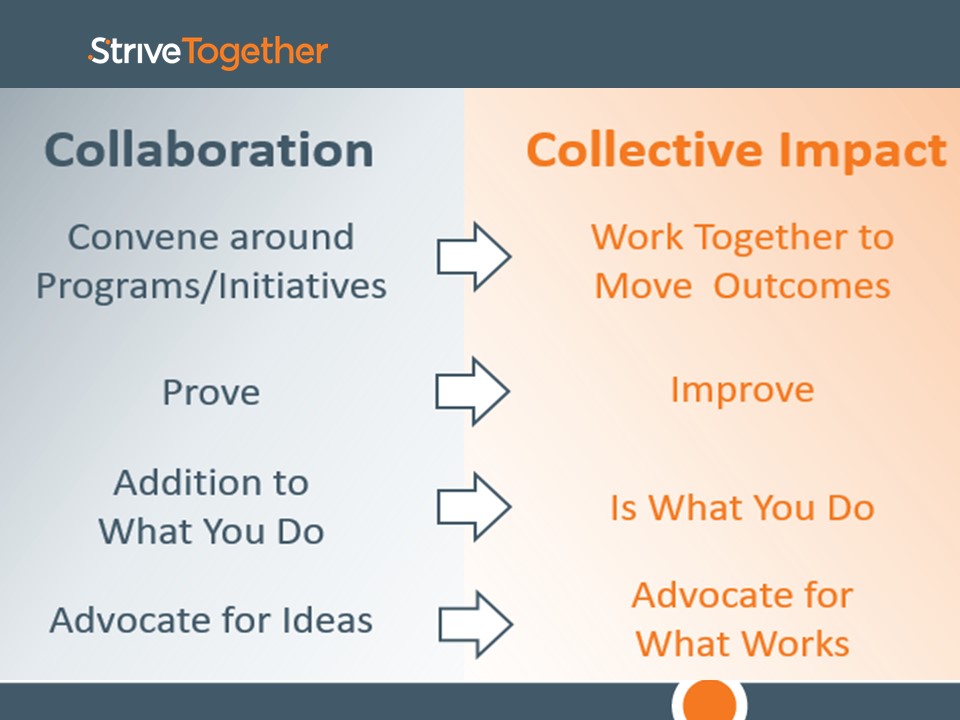
The first is that in collaboration, we have historically come together to implement a new program or initiative. This is most often the case when we wanted to apply for or have been awarded a grant. When it comes to collective impact, community leaders and practitioners come together around their desire to improve outcomes consistently over time. The outcome serves as the true north and the partners can uncover the right practices to move the outcome over time.
This brings us to the second difference: using data to improve, not just prove. In collaboration, data is often used to pick a winner or prove something works. In collective impact, data is used for the purpose of continuous improvement. We certainly want to find what works, but the partners are focused instead on using the data to spread the practices across programs and systems, not simply scale an individual program.
Third, collaboration is often one more thing you do on top of everything else. People meet in coffee shops or church basements to figure out how to do a specific task together and in addition to their day job. Collective impact becomes part of what you do every day. It is not one more thing because it is truly about using data on a daily basis — in an organization and across community partners — to integrate practices that get results into your everyday contribution to the field.
And last, collaboration is often about falling in love with an idea. Somebody may have visited a program somewhere and seen something they liked so they advocated to bring it to town. The core assumption in their efforts is that success elsewhere will be consistent with success right here. Collective impact is about advocating what those practices you know get results in your own backyard. The voice of community partners is leveraged to protect and spread the best of what exists right here and now instead of what one hopes would get results down the line.
It will be those communities that exemplify the rigor and realities of collective impact that can help us fully grasp the shift that needs to be made to achieve population level impact. We are on our way with the interest of so many and we are hopeful that we can collectively embrace this fundamentally new way of doing business.
The post The difference between collaboration and collective impact appeared first on StriveTogether.
]]>