The post Three steps to better results in the New Year appeared first on StriveTogether.
]]>1. The ability to adapt and thrive in the face of challenge. Let’s face it — systems change and transformation is challenging work whether you’re working in one community or scaling what works across a network of nearly 70 communities. Our work requires leaders undaunted by challenging the status quo and changing narratives around economic mobility. We will define how this network holds economic mobility and, importantly, how our work puts young people on the path to economic mobility.
This will include embracing the U.S. Partnership on Mobility from Poverty’s definition of economic mobility that goes beyond attaining economic success and speaks to power and autonomy and the feeling of being valued in the community. While we have always focused on improving cradle-to-career outcomes for every child, we have grown to appreciate the power that resides with youth and families marginalized by systems designed to discount them. We can transform these systems to deliver more equitable results by working with youth and families.
2. An explicit focus on racial and ethnic equity. Racial equity is both a value we must deeply live and an outcome we must achieve to realize our vision. We will operationalize the racial and ethnic equity and inclusion that we seek to advance in nearly 70 communities across the country. Meaningful equity work requires not just change but transformation — a thorough shift in organizational practices, norms, culture and composition, from hiring and recruitment to daily management. This work is hard, messy and complex. It requires healing, reconciliation and commitment. Our resolve comes from the simple belief that every child has value and promise.
Leaders must have the courage to disaggregate data to consider race, ethnicity and gender to inform strategies, drive accountability and engage in tough conversations. While talking about race and ethnicity can be emotionally charged, we have to get comfortable having uncomfortable conversations about the systemic racism underpinning the systems we need to transform.
3. A willingness to collaborate with others, importantly the youth and families most impacted by our work. This speaks again to recognizing the power and authority that resides in the community. Leaders must go beyond listening to community members to validate factors and hone strategies. Leaders must work with affected youth and families by bringing them to the table to develop strategies for closing gaps and creating opportunities. We have called out communication and community engagement as one of the critical capacities needed to transform systems, and we will continue to support our network members in their efforts to more authentically engage and activate community in the work.
So, I extend my deepest appreciation and solidarity to leaders across the Cradle to Career Network. Every time you challenge the status quo, have uncomfortable conversations and disrupt systems in your community, you are taking critical steps toward our shared goal of putting every child on a pathway toward success. You are vital to a movement that is impacting the lives of 13 million kids and counting. The road ahead is long, but this Network is unstoppable.
The post Three steps to better results in the New Year appeared first on StriveTogether.
]]>The post The Cradle to Career Network is unstoppable appeared first on StriveTogether.
]]>— Stacey Abrams, activist, author and civil rights leader
Reflecting on the recent 10th annual Cradle to Career Network Convening, I am more convinced than ever that we are truly unstoppable when we unite for kids and families. Together, we are a national movement impacting 13.7 million youth and counting, fueled by a shared belief that we can — and should — do better for every child. We saw that in the results and progress shared from across the Network on the plenary stage and in workshop and session rooms.
We celebrated and shared some incredible work and impact nationally, including:
- Our 2019 Cradle to Career Champion and a new honor — the Courage in Leadership Award! Let’s congratulate again Susan Dawson, founder, president and executive director of network member E3 Alliance in Central Texas; and ROC the Future, a network member in Rochester, N.Y., and the recipient of our first Nancy Zimpher Courage in Leadership Award.
- Validation that our rigorous approach to quality collective impact produces better results for kids and families. These fantastic findings about the StriveTogether Theory of Action
 are summarized in this recent Stanford Social Innovation Review piece.
 - More network members are advocating, mobilizing and influencing public policy to better serve youth and families. As one example, in New Mexico, Mission: Graduate scored a major legislative victory to curb student absences and improve school climate.
- Three more communities have reached the Proof Point designation: Promise Partnership of Salt Lake in Salt Lake, Utah; Northfield Promise in Northfield, Minn.; and UP Partnership in San Antonio, Texas.
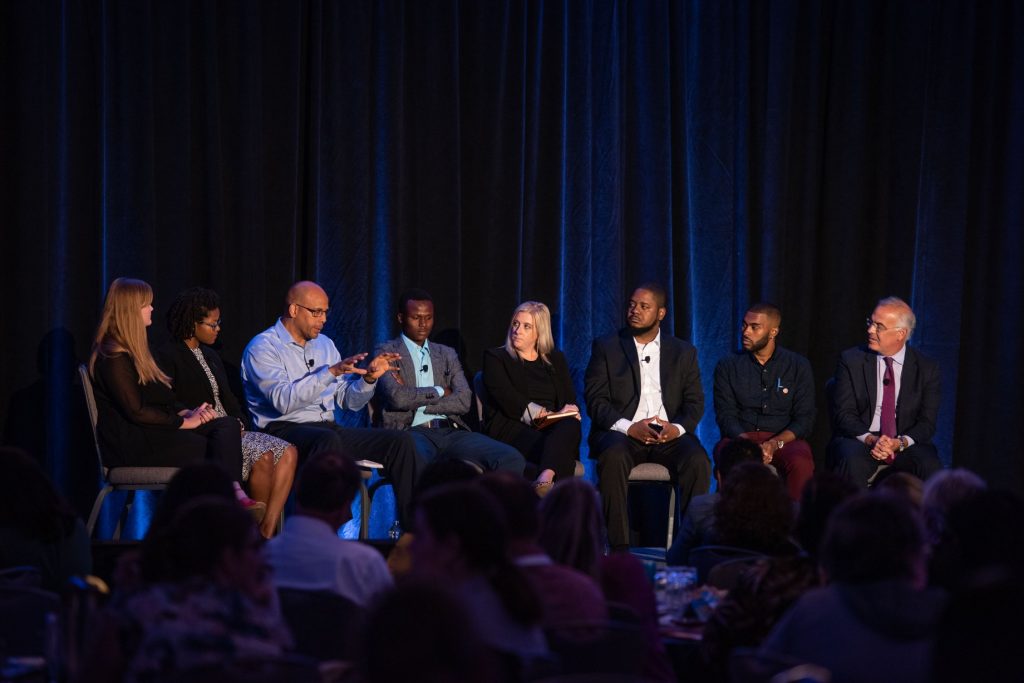
If you are among the 500-plus changemakers who gathered with us in Washington, D.C., I hope you too spent time asking yourself how to better support the success of every child, particularly those facing the most barriers. As I said during the opening plenary, so many of today’s systems perpetuate inequities in the lives of black and brown kids. These are the systems we must transform.
And that work is no easy feat — it’s hard, challenging, messy and exhausting. We need a way to feel rejuvenated, and I think we have plenty of inspiration for the next 12 months from this year’s amazing lineup of keynote speakers including Stacey Abrams, David Brooks, Cecilia Muñoz, Richard Reeves and David Williams.
Here are some key takeaways that emerged from our plenaries:
- “Other people have to see themselves in our story. You have to be willing to create space for other people’s goals to join yours. That’s what makes it collective and that’s what creates real impact.” — Stacy Abrams, activist, author and civil rights leader
- “The data is so important, but data only tells you about the whole population. It doesn’t tell you about the young man or woman sitting in front of you.” — David Brooks, The New York Times
- “Doing, as important as it is, isn’t enough. To get to scale, we have to translate learning to policy so that it can happen everywhere.” — Cecilia Muñoz, New America
- “Evaluation is key. We have to move from policy-based evidence making to evidence-based policymaking.” — Richard Reeves, Brookings Institution
- “How do we take this research and empower folks on the ground? More importantly, how do we get on the ground to understand what the real questions are?” — David Williams, Opportunity Insights
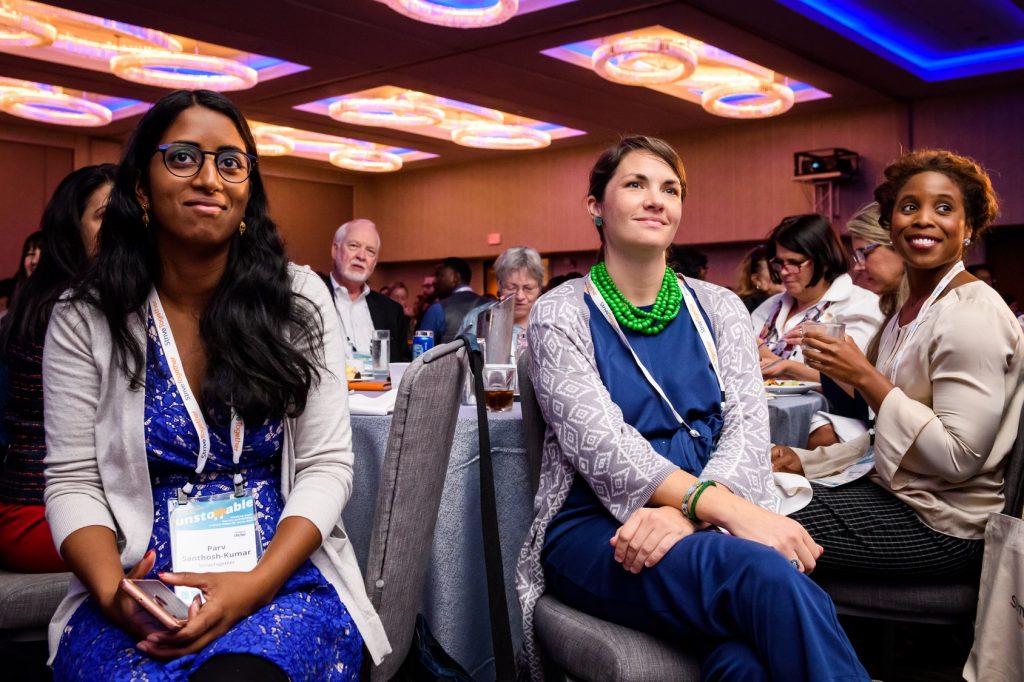
Developing a culture of continuous improvement is one of our core principles — we try to model this annually when we make adjustments to the convening. Last year, we heard a resounding call to continue to center equity in our work.
We shared the work of the Racial Equity Planning Team for network member feedback, including our first racial equity statement. A number of people talked to a TEGA (Technology Enabled Girl Ambassador) about the statement and gave us valuable input. StriveTogether will soon have a racial equity statement to guide our work and we look forward to sharing it.
Recognizing the importance of peer-to-peer learning, we launched a new partner portal! This platform makes it easy to find what you need and connect with other network members. Over 100 people representing 51 partnerships have already logged on to the new portal!
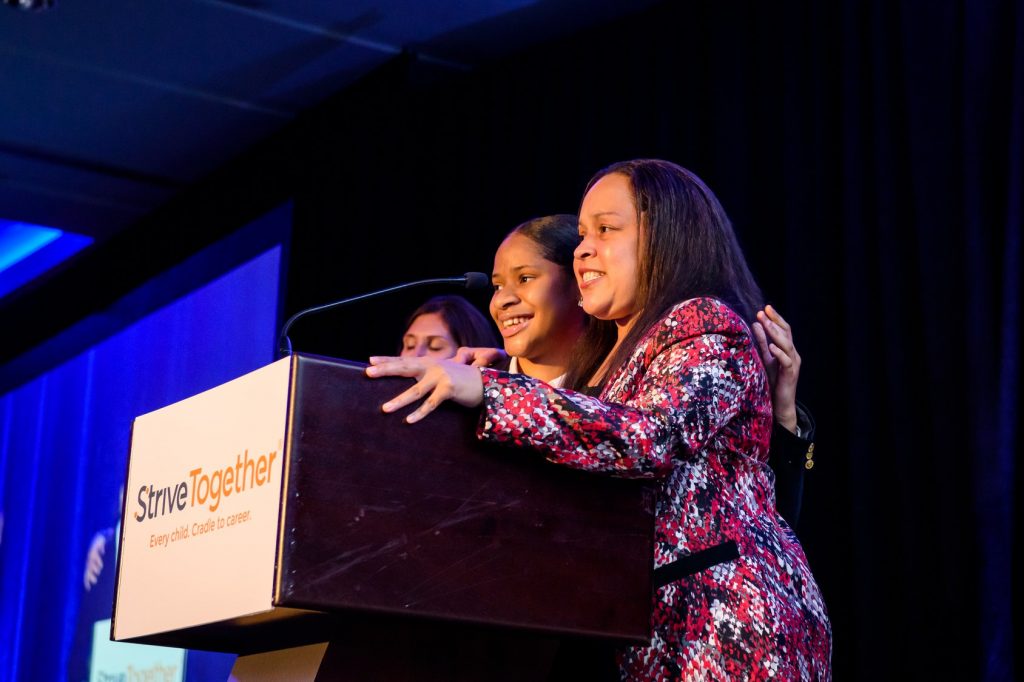
I feel so proud and fortunate to be working in community with thousands of people across the country, breaking down barriers and building better futures for kids and families. But as much progress as we’ve made, we have more work to do to ensure 24 communities reach systems transformation by 2023. I am more confident than ever that we will achieve this goal through the unwavering commitment and unmatched efforts of everyone in the Network.
Thank you to everyone who joined in D.C. or watched our plenaries via livestream (that was new this year!). We know success in this work is possible because we are unstoppable together. As you find better ways to help every child thrive, I charge you to continue lifting up the voices and expertise of young people and to learn what success means to them.
The post The Cradle to Career Network is unstoppable appeared first on StriveTogether.
]]>The post Engaging the community: Progress and learnings from the Network appeared first on StriveTogether.
]]>But acknowledging the full value of the community to achieve racial equity continues to be an area where we know we can improve. To close persistent gaps and get better results for children of color, we must solve problems and find opportunities in partnership with youth and families.
Promoting community authority and racial equity were critical topics during a two-day event held by StrivePartnership under Executive Director Byron White’s leadership. The gathering was held in collaboration with the Kettering Foundation at its Kettering, Ohio, headquarters. Four members of the Cradle to Career Network were invited to discuss improving outcomes for urban youth. Here are four key insights that came out of the convening.
Equip families with the right resources. Our network member in Memphis, Tenn., Seeding Success, works with Memphis Lift to help students and families who have been zoned for low-performing schools. Students are in an inequitable education system, with too many young people graduating with a certificate of completion rather than a school diploma. Memphis Lift supports families to advocate for high-quality education for their children. The organization also provides resources so families can make the school placement choices that are right for their children.
Ensure community voice and expertise are heard. In Austin, Texas, 66% of jobs by 2020 will require some postsecondary credential, and young adults without one have only a 12% chance of earning a living wage within six years of high school graduation. With these statistics in mind, network member E3 Alliance hosted Deliberative Dialogues with students, parents and business leaders to explore the challenges they face, consider ideas for action and recognize existing assets in the community. By including the people most impacted in discussions, they heard about issues like college affordability and the perception that workforce certificates and two-year degrees are less valuable. E3 Alliance’s next steps are to convene a regional council to identify action steps to address challenges and maximize assets identified by community members.
Representation at the leadership table matters. In Tacoma, Wash., network member Graduate Tacoma’s goal is to impact more than 28,000 students, in a district that is made up predominantly of students of color and those impacted by poverty. To make true change, the individuals most affected by the challenges in the community must be at the table. This includes developing a diverse staff representative of the community and leveraging community authority to promote change. As an example, Tacoma barber Dominique Ervin has given books to kids who visit his shop and mentored young men of color. He now provides the Urban Barbershop Scholarship of $500 to students that can be used according to the recipients’ needs.
Shift from deficit framing to asset framing. StrivePartnership shared a story from the Roselawn Community Project. Residents in Roselawn surveyed their neighbors about community strengths to offset the deficit mentality prevalent in this work. Survey results identified seven projects to be led by residents, including projects to promote parent involvement and a sense of community. One key learning is that for the community to authentically lead, the work must slow down. We have to examine the composition of our leadership councils and action networks and ensure we have diverse representation at the table.
Throughout the conversation, several challenges emerged:
- Alignment: We must figure out how to promote dialogue between CEO-level leaders in communities to tear down silos and move everyone in the same direction to improve outcomes for children.
- Funding: Funders require grant reporting in a way that creates barriers to engaging with community organizations and highlight deficits instead of strengths. Some also focus on funding programs rather than systems change, which is the instrumental role that our network members play in their communities.
- Roles: Organizations often combine communication and community engagement as one position, but our network members recommend that these roles be separate, given the different natures of each function.
- Asset orientation: The focus on traditional performance outcomes distracts from other measures valued by community. How can leaders and practitioners shift to a more comprehensive assessment of communities without compromising their focus on results?
While challenges will continue to exist, I’m excited to see the progress being made by the Cradle to Career Network in leveraging community authority to advance racial equity. We are also working to bring you communication tools that you can use to better engage stakeholders. The communicators from across the Network are testing these tools so that they can be refined before we share them more broadly. Let us know how you are strengthening communication and engagement in your community by commenting below.
The post Engaging the community: Progress and learnings from the Network appeared first on StriveTogether.
]]>The post Validation affirms we’re on the right path appeared first on StriveTogether.
]]>More than 4,000 people from the Cradle to Career Network participated in a three-year evaluation of the StriveTogether Theory of Action, and findings confirm our framework is helping communities change systems and improve outcomes for kids and families. I am so grateful to the 14 communities that participated in the evaluation! Their contributions have not only helped StriveTogether refine our work, but they’ve also helped define quality collective impact for the field.
This validation provides reassurance that the framework we co-developed with our Network is helping to improve outcomes, eliminate disparities and transform the systems that impact the trajectory of youth. The theory of action was not developed in a boardroom by a few. It’s the result of the Network sharing insights, learning and fail forwards as we challenge the status quo.
Collectively, we have hypothesized about the type of work that needs to be done and how that work progresses, but we wanted to see how that was consistent across communities and where there might be differentiation. So, we followed the progress of 14 communities with Equal Measure starting in the spring of 2015. We collected additional outcomes data in 10 communities along with 25 interviews with network members and community stakeholders to qualify the findings.
We are now confident about certain truths in our framework. For example, we know that communities are likely to crawl before they walk — and ultimately run. This means that there might be a more elementary use of data in the early stages of the work — but that doesn’t mean data isn’t important.
We also know that a shared vision and aligned messaging is critical in the early stages. If there is no shared agreement around the work to be done, there is really no work to do.
We also see that communities need different supports at different stages in their evolution. For example, it’s not a major challenge to bring folks to the table in support of better outcomes in the early days. That type of collaborative action, though, becomes more challenging as a partnership evolves and folks actually start changing their behaviors and structures.
Next, the evaluation findings show that the Network is consistently strong in the use of data. This is not surprising because the theory of action is predicated on the use of data. The Cradle to Career Network approach is built off the idea that if communities have more access to data — and can use data differently — we can do better for kids and families. Many years ago, we started talking about the importance of using data as a flashlight, not a hammer. That’s still a guiding value in our approach to this work. We know that there is much more work to be done to enable easy access to data across a community, but this is certainly a bright spot in our network.
Another important principle of the theory of action since the very beginning is community engagement. We’re learning, though, that engagement is not enough — to fundamentally transform systems, community members need authority. Community engagement is often transactional — ask the community what they need and then maybe we go do it. This transactional approach perpetuates the systems that are already delivering abysmal outcomes. Shifting power dynamics has to be at the core of this work.
We have also shifted our approach from just eliminating disparities to one that champions advancing equity. Structural/systemic inequities are rooted in mental models and patterns of behavior that can’t be programmed away.
While we have an explicit commitment to equity externally, we’ve realized the importance of grounding our internal operations in racial equity. It’s easy to stand on the parapet and tell others they need to do better — it’s more important to hold that mirror up to ourselves. We’re building in anti-racist caucuses, racially equitable hiring practices and vendor/contractor practices and supporting our team on their own racial equity journeys.
We are using the evaluation findings to inform our work, including the most recent revision of the theory of action last year. The fourth revision underscores that this is a living document and includes the creation of the Systems Transformation Gateway. This new gateway calls out the practice and behavior changes needed in systems to deliver better and more equitable outcomes. We know our work has to focus on getting to zero disparities. We edited the equity principle to be about advancing equity — going beyond eliminating locally defined disparities. We also inserted policy more explicitly in earlier gateways. Listen here for additional insights from Equal Measure’s podcast.
As we continue to learn together, we will achieve greater clarity on systems transformation. This is new territory for all of us. But we have a road map, our validated framework, to guide us.
The post Validation affirms we’re on the right path appeared first on StriveTogether.
]]>The post Their future, our mission appeared first on StriveTogether.
]]>Systemic inequities fail children of color and youth living in poverty. Transforming these systems and building a civic infrastructure in communities that delivers better cradle-to-career outcomes is not for the faint of heart. It’s hard work. It takes time, commitment and perseverance. It’s work we embrace because we refuse to settle for a world where a child’s potential is dictated by the conditions into which they are born.
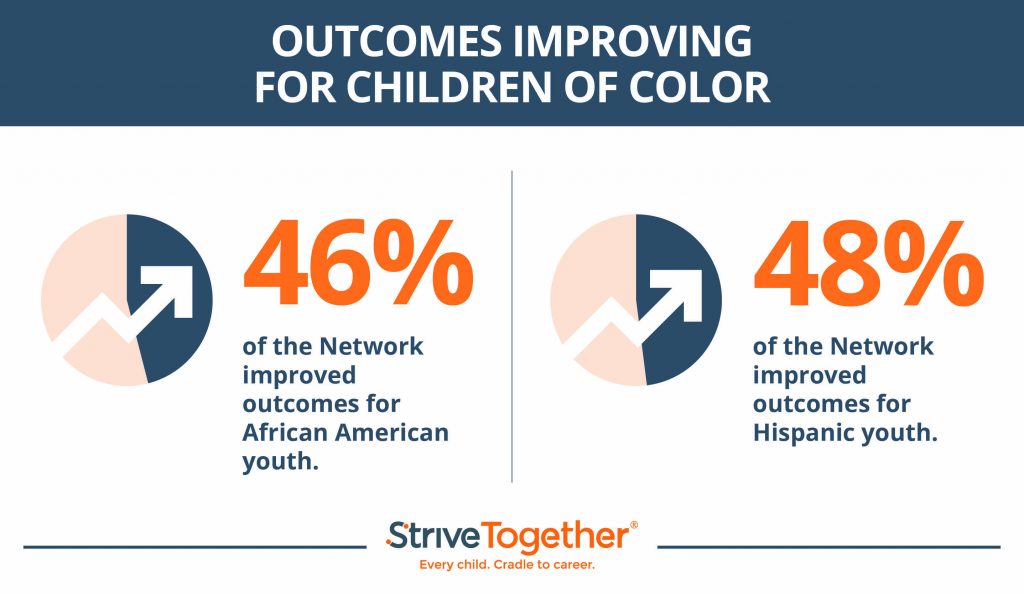
Nearly nine million of the youth impacted by the Network over the last year were children of color. Almost half of the Network reported outcomes improving for African American and Hispanic youth. Centering racial equity in our work is critical. Equitable systems serve every child and family better.
Our Cradle to Career Network members are creating more equitable systems through their programmatic and systemic work in communities. They’re using disaggregated data to have the tough conversations and implement targeted strategies that enable measurable progress. They are identifying and challenging the systemic barriers that prevent equitable results at scale. Every partnership must hold themselves accountable for delivering equitable results. It is the only way to achieve our cradle-to-career vision.
We have come a long way in just two short years since we officially became an independent organization. Our network members consistently share progress throughout their own annual reports. Now we’re doing the same. Our first annual report shares outcomes and operating highlights. It explains why we exist, what we do, how we do it and who we serve. It explores how we convene, coach and codify learning across the Network. You’ll also see stories from partnerships working to transform systems. Finally, you will learn how we are investing in change through the Cradle to Career Community Challenge.
While it’s important to take time to celebrate past results, I am so much more excited about looking ahead to the future. I’m energized by the incredible policy wins that our network member communities and states are experiencing, I’m excited about the opportunities for innovative financing to sustain the work, and I love hearing about how kids’ lives have been transformed by cross-sector partnerships. That’s what matters, after all — the 13.7 million and counting. Every one of those kids deserves every chance to reach their potential. The commitment of this Network to our shared vision of success for every child, cradle to career, affirms my belief that change is possible.
Read the full annual report here.
The post Their future, our mission appeared first on StriveTogether.
]]>The post Social change happens at the speed of relationships appeared first on StriveTogether.
]]>After spending an afternoon with Spartanburg Academic Movement, he reached back out to me to talk about his experience. During our call, he shared that he was surprised by what he saw in Spartanburg — different community members coming together around data to collaborate, solve problems and improve outcomes. He said he had been traveling across the country as part of an Aspen Institute initiative and that he was encountering people in local communities forming relationships to solve complex problems. A couple of months later, he wrote about the StriveTogether approach as one of many examples of people working to repair the social fabric of an increasingly fractured country.
 Over the past year, Brooks has continued to lift up stories of people in communities working together to solve problems. He calls it “weaving” and is making it a personal mission — through his column, his latest book and his new project at the Aspen Institute — for “weavers” to build inclusive communities centered on connection and relationships rather than hyper-individualism.
To officially launch this project, the Aspen Institute, under David Brooks’ leadership, last week hosted a gathering of 250 weavers from around the nation, called #WeaveThePeople in Washington, D.C. I was lucky enough to be invited, and wow, what an experience. I didn’t know what to expect going in, but the event was not your typical conference.
Have the courage to speak hard truths
We spent the first part of Day One hearing powerful stories of what it looks like to make connections and build relationships in community. We also spent time as a group defining our shared values. The values that emerged will feel familiar to members of the StriveTogether Cradle to Career Network: authenticity, community voice, inclusivity, curiosity, courage, equity. It should come as no surprise that I added results to the list.
Establishing our core values as weavers prepared us for what would come next — a critically important discussion about the significance of race in our work. As group members challenged one another not to sugarcoat the reality that deep systemic issues persist and that oppression in this country is intentionally designed, the conversation got very real. Things got uncomfortable, the planned agenda fell apart, and through the awkwardness, this community of weavers started to build trust.
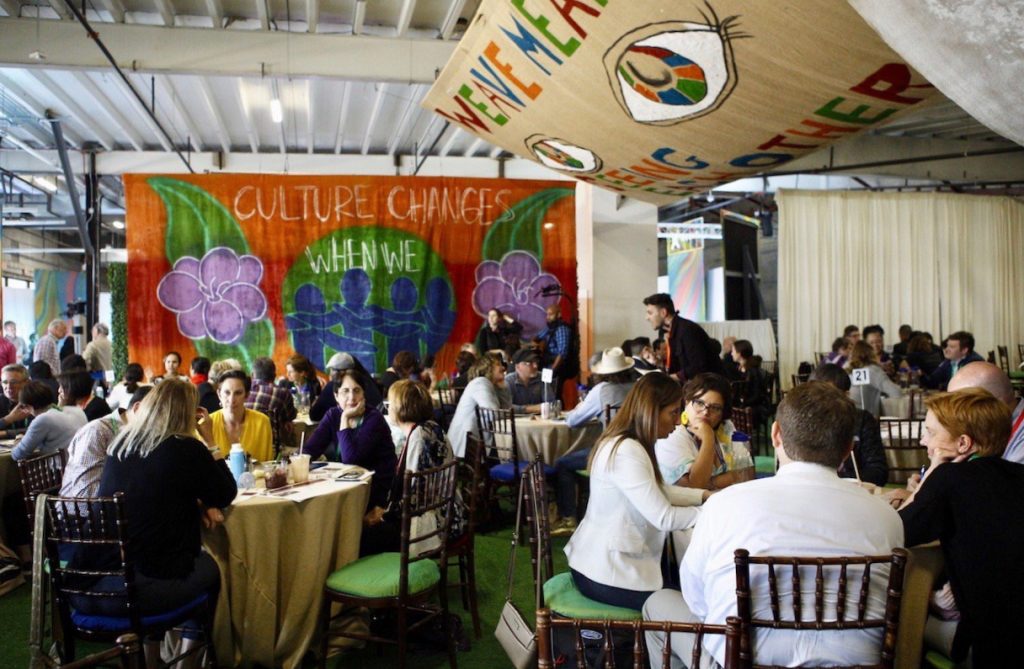
I realized how necessary it is for us to have the courage to speak hard truths and that those of us with power and privilege (i.e., white leaders like me) have a responsibility to acknowledge it and work through the discomfort. I thought about the parallel process that happens in communities across the Cradle to Career Network — how partnerships must identify shared values, speak hard truths and confront systems of oppression head-on to get to results. I came into this three-day event wondering what the result would be. I was starting to feel like I was part of a social experiment in which the relationship was the result — and I was struggling a bit to reconcile that.
We have to work across differences to achieve our results
By Day Two, I decided I would lean in to the design and trust the experience. We spent time in the big groups and small groups, discussing issues like the science of relationships and how to talk across differences. Weavers shared deeply personal stories of trauma and how that has helped them to build trust and make connections. Journalists gave us tips on how to tell better stories about our work and encouraged us to capitalize on the fact that Americans gravitate toward “whodunit” plots and crime dramas in which groups of people address and solve compelling problems together.
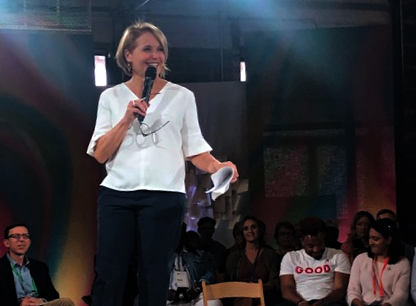 And then I was more than a little starstruck when America’s sweetheart herself, Katie Couric, stood up to facilitate a panel of weavers talking about “the neighborhood as the unit of change.” We were finally getting to the importance of place in this work, AND the conversation was being led by my all-time favorite Today Show personality. During this panel, one of the speakers, Janet Topolsky of Aspen Strategies Group, asked us, “How do you meet people, not where the need is, but where they dream?” This resonates in our work at StriveTogether. We can’t stop at analyzing the problem; rather, we must look to the future.
Later in the day, Eric Liu of Citizen University reminded us that America is a country founded on arguments. Anyone who’s seen “Hamilton” and enjoyed its epic rap battles knows this — America is both a democracy and a republic, a beautifully complicated melting pot for diverse peoples with conflicting ideologies. Arguments are a given. But Liu is challenging us to do better, because the more divided we become, the more stupid our arguments become. Liu encouraged us to have better arguments instead of unproductive ones on Facebook.
My echo chamber has also become quite cozy and most of the readers of this blog are in it. But our work at StriveTogether is about changing systems, and systems are made up of people — people of different ideologies and political persuasions. We have to work across differences to achieve our results. To have better, more productive arguments, we must take winning off the table, build relationships, listen passionately, embrace vulnerability and be open. This mass multicultural democratic republic is an experiment, and weavers are leading the way because we know how to build connections and leverage relationships.
By the end of Day Two, like so many others, I had shed some tears, questioned my own personal values, “weaved” with more than a few brilliant people during breaks to figure out how to work together to achieve our shared results.
‘Relationships are built at the speed of trust’
Day Three was all about action and the question: Where do we take this movement from here? Our big circle discussion included designer Lisa Kay Solomon, who walked us through some examples of innovative design and challenged us to think about what the structure could look like for taking this work forward, how we engage more people in the movement and what might be the unanswered questions we need to address. We moved to our small groups and began mapping out a design. Despite my desire to get to action, I was struggling with talking strategy because I was not clear on our shared aim or result for the work. I wanted to name something, anything, even as broad as “solving the country’s most intractable problems” (not exactly a SMART aim!), but I was challenged by some other weavers that the relationship is the result.
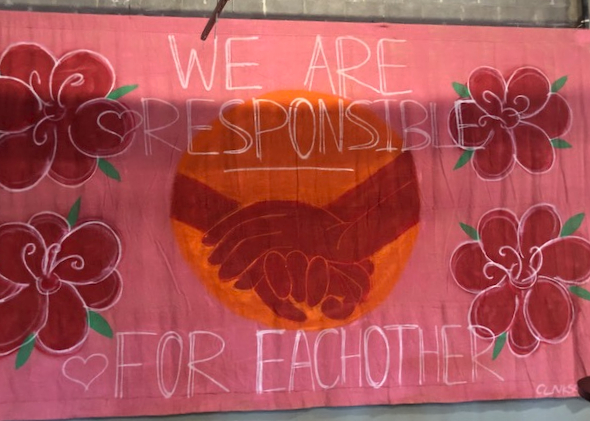
As we came together in the big group of 250 weavers, it became clear there was more trust to be built and more work to be done to become a true community. I remembered a blog by a partner in this work from Memphis, Adriane Johnson-Williams, in which she wrote that trust is a verb and that trust has to be built before action can begin. Trust takes time and is built through relationships. So, perhaps the relationship is indeed the result. To quote a fellow weaver, the Rev. Jennifer Bailey of Faith Matters Network, “Relationships are built at the speed of trust, and social change happens at the speed of relationships.” Could anything be more true in the work we are trying to do?
I am leaving #WeaveThePeople very optimistic about the future because our Network is comprised of passionate and innovative weavers across 66 communities who impact more than 13 million children. We are a powerful movement AND we can benefit greatly from connecting to other weavers. The power of relationships and community building makes us unstoppable. I encourage you to become a weaver.
The post Social change happens at the speed of relationships appeared first on StriveTogether.
]]>The post Being unstoppable in pursuit of greater upward mobility for every child appeared first on StriveTogether.
]]>Last week, I painstakingly bent over my computer to write a blog on economic mobility. This is, after all, the north star of the StriveTogether Cradle to Career Network. I was mulling over a few research papers, each with different sets of indicators, when I was struck by a seemingly simple idea (and one I can’t believe I didn’t think of earlier!). I asked my 11-year-old daughter, Audrey, “What does success look like for you as a grownup?” Her answer nearly brought me to tears.
Audrey said, “Success looks like having a job, where I get decent money and I have a family and I have a normal house and my kids go to a good school and um … I’m just, happy.” That’s it. Our young people don’t care about moving quintiles — that’s just technical jargon. As I picked my chin up off the floor, I thought about how profound this statement was. And I would be willing to bet that Audrey’s answer is the same for millions of other kids across the country.
I want my kids to experience success in whatever way they define it. Every parent wants the same for their own children. We all hope for the components that lead to overall well-being:
- Financial stability
- Fulfilling employment that provides an adequate quality of life
- Opportunities for education
- Stable housing
- Social supports
- Accessible and affordable health care
I also asked Audrey if she thought she would be able to achieve that goal. She said she thought she could if she worked hard. But then I asked if she thought every kid would have that same opportunity and her answer was “probably not.” We have been talking a lot about privilege in our house lately. It was clear to me in that moment that Audrey recognized hers.
And there’s data to back it up. Economist Raj Chetty and his team show that 70 percent of Americans born in the lowest income quintile will never reach the middle class, and black households are more likely than their white peers to experience downward mobility. These outcomes are the result of discriminatory policies and practices with origins in systemic, structural and institutional racism.
These outcomes are unacceptable. At StriveTogether, we refuse to settle for a world in which a child’s potential is dictated by the conditions in which the child is born. The Cradle to Career Network is a national movement unified by a clear purpose: helping every child succeed in school and in life, regardless of race, zip code or circumstance. Putting children on the path toward economic mobility is our north star. Our ambitious five-year strategic plan, which we officially launched this year with the Network, is focused on putting every single one of the 13.7 million children we reach on the path to middle class by middle age. We especially want to improve outcomes for the 8.6 million children of color in our communities.
This is why StriveTogether is committed to transforming systems and eliminating disparities across the cradle-to-career continuum, with the overarching goal of economic mobility. One of the first steps was adding employment as the seventh outcome in our cradle-to-career roadmap. This addition was a long time coming and finally put a stake in the ground around measuring career in cradle to career. But employment does not equal economic mobility, nor is employment how we measure economic mobility. Many Americans with jobs are not earning more than their parents did, relative to today’s standards. Rather, employment, like the other six cradle-to-career outcomes, is one interim (but very important) measure of upward mobility.
As we go on this journey as a network, I feel reassured that we are not alone. Recently we engaged in some conversations with experts and thought leaders from Brookings Institution, Opportunity Insights, Results for America, Urban Institute and Enterprise, all of whom are working to identify a set of interim measures for economic mobility. Although a number of hypotheses exist and are being tested, no one has quite figured this out. Still, I’d posit the Network is a leader in making sense of this complexity because we are doing the work on the ground and learning as we do it in 67 communities across the country.
Our evolving approach was essentially validated when I sat in the audience at one of Raj Chetty’s recent speeches and he put up a slide that included our cradle-to-career roadmap (in StriveTogether brand colors and all!), with additional indicators such as family stability, social capital and affordable housing layered beneath the educational outcome areas. For more than a decade, our Network of partnerships has measured progress across the cradle-to-career continuum, and now it’s a core part of every outcomes framework I’ve seen from these experts so far.
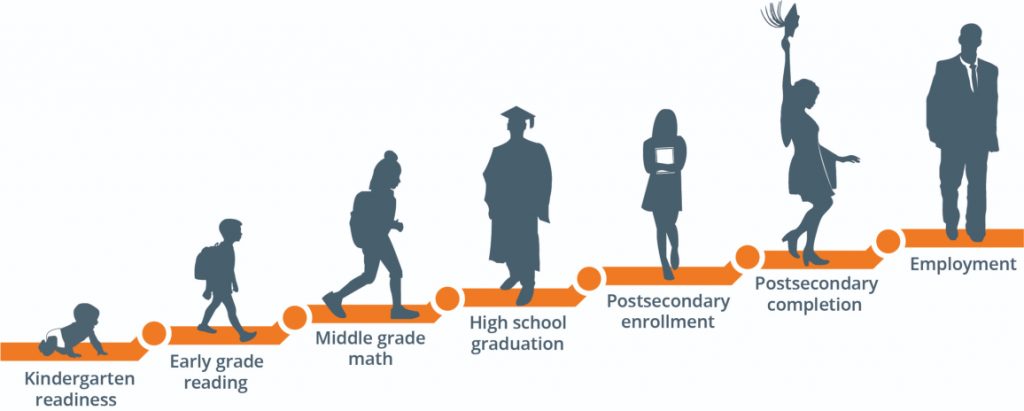
The bottom line is this: The only true path to mobility for every child is zero disparities. The only way we will get to zero disparities is to transform systems. And to transform systems, we must center equity and work with adjacent sectors like health, housing and transportation. We are on the right path, but it won’t be easy. This Network is leading the charge on this important and groundbreaking work.
Every child, regardless of the quintile into which they’re born, should have every opportunity to achieve their definition of success. That’s the American Dream, right? We cannot and will not stop until every one of the 13.7 million children impacted by this Network is on that path. We will be unstoppable until every child succeeds from cradle to career.
The post Being unstoppable in pursuit of greater upward mobility for every child appeared first on StriveTogether.
]]>The post PolicyLink and StriveTogether: Building cradle-to-career pathways from poverty to opportunity appeared first on StriveTogether.
]]>At PolicyLink and StriveTogether, we believe every child should have the opportunity to succeed in school and in life, regardless of race, zip code or circumstance. This is the most pressing issue of our generation. Yet increasingly the data shows that the American dream is fading. According to widely shared economic mobility research, only half of all children will earn more than their parents and there are dramatic disparities in mobility between white and black men. Racial and socioeconomic disparities show up at every milestone along the cradle-to-career education pipeline. Place does, in fact, determine opportunity in America.
Recognizing that systems and structures in communities across the country exist to perpetuate these disparate results, PolicyLink and StriveTogether each set out on our respective journeys to create cradle-to-career solutions based in place to tackle systemic inequities and get better results for kids and families. For years our respective organizations have walked side-by-side, learning from one another. We produced a white paper on aligning for impact to demonstrate how our cradle-to-career approaches complement one another. In some communities and states, our respective cradle-to-career efforts have partnered to accelerate progress and achieve policy wins.
We share the belief that real change is rooted in community transformation. By bringing together people from across a community and keeping equitable results at the center of our work, we can transform systems and achieve more equitable outcomes for children and families commensurate with the scale of the problem. Given our aligned beliefs and the sense of urgency we feel, PolicyLink and StriveTogether are now partnering to accelerate the achievement of results through the Promise Neighborhoods program. The time is now.
Through this partnership, both organizations will ramp up our abilities to meet an increasing need within the field for technical assistance and to influence what is becoming a robust policy opportunity to increase place-based efforts across the United States. We will share the learnings accumulated over years of supporting placed-based initiatives and coordinate our efforts on the ground to maximize impact. Together, we will work with community leaders to design and implement the next generation of place-based initiatives and policy to ensure the success of every child.
Building a movement
Both PolicyLink and StriveTogether grew out of community partnerships, and we believe partnership with a clear purpose is needed now more than ever.
PolicyLink was founded in 1999 with the belief that solutions to the nation’s challenges rest with those closest to those challenges and that by bringing local voices, wisdom and experience in facing these challenges profound policy transformations can emerge.
In 2008, PolicyLink partnered with the Harlem Children’s Zone and the Center for the Study of Social Policy to design the federal Promise Neighborhoods program. The U.S. Department of Education joined the partnership to implement the program. They worked toward a shared vision that all children and youth growing up in Promise Neighborhoods would have access to great schools and strong family and community support systems. The results-based work of local leaders led to the incorporation of Promise Neighborhoods into the Every Student Succeeds Act in 2015. This permanent program has provided federal grants to 60 communities. Each year, at least five grants of $30 million each are awarded to Promise Neighborhoods.
StriveTogether began in 2006 as a local effort in Cincinnati and Northern Kentucky to bring cross-sector community partners together to change the trajectory of children’s lives, particularly children growing up in poverty and children of color. Local leaders held themselves accountable for creating and implementing a cradle-to-career vision. They organized around data and reprioritized local investments to have a greater impact.
Within several years, as StrivePartnership of Cincinnati and Northern Kentucky began to see early improvements across cradle-to-career outcomes, other communities took note. The StriveTogether national Cradle to Career Network was formed to spread and support this approach. Today the network is comprised of 67 cradle-to-career partnerships across 29 states impacting 13.7 million children, 8.6 million of whom are children of color.
Change is possible
We refuse to settle for a world where a child’s potential is dictated by conditions in which the child is born. Building cradle-to-career pathways from poverty to opportunity is the urgent work of our time. To achieve this, we must rethink how we work and partner. By aligning our work, we can accelerate results for more children and families in more communities.
After years of separate but aligned efforts — both achieving population-level results — PolicyLink and StriveTogether are collaborating to accelerate better and more equitable outcomes for the most marginalized children and families. PolicyLink and StriveTogether are not consolidating or merging; instead, we are aligning to build on our respective strengths in the following areas:
- Aligned theories of action
- Modeling the importance of leaders of color leading place-based efforts and sharing lessons in a peer-to-peer learning community
- Building upon the deep experience of the Promise Neighborhoods Institute and StriveTogether partners to coach the next generation of leaders to implement local strategies to improve equity and outcomes
- Integrating complex strategies that include family engagement, programmatic practice, and systems and policy changes
- Providing racial equity thought leadership
- Advancing policy, advocacy and mobilization at the local, state and federal levels
Together, we share a goal of helping communities permanently transform how the systems that surround children and families serve them better and more equitably. From education and housing to public transit and health care, we can change what’s possible for millions of children across the country.
We can eliminate inequities, remove roadblocks and set more children on the path to their full potential. The cradle-to-career movement will have an impact felt across the nation. Together, we can change what’s possible so that every child has every chance to succeed.
The post PolicyLink and StriveTogether: Building cradle-to-career pathways from poverty to opportunity appeared first on StriveTogether.
]]>The post Why investors should ‘bet big’ on StriveTogether appeared first on StriveTogether.
]]>Jim Shelton, the former head of Chan Zuckerberg Initiative’s education division and former deputy secretary of the U.S. Department of Education, encourages investors to place “big bets” on “population-level” change. He cites the work of economists Raj Chetty, Emanuel Saez and others whose data show that despite significant investment “the place where someone grows up and the color of one’s skin” affect economic mobility. He argues that place-based progress demands systemic and comprehensive solutions. He then points to StriveTogether for “providing the infrastructure” to learn and scale practices.
I hope investors will heed Shelton’s advice and place big bets on population-level changes that have the biggest potential impact for every child and community member.
In the same issue, Tara Dawson McGuinness and Anne-Marie Slaughter write about public problem solving. McGuinness is a senior fellow at New America and teaches public problem solving at Georgetown University’s McCourt School of Public Policy. Slaughter is the CEO of New America and the former dean of Princeton University’s Woodrow Wilson School of Public and International Affairs.
McGuinness and Slaughter focus on the need to eliminate social and economic challenges, rather than just managing symptoms of these problems. They lift up different approaches that have four common elements:
- People-centered
- Experimental
- Data-enabled
- Designed to scale
While these concepts aren’t new, the authors share how these four elements are being combined by innovators to change how problems are identified and solved. This work “reflects a bigger movement” involving public, civic and philanthropic problem solvers. McGuinness and Slaughter go on to describe social entrepreneurs and different pathways to spreading successful strategies. They write, “StriveTogether, a network that builds communities’ capacity to tackle outcomes for children from cradle to career, has demonstrated real impact.”
It’s great to see our work highlighted so positively by nationally renowned thought leaders. This recognition reaffirms that we are on the right track in creating real change that will ensure every child has every chance to succeed.
I encourage you to share these stories with your networks and supporters. By partnering with StriveTogether’s Cradle to Career Network, investors are placing a big bet on problem solvers showing real impact.
The post Why investors should ‘bet big’ on StriveTogether appeared first on StriveTogether.
]]>The post Sorry, Howard Schultz: If you don’t see color, you can’t be a leader for racial equity appeared first on StriveTogether.
]]>Over my 18-year career — and especially over the last year and a half — I’ve been asked to launch a lot of meetings and planning efforts. (I should add metaphorical ribbon-cutting to my resume!) But the kickoff to last week’s StriveTogether Racial Equity Planning Team is long overdue and comes at a critical time for the Network and the country.
Something else happened last week on the same day our Racial Equity Planning Team first met. During a town hall meeting on CNN, Howard Schultz, former CEO of Starbucks and possible 2020 presidential candidate, responded to a question about racism at Starbucks, saying that he “grew up in the projects and doesn’t see color.” Wait, what? I did a double-take wondering if he seriously just said that. But he did.
This is one of the most cringeworthy things that well-meaning white people say. And I get it. I do. My guess is that like me (and perhaps like many of you), Howard Schultz was taught to see racism only as individual acts of hatred — and not as the systems and structures that result in white dominance and privilege. And so if we’re “colorblind,” then we can’t be racist, right? Wrong.
Comments like this underscore how much more needs to be done to achieve StriveTogether’s vision of “every child, cradle to career.” Equity is at the center of our work as a Cradle to Career Network — I often say that equity is the work. With racial equity as a priority in our new five-year strategic plan, we are actively working to build the capability of cradle-to-career partnerships to close disparity gaps and create more equitable systems that lead to economic mobility for black and brown families.
The data makes it crystal clear that this is where we need to focus as an organization and network. Our recent assessment of communities across the Cradle to Career Network shows that the 67 partnerships in the Network impact 13.7 million students, 8.6 million (or 62 percent) of whom are students of color. When you take a closer look at this data, it is evident that systems are perpetually failing students of color. We shouldn’t be surprised by this. We know that systems and structures in our communities are designed to perpetuate these results. For this reason, the Network is doubling down on our efforts to transform systems so that race and income no longer dictate a child’s ability to thrive.
This is no small task and requires courageous leadership at all levels and across all sectors. I am grateful to be able to work with the diverse group of individuals who comprise the Racial Equity Planning Team as we unpack the key barriers facing communities. Together we will prioritize policies and practices needed to address those barriers.
In addition to this Planning Team work, StriveTogether continues to build our racial equity competency. Our organization recently has started holding racial affinity groups for staff. Once a month, I participate in a white anti-racist affinity group along with some of my colleagues. I can admit I was skeptical at first. I wasn’t sure how putting a group of white people together in a room could be productive — isn’t that just the recipe that has led to the outcomes we see today? And, if I’m honest, I can admit that my own white fragility had me a little freaked out about saying or doing the wrong thing, especially in my role. But as I’ve written about before, going on this journey to become a white leader for racial equity won’t be comfortable and will require learning in public, so that’s what I’m doing. And I’m learning and evolving and finding my voice. And anyone who knows me well knows that, once I find that voice, I usually don’t stay quiet.
Rather, I have started using my white privilege as a megaphone to help educate other white people, especially white leaders. And there are a lot of us. White people, especially white men, still dominate leadership roles in every sector. And it is not a surprise that, when reviewing the StriveTogether assessment data, we see that most cradle-to-career partnerships in the Network are led by white people.
Fellow white leaders in this work: This is very important and something I want to emphasize. Disregard what Howard Schultz said. You absolutely do see color. And you have to. Please, I’m begging you. Because if not, if you hide behind this idea of “colorblindness,” then you continue to whitewash history and the systemic oppression and injustice suffered by entire groups of people. I know that it makes you uncomfortable and maybe a little stressed. But don’t you think we should be made to feel uncomfortable and a little stressed? After all, the color of our skin privileges and protects us — we can probably handle a little stress and discomfort.
Because if we cannot see color, then we don’t end up naming race in this work. And if we can’t name race, then we won’t be able to challenge the systems and structures that perpetuate inequitable results. And if we can’t transform the systems, then we won’t be able to embrace or enable the future we strive for — a future in which every child has every opportunity to succeed and thrive from cradle to career.
I believe we can do all of this. We can see color; we can celebrate the beauty and opportunity in diversity. We can transform systems to achieve more equitable outcomes. We can be white leaders for racial equity.
The post Sorry, Howard Schultz: If you don’t see color, you can’t be a leader for racial equity appeared first on StriveTogether.
]]>