The post Government and nonprofits can seed and nurture innovation appeared first on StriveTogether.
]]>Promise Neighborhoods communities share our belief that every child should have the opportunity to succeed in school and in life, regardless of race, zip code or circumstance. The purpose of Promise Neighborhoods is to transform communities to support cradle-to-career solutions and get better results for children and youth. The program is a great example of the federal government seeding an innovative approach for improving outcomes in the nonprofit sector. StriveTogether is proud to partner with PolicyLink, which leads the Promise Neighborhoods Institute, to accelerate the achievement of equitable results for kids and families.
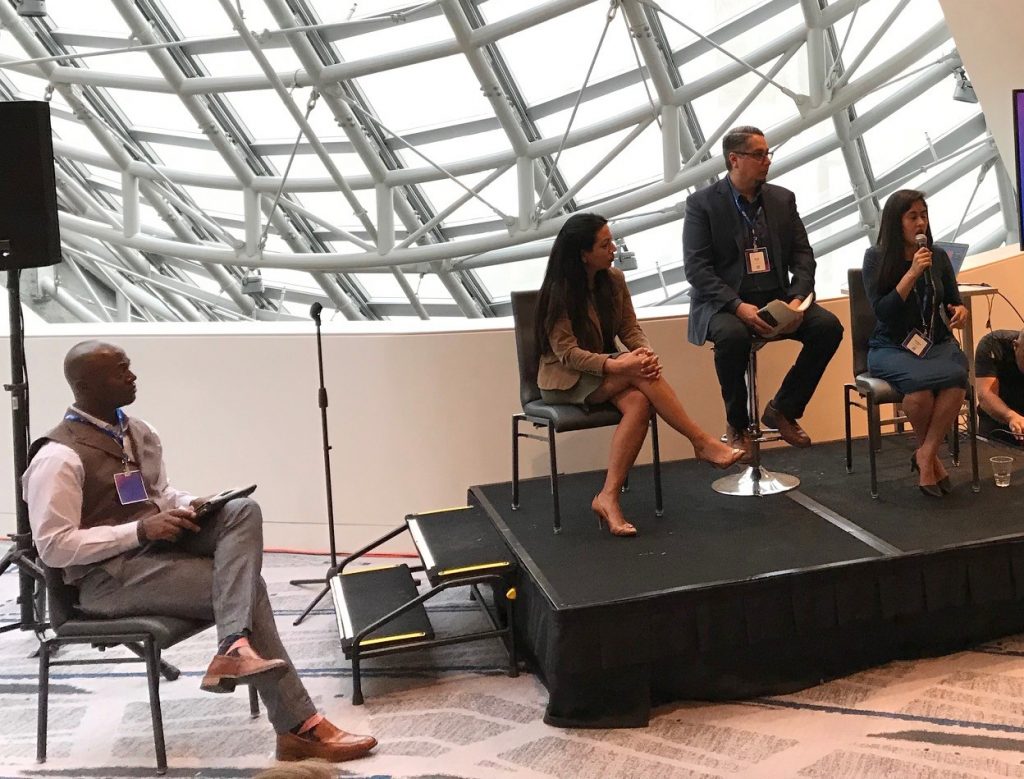
Directors from three Promise Neighborhoods participated on the panel:
- Dreama Gentry, Partners for Education in Appalachian Kentucky
- Richard Raya, Mission Promise Neighborhood in San Francisco
- Sondra Samuels, Northside Achievement Zone in Minneapolis
Dr. Betina Jean-Louis of the Harlem Children’s Zone in New York City also joined us for this discussion, which focused on children in these communities being just as capable of living successful and fulfilling lives as peers from more advantaged backgrounds and communities. But we need to change current systems, practices and policies to support the trajectory of these children toward future opportunities and upward mobility.
The neighborhoods represented by this panel couldn’t have been more diverse. They represent large populations of children from rural, overwhelmingly white to urban, overwhelmingly Latino and urban, overwhelmingly black. The organizations behind these cradle-to-career, cross-sector collective impact approaches have their origins in the sectors of nonprofit, financial and housing assistance, and higher education. Here are four insights they have in common despite these differences:
- Outcomes are impacted by what takes place at school, at home and in communities. Improving student outcomes means intentionally linking the unique needs of children in all settings with all parties who have a contribution to make in this work.
- Stakeholder decision-making must be grounded in data. First, this means data must be accessible to communities and stakeholders at the whole population level and individual level. Also, it must be disaggregated by race and other factors so that inequities can be properly identified.
- Community members and youth must be a part of the solution. Ownership of strategies to transform communities and neighborhoods can only be reached through co-design of solutions.
- Strong school partnerships are essential. Trust and results have to be front and center. Trust is constantly built or broken, and it’s always fluid. Results for every child have to be constantly lifted up and held as the fixture for collective efforts to improve.
The Promise Neighborhoods program infuses millions of dollars over fixed periods of time —typically $30 million over five years — into the most distressed communities across America, with the intention of creating and sustaining cradle-to-career support for children and youth. These grants are ideal seeds of innovation that can be nurtured over time and scaled by neighborhoods that join StriveTogether’s national network after the grant period end. They provide an incredible boost of financial resources and technical assistance for a model collective impact approach that the StriveTogether framework and Cradle to Career Network can sustain over the long term.
Promise Neighborhoods and StriveTogether can serve as an example where government plants the seeds of innovation in a community, and the nonprofit sector cultivates and makes possible the full blossom of sustainability and community transformation.
The post Government and nonprofits can seed and nurture innovation appeared first on StriveTogether.
]]>The post Why StriveTogether, a national network improving outcomes for kids, supports the National Housing Trust Fund appeared first on StriveTogether.
]]>The post Why StriveTogether, a national network improving outcomes for kids, supports the National Housing Trust Fund appeared first on StriveTogether.
]]>The post StriveTogether joins health equity initiative appeared first on StriveTogether.
]]>For too long, our nation has attempted to improve health by focusing primarily on health care alone. To truly achieve health equity, in which everyone — regardless of race, neighborhood or financial status — has the opportunity for health, we must also consider the broader determinants of health, including community environment, education, employment, housing, income and public safety.
StriveTogether works to transform all the systems that influence children’s lives and futures, from education and housing to health care, public safety and human services. This place-based, collective impact approach works far better than isolated efforts to fix complex social problems.
That is why StriveTogether is excited to have Jennifer join other innovative leaders to collaborate around advancing systemic solutions in health equity.
For the next year, ambassadors will participate in three in-person meetings, a series of webinars and ongoing online engagement that will embolden them to share ideas and experiences, forge new alliances, generate new solutions and promote health equity within their own work. Ambassadors will also apply the skills and connections gained through this fellowship to a specific project tied to their work as part of an ongoing commitment to foster practices that advance health equity in their own organizations.
This fellowship is supported by the Robert Wood Johnson Foundation and seeks to advance health equity by convening leaders from a variety of sectors to promote policies, practices and systems that foster a Culture of Health. Building a Culture of Health means focusing on the grander whole of what being healthy and staying healthy means — ensuring students are ready to learn, workers are able to be productive and families can thrive across every community.
StriveTogether’s participation in this effort will bring fresh insights to how our Cradle to Career Network can improve outcomes for as many families as possible.
About the Robert Wood Johnson Foundation
For more than 45 years the Robert Wood Johnson Foundation has worked to improve health and health care. We are working alongside others to build a national Culture of Health that provides everyone in America a fair and just opportunity for health and well- being. For more information, visit www.rwjf.org.
About FSG
FSG is a mission-driven consulting firm. We are experienced advisors to corporate, foundation and nonprofit/NGO leaders. Through our combination of customized consulting services, powerful insights and ground-breaking initiatives, we help clients around the world create social impact.
About PolicyLink
PolicyLink is a national research and action institute advancing racial and economic equity by Lifting Up What Works®.
The post StriveTogether joins health equity initiative appeared first on StriveTogether.
]]>The post Transferring power to communities: Insights from Upswell 2018 appeared first on StriveTogether.
]]>Relationships are the anchor of progress. New York Times columnist David Brooks shared the power of individual connections in a talk that illuminated a path we can each take to real change. Our collective ability to make change is that each one of us is in relation to someone who doesn’t think exactly like we do. That individual relationship holds the potential to change a mindset. When mindset changes, behavior changes. And when behavior changes, our social fabric changes.
The relationships we form in community allow our work to become less divisive and more empathetic. Through these connections, we can determine how to arrive at decisions that are made with deep thought and consideration from all sides.
 Community power manifests itself in different ways — meaning there’s more than one place to start. In a focus group called “Beyond Transforming Systems to Transferring Power,” I asked participants to share what it means to authentically engage the community. What does it look like when power is held by the community? Through our conversation, participants shared measures that can show when a community has come into its own power. Here are some of their ideas:
- When a community has power, it controls its own narrative. The community is viewed from an asset-based frame, not a deficit-based one.
- When a community has power, it’s reflected in physical presence of decisions being made. Community members have a seat at the table.
- When a community has power, community members are helping to direct where resources go, including philanthropic dollars.
- When a community has power, the people being served in community feel comfortable in the spaces they’re receiving support. For example, when families come to pick their children up from a homework center, family members linger to interact with staff members. The space becomes less transactional and more relational because of the relationships built and respect and value shared.
- When a community has power, community members are at the table for the co-design of processes and strategies, from initial stages through the policy process. Too often we involve community at the program level but leave behind their input at the policy stage. Rather than claiming to speak as a proxy for the community, we need to support community members to speak directly to decision making.
We shift power to communities because it makes sense — and it’s the right thing to do. In our conversations, I gathered ideas from attendees around a simple question with complicated answers: Why does this matter?
Participants shared how shifting power to communities has an economic advantage. If everyone has the opportunity to achieve economically, our communities and country become more stable. People are less dependent on the resources of the government, so those resources can be used in more sustainable ways. Results become more sustainable as well when communities own their agency in determining outcomes. If community members hold the power to determine what outcomes are, the community feels more ownership over the work — and ownership over continuing the work if resources end. Transferring power to communities also contributes to safety. A lack of opportunity or resources, leading to feelings of disenfranchisement, can create the attitudes and behaviors that may lead to unsafe communities.
But in addition to these value propositions and more, we work to shift power to communities for more than economic interests or fewer crimes. We do this work because of the moral of justice: It’s simply moral and just to include communities and ensure they have power over impacting their own outcomes. I look forward to hearing and lifting up examples from across the StriveTogether Cradle to Career Network of communities and community members owning their agency, from programs to policy, and using their power to improve the outcomes that are most important to them.
The post Transferring power to communities: Insights from Upswell 2018 appeared first on StriveTogether.
]]>