The post Learn to Earn Dayton achieves proof point as systems change to support students appeared first on StriveTogether.
]]>Here are a few examples of how systems are changing to support students in Dayton and Montgomery County:
Working collaboratively with Learn to Earn Dayton, the city of Dayton and Montgomery County have changed policies to address critical education needs.
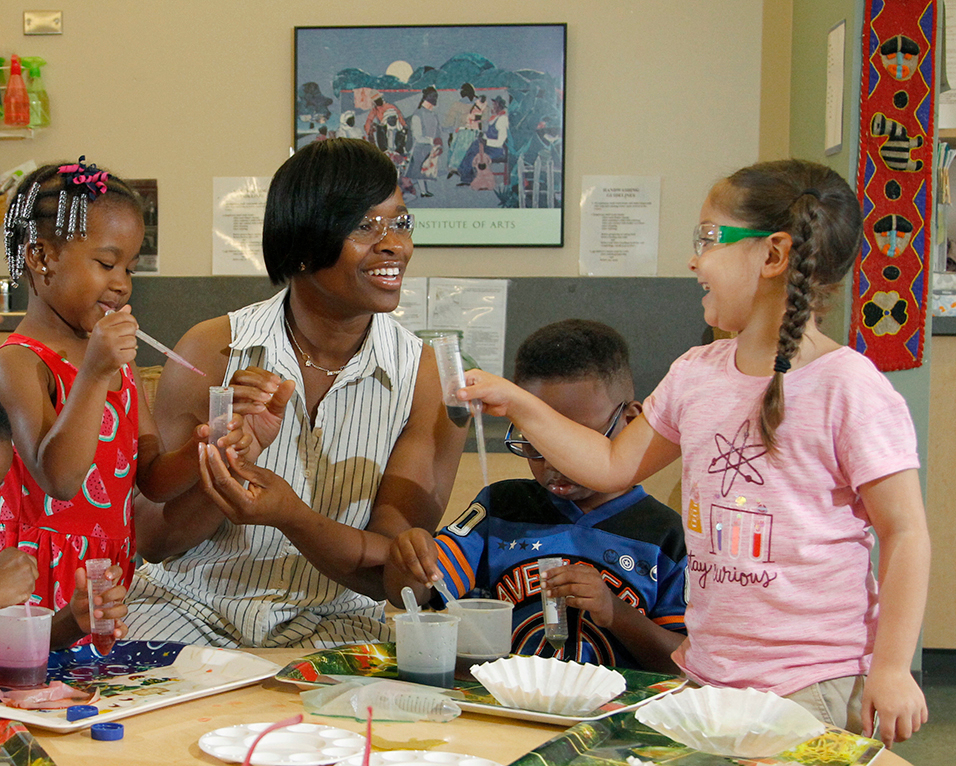 Within the last two years, the partnership has played a critical role in the success of two tax levies to support students and families, including mobilizing voters to pass the levies and disseminating funds. Learn to Earn Dayton led focus groups with the community to understand barriers to access to preschool. The results from those focus groups led to a Preschool Promise initiative that has dedicated more that $30 million for preschool over the next eight years. More than 1,000 preschool children benefitted from the levy in 2017.
In another policy success, Montgomery County voters passed a human services levy. The funds are available through a joint application process with United Way of Greater Dayton and are dedicated to collective impact practices in education that use evidence-based interventions. Previously, these funding sources were separate and allocated only in a general way for education. Now, funds from United Way, private and corporate donations, and Montgomery County property taxes are guided by shared goals and agendas.
Practitioners have access to student-level data to inform actions and narrow disparities.
Learn to Earn Dayton has created a culture of data use by making data reports available to all schools to support analysis and decision-making. This real-time access to student-level data has made an impact.
Lisa Minor, director of curriculum at Trotwood-Madison City Schools, shared the importance of accessing data from schools across the community. Student-level data enabled Minor to work with school district leaders to identify the supports students needed to be successful. “As a principal, it was very powerful to not only see the scores from my building but also the data from surrounding schools that feed into mine,” she shared.
 Student-level data was also used to address disproportionate discipline rates. Data in the school district showed that disproportionate discipline rates for male African-American students correlated to lower academic performance. The school fostered a partnership with the University of Dayton to create professional learning communities for teachers during the 2016-2017 school year. Currently, there are 22 participating teachers, and mid-year data show that teachers who have participated in the learning communities have higher classroom performance than those who have not. As a result, Trotwood-Madison City Schools plans to integrate culturally responsive training into new teacher professional development opportunities, including classroom management, to improve teacher effectiveness.
The community works collaboratively to spread best practices and action plan.
Learn to Earn Dayton hosts an annual summit for the community around relevant education topics. The event allows 500-600 key stakeholders to learn from each other and share best practices, including how they are using data.
During one of the summits, the partnership brought in Joel Vargas, vice president of school & learning designs at Jobs for the Future, to present on the importance of eighth-grade algebra. This event lead Brookville Superintendent Tim Hopkins to redesign his sixth- to eighth-grade math curriculum so that he could offer Algebra I as the default course for eighth grade, something not previously offered by his district. Learn to Earn Dayton, with partner support, hired consultants to help Superintendent Hopkins with the redesign, including adjusting standards so that all students were ready for Algebra I when they started eighth grade.
 Five years after the change, the first group of students to use the new curriculum is preparing for high school graduation and postsecondary enrollment. The students in Superintendent Hopkins’ district have seen increased rates of FAFSA completion (over 95 percent in both 2016 and 2017), high school graduation and postsecondary enrollment compared to other districts.
What’s next?
Learn to Earn to Dayton has created a strong culture of data use, collaborative action and continuous improvement. The community’s partners share a commitment to equity and eliminating disparities. Building on a solid foundation, Learn to Earn Dayton is well-positioned to deepen its impact and do what it takes to ensure every child in the community reaches his or her full potential.
StriveTogether congratulates Learn to Earn Dayton on this milestone along the path to success for every child in Dayton and Montgomery County, cradle to career!
The post Learn to Earn Dayton achieves proof point as systems change to support students appeared first on StriveTogether.
]]>The post ‘Connecting the dots’: Advocating for policy change in Ohio appeared first on StriveTogether.
]]>Peggy Lehner, chair of the Senate Education Committee; Jim Tressel, Youngstown University president; Paolo DeMaria, Ohio’s superintendent of public instruction; and economist Eric Hanushek of Stanford University added their expertise to the event.
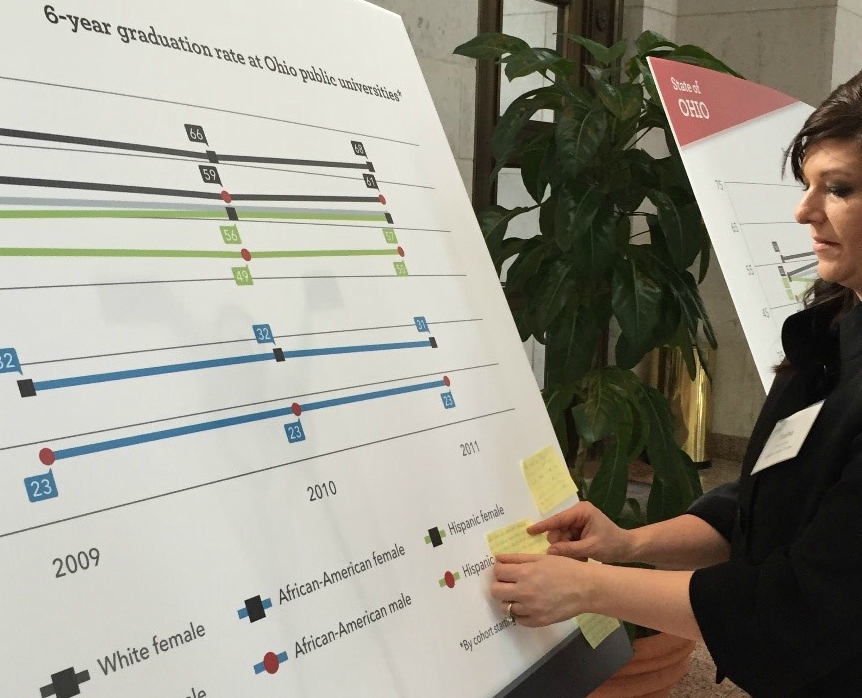 The day started with a data walk organized by the cradle-to-career initiatives. Attendees explored displays highlighting the state’s progress on its 2025 postsecondary credential goal and other critical milestones. The data emphasized the direct link between the milestones and postsecondary attainment.
The data around the room was a powerful visual reminder of the immediate change needed at multiple levels to reach and sustain the state’s vision. The Ohio Department of Education’s goal is that by 2025, 65 percent of Ohioans will have a 2- or 4-year degree or a certificate for a marketable career. Currently at 44 percent attainment, Ohio ranks 33rd in the country.
Reaching 65 percent is “not a pie-in-the-sky goal. It is an economic imperative,” State Senator Sue Lehner said. Economists estimate that in 2 years, two-thirds of jobs nationally will require a postsecondary credential. Ohio’s 44 percent attainment rate falls well short of the target, and this deficit will continue to have a significant economic impact on the state. It’s not surprising that Ohio also currently ranks 33rd in gross state product and 42nd in the nation in growth rate in income per capita. These economic health measures are intrinsically linked to Ohio’s graduates.
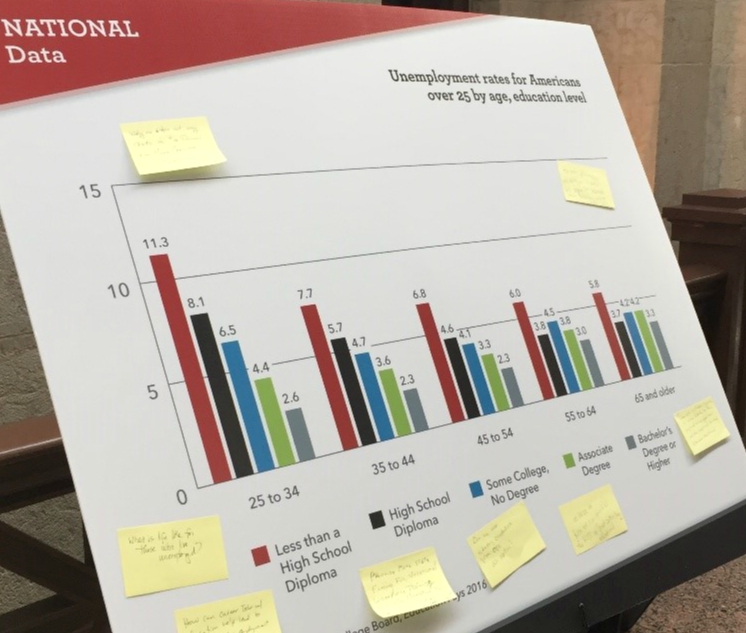 Organizers of the event conveyed the importance of education in today’s fiercely competitive global economy. Those who get a good education are healthier and happier. They live longer. They earn more money. They’re less likely to lose their jobs, and they’re more likely to be able to support their own children. Creating a 21st-century workforce requires delivering a quality education to every child and especially children of marginalized communities. To ensure equity, states need to examine disaggregated data and look at sub-populations of student success rates. Educating just some of the state’s young people is not good enough. If all citizens prosper, so will the state.
This is not a uniquely Ohio problem. So far, only nine states have achieved 50 percent attainment of degrees or certificates. Massachusetts and Colorado, the current national leaders at 55 percent, understand that there is much more work to do to reach 65 percent in the next few years. They also know that 65 percent is not enough unless they close disparity gaps for communities of color and low-income populations.
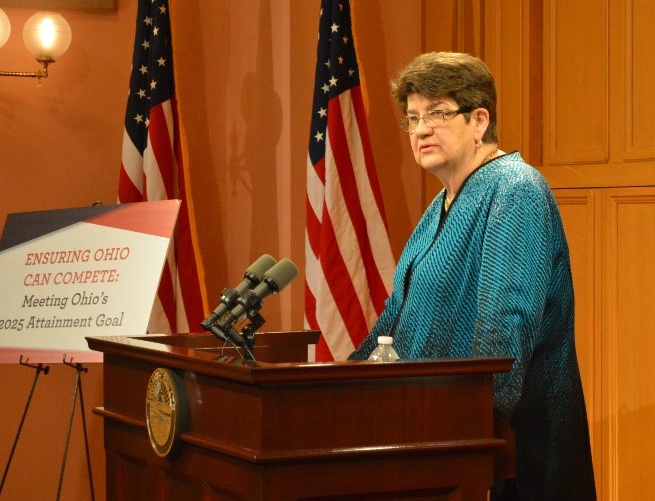 The entities who convened the event in Ohio laid out their roadmap to accomplish Ohio’s vision, including the commitment needed from all stakeholders. The report and their testimonials note three key components of this plan:
- Local place-based collaboratives must use disaggregated data to diagnose local problems and develop localized solutions that will close disparity gaps and raise achievement.
- Ohio’s employers need to work the state’s education system to prepare graduates with the necessary technical and soft skills for the high need jobs of today and the jobs of tomorrow.
- Policies must change at the state and local levels to support student success and create an environment that allows for systemic change.
The day ended with a hearing of the Senate Education Committee. Dr. Hanushek, cradle-to-career partnership directors and state business officials testified about what it will take to “connect the dots from cradle to career.” The message of these testimonials was clear: To create results, state policies need to change. Their testimonials echoed the recommendations outlined in the report they jointly published, including Ohio’s need to:
- expand access to high quality early childhood experiences for Ohio’s most at-risk young children so they start school ready to learn;
- ensure that all teachers have the academic and clinical preparation they’ll need to teach all children, especially children from low-income backgrounds and underrepresented students;
- ensure school counselors and other staff are trained to help students know their career and post-high school educational choices; and
- ensure that all school districts have access to, and use, National Student Clearinghouse data to know their students’ success in earning a degree or credential.
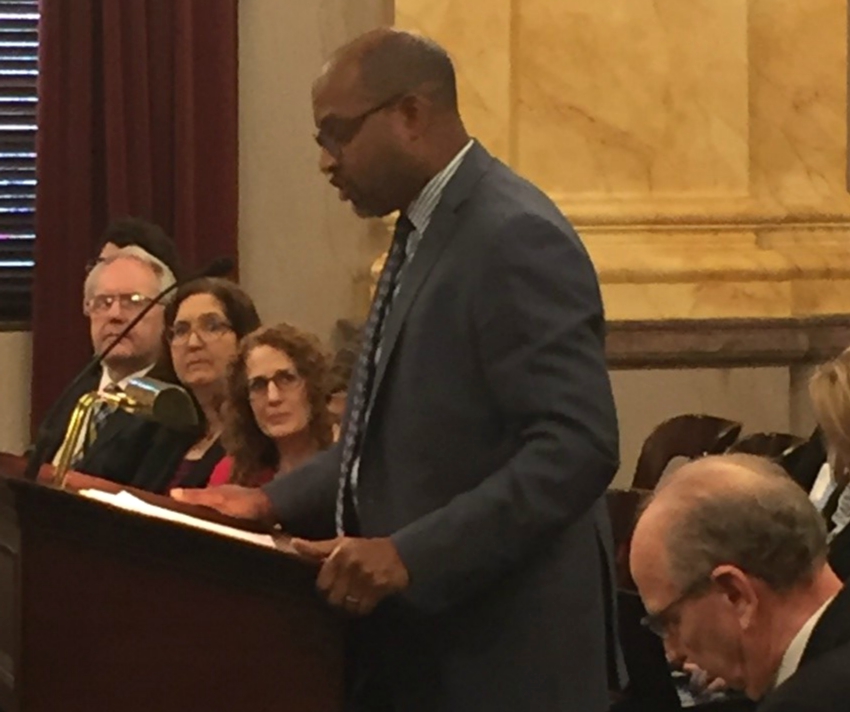 Events like the one on January 31 show that Ohio is creating programs to support students, but more needs to be done in changing policy. The state has created a “Step Up to Quality” initiative to support preschool improvement and is expanding career recognition programs earlier in the elementary years. The Department of Education is working with high schools to make sure every student graduates with an education plan and has adopted College Credit Plus to help students save money and get a head start on earning college credit. But the event also showed that what is being done is not enough.
According to Dr. Hanushek, improving schools should be Ohio’s top policy objective. “Improving schools takes effort, improving student performance takes effort. And it’s not about how much money is spent. It’s much more important how that money is spent,” Dr. Hanushek said.
The post ‘Connecting the dots’: Advocating for policy change in Ohio appeared first on StriveTogether.
]]>The post PolicyLink President Michael McAfee and panel ends 2017 Cradle to Career Network Convening on high note appeared first on StriveTogether.
]]>“Don’t settle for individual successes and don’t become complacent with broken systems,” Michael said earlier during his speech, his words a pressing reminder that this work is about changing systems of oppression for people of color and those in poverty. Talking explicitly about race may create discomfort, but Michael said in this work, candid conversations are the only way to create change.
Attendees at the national convening decorated their lanyards with buttons that had sayings like “Data Champion” and “Systems Disrupter.” As Michael spoke, I thought a lot about what it means to disrupt systems. To disrupt systems, Michael said you must hold three things in everything you do:
- Hold the interest of entire populations. “Random opportunity is still too random in America,” Michael said. “We can’t tolerate a system where I make it out of poverty but still have two sisters who are in it.”
- Call your number out. One lesson that Michael carries with him every day is that unless you can call out your number, you won’t get the traction you need. In every meeting, Michael says he has to be able to call out that he is working to support the 14 million American children in poverty. Those children are the reason that Michael knows he can’t become complacent in this fight. “What matters in this work is population level results.”
- Hold the right mix of solutions. To be effective in this work, every community needs the right mix of programs, policies and interventions. The entire community is an ecosystem, which needs to be configured properly to support students of color and to get students living in poverty out of it.
Michael urged attendees to ignite conflict to reverse oppressive systems around this county. “White middle-class America wasn’t built off programs. It was built off good federal policy.”
In the panel that followed Michael’s keynote, Sondra Samuels of the Northside Achievement Zone, Michelle Walker of Generation Next and Muneer Karcher-Ramos of the Saint Paul Promise Neighborhood talked about their work to change systems in Minneapolis-St. Paul, Minnesota.
Doing systems-level work means not resting until we create new systems that work for every child. Walker from Generation Next, a local partnership in the Cradle to Career Network, said we all have the story of one child whose life was transformed by this work. But we need to eliminate inequities so every student has a success story.
Despite all their great work, all three panelists agreed they are far from realizing the dream they’re fighting for. Minnesota still has one of the highest achievement gaps in the nation between white and black students. All three panelists said that it’s going to take public funding to drive the work that private philanthropic dollars are simply unable to.
Minnesota’s State legislature recently passed $6 million to support cradle-to-career partnerships. This is a huge win for the cities and rural communities in Minnesota, but as we learned from Steve Ballmer a day earlier, this is not even a drop in the bucket of the more than $590 billion public dollars spent in the education space each year. We have to better align those dollars for the equitable impact we’re all striving for.
In her closing remarks, Sondra described the current place in time we find ourselves. We inherited a house that wasn’t built right — one that was built on a foundation of slavery and oppression. However, we have the tools to fix the foundation, but first we must acknowledge the truth about poverty in America and the education of students of color. We must spend our lives working to change that truth because it is unacceptable.
This resonated a lot with what I heard from people at the convening. We must be prepared to blow up broken systems and we must be willing to rebuild better ones. We must be willing to step into our power because 14 million kids in America need us to right now!
The post PolicyLink President Michael McAfee and panel ends 2017 Cradle to Career Network Convening on high note appeared first on StriveTogether.
]]>