The post Finding solutions through an inclusive process appeared first on StriveTogether.
]]>Historian and writer Jon Meacham shared this thought during his speech at the Southeastern Council of Foundations’ annual meeting on November 8, 2018, in Louisville, Ky. He talked about the work that needs to be done in a political climate where lines are drawn and little compromise seems possible. This approach speaks to the heart of collective impact — the focus of the panel I participated in during the event.
It was an incredible experience to walk past leaders of foundations in the south and hear informal discussions about how they believe their communities were ready to come together to discuss topics like equity — specifically, race equity. In the panel on collective impact, leaders wanted to better understand how this framework could move their communities from conversations to action.
At the panel, leaders heard about its effects firsthand when Alamance Achieves, a partnership in the StriveTogether Cradle to Career Network, shared how keeping results focused on children and cradle-to-career outcomes creates a collaborative environment and allows the community to overcome challenges. Robert Albright of the Collective Impact Forum reminded the room that the ideas behind collective impact are not new. Before StriveTogether started refining this approach, communities had collaborated to improve results. I reminded the room that indeed collective impact has spread across the country because it is proven to be effective.
Collective impact is effective because, at its core, it is designed to unite stakeholders around an intended result to improve outcomes for children. Mental models are challenged when leaders are asked to consider what keeps them from working with other leaders and organizations, and then to think about how working with nontraditional partners can shift the results in their communities. One tool StriveTogether considers essential to the work is a results at the center chart, which shows partnerships who needs to be at the table. This chart is a living document that changes based on the needs of the children in the community, not the preference of one leader or organization.
The work of StriveTogether and the Cradle to Career Network succeeds because of its inclusive approach. Everyone in collective impact and results work should have a voice. We ask partnerships to be willing to fail in their work and learn from what went wrong. When we ask what could have been done differently, the answer often reflects who was not involved. In difficult conversations, we should remember that bringing together multiple stakeholders is crucial in not missing solutions along the way. To improve outcomes for kids, a collective cannot be based on what we want but must be focused on what the community needs.
The post Finding solutions through an inclusive process appeared first on StriveTogether.
]]>The post Lessons from Oakland: Equity Summit session shares power of aligning passion appeared first on StriveTogether.
]]> Communities United for Restorative Youth Justice, Brotherhood of Elders, The Unity Council, Positive Communication Practices and National Comrades Network realized commonalities between their groups and the communities they serve. In addition to facing and discussing the same issues, these groups share a respect for the past, traditions and the wisdom of elders. They formed an alliance that has benefitted from increased investments, including improvements to community centers and tech programs. Now, the young people they work with benefit from these additional resources and the opportunities for organizations to partner or share space.
As StriveTogether continues to provide leaders with the skills needed to move to action using a specific framework called Results CountTM , this work in Oakland allows an opportunity to consider steps in this work. Organizations in the StriveTogether Cradle to Career Network must disaggregate data by race and other factors. It’s important to understand where communities are struggling and exactly how partnerships should advocate for our children. As a Network, we should always be aware of how each demographic is trending, but that does not mean we keep those groups sectioned off from each other. Discovering shared pain points in multiple demographics provides an opportunity to leverage resources across communities, employ collective impact and create a space for dialogue.
Martin’s insight that “those closest to the problem are closest to the solution” is highlighted in the tools and resources of Results CountTM work. When StriveTogether supports partnerships to create Results at the Center charts, we place the desired result in the center. Closest to that result are the organizations or individuals that can most impact that change, placing “those closest to the problem…closest to the solution.” The chart also has sections to designate specific sectors that can influence cradle-to-career work.
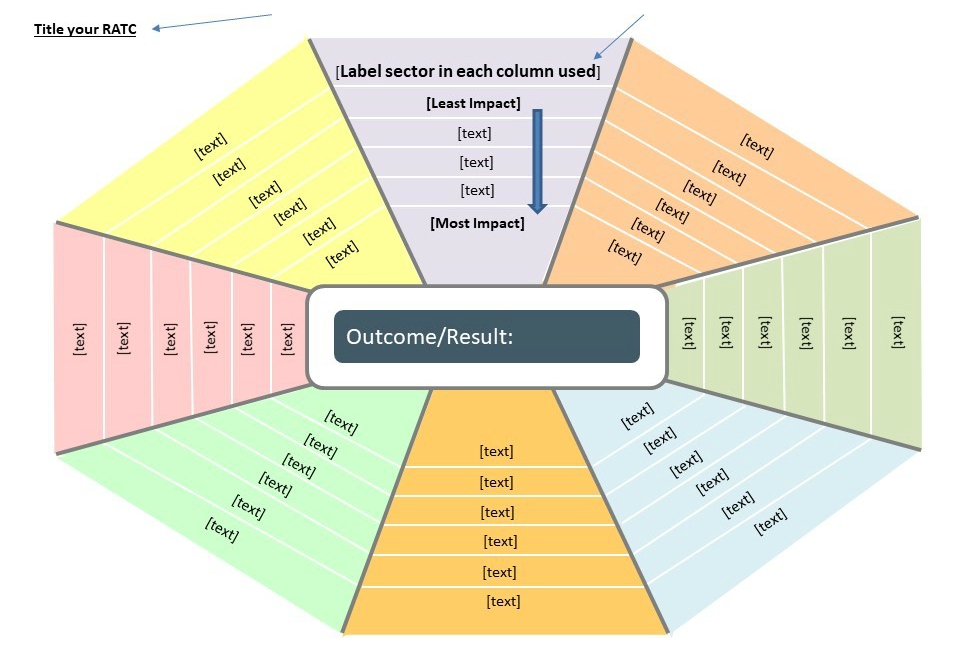
Through disaggregating data and creating sections in charts, it may become natural to keep issues and populations separate. However, while it’s important to know who is closest to making the result happen, we should always focus on alignment. That is the power of collaborative action: Individuals, organizations and systems align to meet the needs of our communities. According to the Theory of Aligned Contributions, a resource for creating systems-level change, “Leaders create collaborative work out of the power and experience of their separate work.”
Disaggregated data, along with seeing gaps, allows us to find the shared points of pain in separate communities and think about how to bring people together for a common result, regardless of ethnicity or economic status. Partnerships in the Network constantly consider how to leverage resources. The work done by the organizations in Oakland, presented at the Equity Summit, is an example of how to leverage passion.
Different communities that share the same struggle likely also share the same passion to make life better for children. Conversations and work focused on poverty are opportunities to find common ground across different demographic groups. If leaders can identify cross-community concerns and a shared desire to do the work and then align that momentum to an agreed-upon result, more people are can be connected to the work. In addition, as advocacy work increases, those combined communities create a larger alliance of citizens that can impact policy.
The Equity Summit session on supporting Black and Brown boys and young men was specific to issues in Oakland, but it provided insights on collaboration and alignment that can be used across the national StriveTogether Network. In our work, we bring together community leaders, professionals and organizations to look at data to inform decisions. This session set a powerful vision of what it looks like when communities align passion toward a shared result.
The post Lessons from Oakland: Equity Summit session shares power of aligning passion appeared first on StriveTogether.
]]>The post The collective impact work of MLK appeared first on StriveTogether.
]]>Shot rings out in the Memphis sky
Free at last, they took your life
They could not take your pride”
“Pride (In the Name of Love)”
U2
This April 4, 2018, marks 50 years to the day the Rev. Dr. Martin Luther King Jr. was assassinated. Leaders across the country will reflect on his work, including “I Have A Dream,” “Letter From Birmingham Jail” and “I’ve Been to the Mountaintop,” his last speech. Along with Winston Churchill and John F. Kennedy, King ranks as one of the greatest orators of the 20th century. Five decades after his murder, we still look to him and his words to motivate us to fight for change.
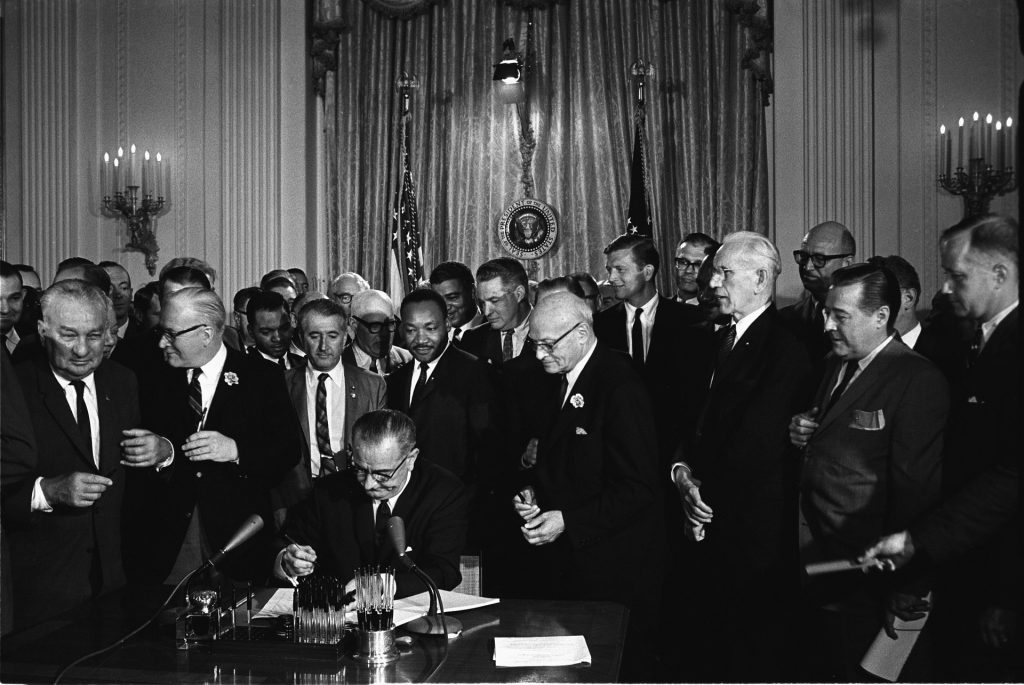
The Rev. Dr. Martin Luther King Jr. and others look on as President Lyndon B. Johnson signs the 1964 Civil Rights Act.
When we think about King’s work, we think about the marches, the organizing and the tireless work of him and thousands of others during the Civil Rights Movement and the March on Washington for Jobs and Freedom. The Civil Rights Movement resulted in the Civil Rights Act of 1964, the Voting Rights Act of 1965 and the Fair Housing Act of 1968 (passed by the House of Representatives six days after King’s death).
Often, we overlook the Poor People’s Campaign, King’s work at the time of his death. King and the Poor People’s Campaign advocated for changes that would prepare all people for the opportunities available from these legislative victories from the 1960s. The Campaign was a multi-ethnic effort for fairness and access to the American economic system for all people focused on race and income disparities. Essentially, it was equity work — the work of the entire StriveTogether Cradle to Career Network.
The Campaign also connected people through their shared struggle, bringing together a diverse group of people ranging from residents of Kentucky’s Appalachian Mountains to field workers from California. The Campaign’s first meeting included representation from more than 50 multicultural organizations. This approach is similar to StriveTogether’s model of Collaborative Action Networks, when cross-sector practitioners and individuals organize around a community-level outcome and use a continuous improvement process to improve that outcome.
Exactly one year before his assassination, King gave a speech in Chicago where he stated, “We as a nation must undergo a radical revolution of values. … We must rapidly begin the shift from a thing-oriented society to a person-oriented society.” Since 1968, the gap between America’s wealthiest and poorest citizens has increased steadily. Using data from the IRS, economist Emmanuel Saez has shown that in a 20-year period from the mid-1980s to the mid-2000s, the income gap increased 80 percent. Fifty years ago, King saw disparity gaps as a concern that should be addressed. Today, StriveTogether seeks to shrink this gap, with communities aligning resources to achieve better results for children.
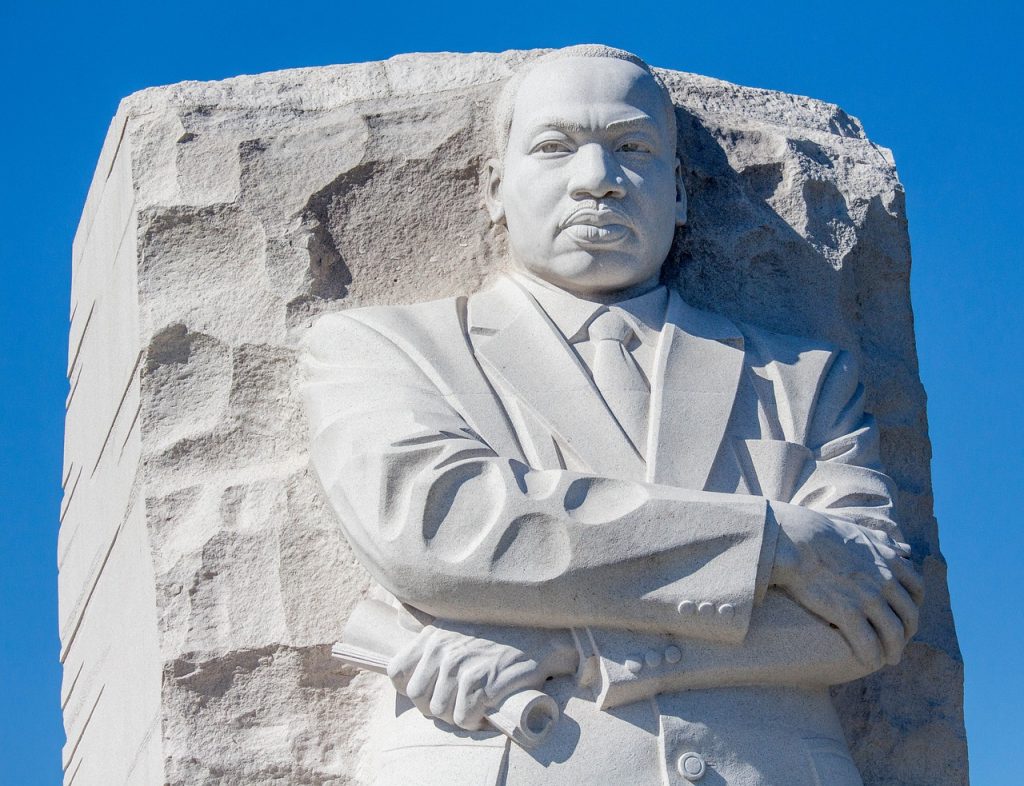
The Martin Luther King Jr. Memorial in Washington, D.C., features the Stone of Hope, a granite statue of King carved by sculptor Lei Yixin.
Although King’s work has at times been remembered as an individual achievement, it is an example of how to reach results through collaborative action and collective impact. For instance, the March on Washington could not have been accomplished without the Big Six. In the Big Six, King, chairman of the Southern Christian Leadership Conference, worked with five leaders from other organizations. In addition to Rep. John Lewis from the Student Nonviolent Coordinating Committee, leaders came from the Brotherhood of Sleeping Car Porters, the NAACP and the National Urban League. Two other leaders often are excluded when discussing the Bix Six (at times referred to as the Big Four): Dorothy L. Height of the National Council of Negro Women and James Farmer from the Congress of Racial Equality. The omissions of Height, a woman, and Farmer, a gay man, have been attributed to gender and sexual bias. An all-black collaborative but not monolithic, the Big Six was progressive, conservative, socialist, old, young, Christian and secular.
PolicyLink President Michael McAfee wrote in his paper The Soul of Collective Impact that “backbone organizations must have the courage, capacity, and credibility to take on the biggest problems in our nation, starting with structural racism.” McAfee also advocates for results-based accountability, a foundational skill that supports the Results Count approach. This approach includes using adaptive leadership, collaborating with others and highlighting and reducing disparities, while recognizing that race, class and culture impact outcomes and opportunities for vulnerable children. Decades after King mastered these skills, StriveTogether has staff trained in results-based leadership and provides offerings to the network to spread this approach throughout our communities.
As King’s work moved to the Poor People’s Campaign, his collaborative network expanded to a diverse membership in race, culture and economic status. It included Rodolfo Gonzales and Reies Tijerina, who informed collaboration on Chicano issues. King’s leadership and willingness to collaborate for results has been praised. As we reflect on his life, we cannot overlook his work to close gaps with a diverse group of people King and those working alongside him during the Campaign understood the importance of presenting disaggregated data, and the diversity of its leadership and sponsors (American Federation of Teachers, the YMCA and the United Steelworkers Union) reflected the population. In the StriveTogether network, disaggregating data by race is critical to supporting the success of every child.
In one of King’s last speeches during a visit to Mississippi in 1968, he spoke about the U.S. government excluding African Americans from land grants, which gave farmers property, tools and training. Following slavery and the oppressive practices of sharecropping in the Jim Crow south, farming was a trade in which many Blacks would have been successful. King presented this exclusion of Blacks as a case for the necessity of the Poor People’s Campaign and march. In this speech Rev. King would call out many of those beneficiaries of this federal subsidy. “Today these people are receiving millions of dollars not to farm and they are the very people telling the Black man that he needs to lift himself up by his own bootstraps. … This is what we are faced with and this is the reality,” King said in his speech. He followed that statement by saying the march on Washington was “to get our check,” meaning it was time for all people to be included in the economics of this country and the American Dream.
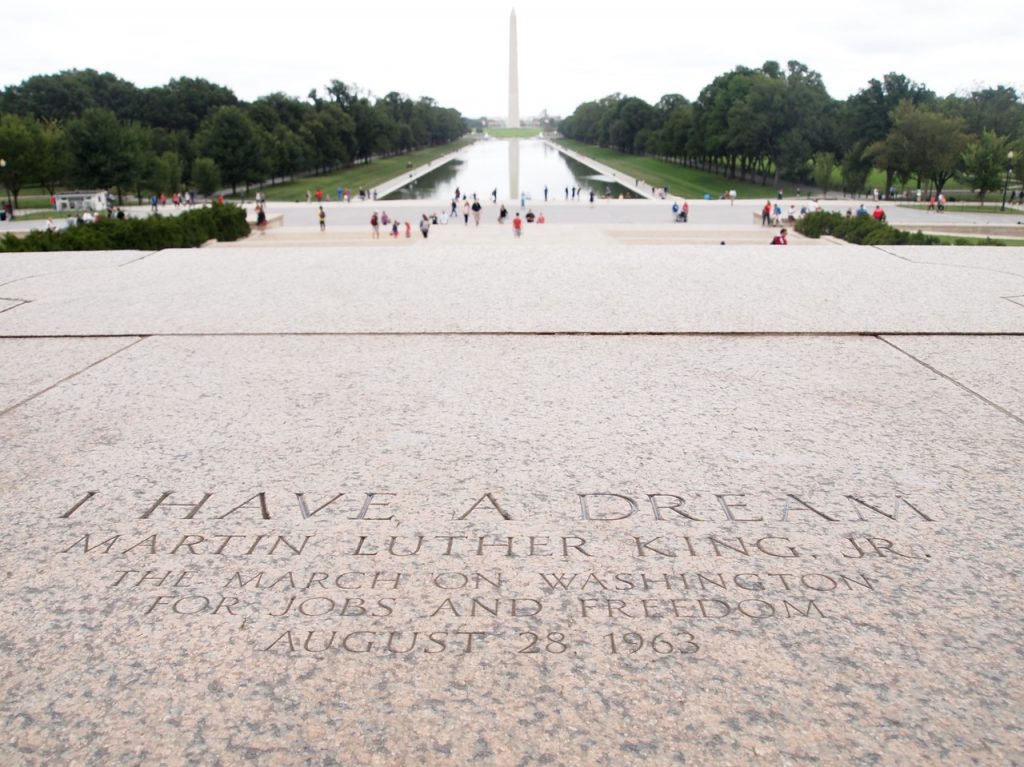
On August 28, 1963, Martin Luther King Jr. gave his “I Have a Dream” speech from this spot on the Lincoln Memorial steps.
Many other African American colleagues in the Cradle to Career Network and I are in the first generation of Black people to be born with our full rights as American citizens. There are many Black people we work with and respect in the Network who were not born with these rights. These rights were secured through the collaborative action and collective impact work of King, the rest of the Big Six and many others. It is safe to say King would expect collaborative work on behalf of today’s Dreamers, children who only know this country. He would expect us to work on behalf of Native American tribes that are recognized as sovereign nations but face mass incarceration in a U.S. justice system that operates outside of the cultural norms of each of these nations.
On April 4, let’s ask ourselves and each other if we are keepers of the dream. The dream, as presented on August 28, 1963, during the March on Washington for Jobs and Freedom, did not stop that day. It grew into collaborative work for improving conditions of all people, specific to the issues of every racial group and culture with respect to geographic areas. StriveTogether’s new strategic plan speaks to the equitable outcomes King sought when he died. As a network, we collectively are all keepers of the dream and the work of the Rev. Martin Luther King Jr. is our work.
The post The collective impact work of MLK appeared first on StriveTogether.
]]>The post The effects of repealing net neutrality on our most vulnerable students appeared first on StriveTogether.
]]>This was partly made possible by the net neutrality policy put in place by President Barack Obama in 2015 requiring that internet service providers, or ISPs, treat all online content the same. This rule was rolled back in late 2017 with the “Restoring Internet Freedom Order.” The decision to reverse net neutrality impacts online speed and access to content, allowing ISPs now to block or slow down certain websites or types of content and show preferential treatment to others.
After voting to overturn the law in December, the Federal Communications Commission (FCC) has officially declared that net neutrality will come to an end April 23. Soon ISPs will be able to sell the internet in bundles like cable television, forcing people to pay extra for individual sites and potentially censoring information.
The net neutrality debate has been looked at as a business issue and a consumer concern. Startups and entrepreneurs might not be able to afford higher fees; the smallest voices may no longer be heard and able to thrive. But the recent decision to repeal net neutrality also has potential implications on education that should be addressed at local and national levels.
For a school system facing budget constraints, paying extra for increased speed or the guarantee that students have access to open source tools (e.g., Mozilla, Inkscape, RedNoteBook, etc.) may not be feasible. The removal of net neutrality does not take into consideration the local monopolies maintained by internet service providers. Many of our school districts can receive broadband services from only one or two providers, looking for a rate that fits within the budget of a cash-strapped-school in a market that does not have enough business to provide services at a competitive rate. This may become a growing problem for school administrators.
Additionally, the family who can’t access a simple internet resource such as Wikipedia — an online service that cannot compete within a digital marketplace — may be limited to the preferred knowledge content of the provider. The implications of the “Restoring Internet Freedom Order” on families with fewer resources are the most concerning. The family who lives miles from the closest library is at the mercy of what its provider allows in terms of access and speed.
Supporters in the state and federal government have expressed plans to continue fighting for it. Dozens of state attorneys general are now expected to join private net neutrality advocacy groups to file lawsuits against the order. Here are some ideas for local partnerships to strive to maintain an open and free internet:
- Meet with local internet service providers to express concerns on behalf of schools and families
- Partner with consumer advocacy groups, specifically on this issue
- Lobby local and state officials for their support
- Connect with other partnerships within the network to discuss how to address student needs at a national level
“It’s hard to imagine that ISPs would block access to educational resources, or require districts to pay more for quicker access,” writes Getting Smart coordinator Erik Day in a blog (Day, 2018). However, with the removal of net neutrality, that possibility exists. It is important to have an understanding and eventually agreements in place with local internet service providers to maintain current levels of access to knowledge for schools and families.
Recommended reading
How repealing net neutrality could affect schools’ internet access
Net neutrality: Removal and its potential effects on education
The FCC announces the last days of net neutrality
What the end of net neutrality would mean for education
The post The effects of repealing net neutrality on our most vulnerable students appeared first on StriveTogether.
]]>