The post Key factors for success in collective impact appeared first on StriveTogether.
]]>The post Weaving communities for better results appeared first on StriveTogether.
]]>Last summer, Brooks toured the country, visiting communities enriched by what he calls “weavers” — individuals and organizations creating trusting relationships to repair the frayed social fabric seen in the ways we ignore our neighbors or separate ourselves by our differences.
Collective impact aims to strengthen this fabric. Brooks got his first look at the StriveTogether brand of collective impact when visiting the Spartanburg Academic Movement, where he was touched by the way community-based partnerships were connected to serve the community’s children. He chronicled his discovery in a column aptly titled “A really good thing happening in America.”
At the convening, Brooks pulled forward his experience in South Carolina in his remarks and the panel discussion that followed. The panel was moderated by Jim Shelton, the former deputy secretary of education who coined the Cradle to Career Network’s term “proof point.” Shelton opened with a line from the column that crystalized one Brooks’ primary lessons from his Spartanburg visit: “Trust is built and the social fabric is repaired when people form local relationships around shared tasks.”
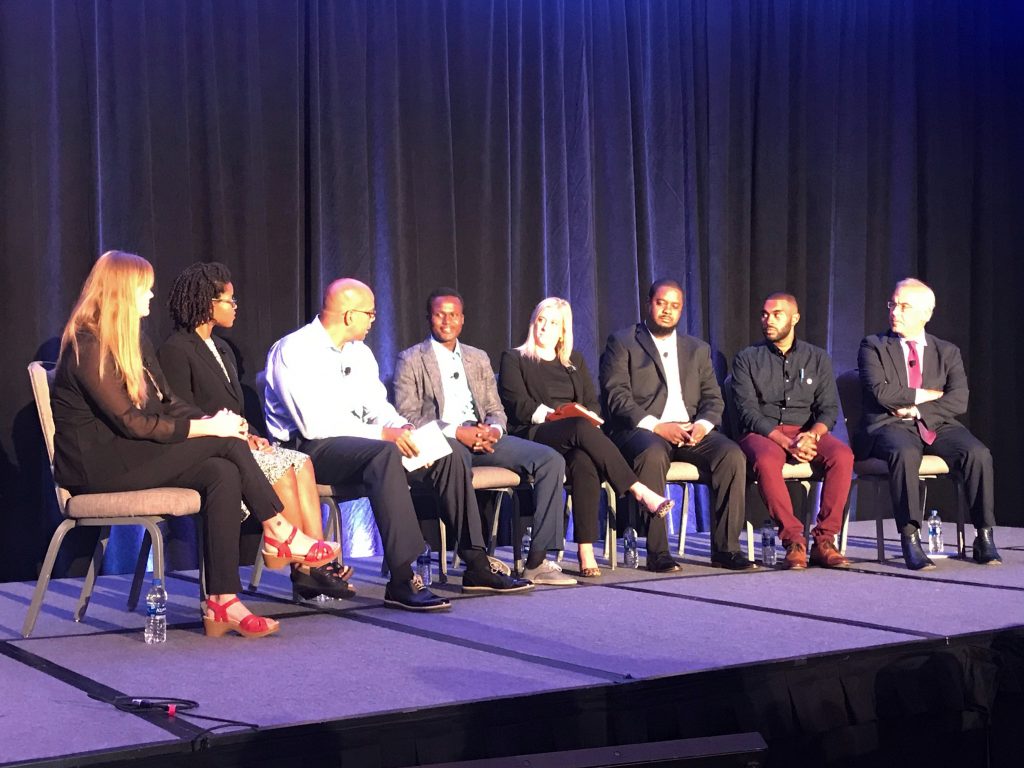
One by one, panelists described the examples of weavers working on these tasks in each of their communities:
- For Abdi Iftin and Amy Tehrens Terpstra at United Way of Salt Lake, weavers are the 565 volunteers in the community who donated school supplies for students, and the young people who work as grassroots connectors for parents and families across a range of immigrant experiences.
- Keith Lovelace of New York City’s Community School 61 and Michael Partis of South Bronx Rising Together spoke of the elders who make multiple visits to schools each week to read to students, alongside former students who return as volunteers.
- Elyse Peters and Shardé Oliver at Bold Goals Coalition of Central Alabama described how colleagues in rural Alabama build trust by sharing their local context, weaving partners into the community fabric.
These and other examples shared illustrate communities creating connections through meaningful relationships and appreciation of place. Such stories of relationships can often be overshadowed by leaders’ drive to achieve results. Brooks reminded audience members that as they navigate challenges back home, it is their relationships that will sustain the work. Relationship building is a skill, Brooks said.
“We all say we want to be good at relationship, but the people who are really good at it have gone through some sort of metamorphosis,” he shared.
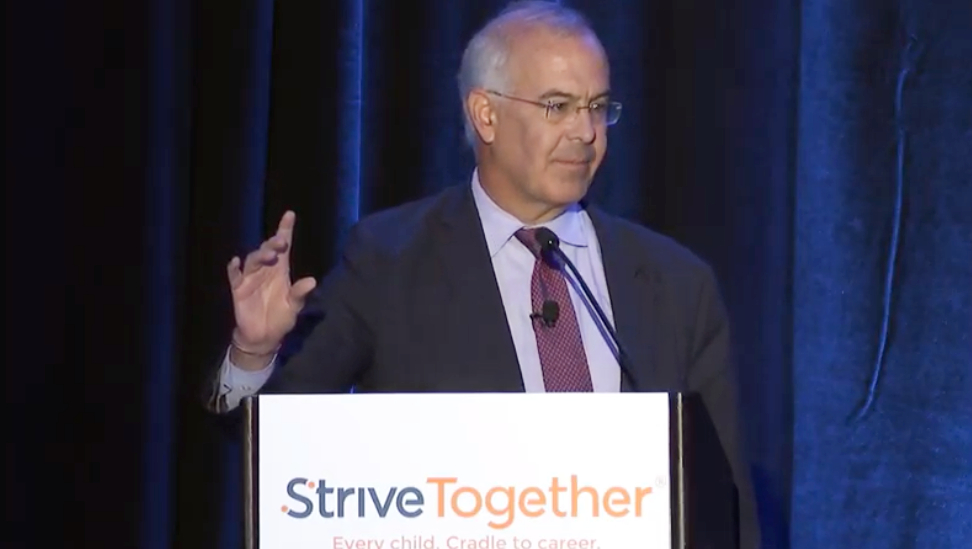
This metamorphosis is a narrative that Brooks has experienced in his own life, which he explained using StriveTogether’s name. Of the words “Strive” and “Together,” Brooks says he’s always been better at the first. He was a striver from an early age who chose his profession of writing after reading about Paddington Bear as a child. His journalism studies have led him to a career of achievement, with multiple books and a regular column in one of the country’s most prominent periodicals. But as his career progressed, Brooks found himself mostly alone, falling into a personal valley caused by a “lack of togetherness.” His charge to the audience was to remember the second part of StriveTogether’s name.
As an organization, StriveTogether too has seen metamorphosis, beginning as a network of like-minded partnerships creating collective impact in more than 100 communities. After an update to our theory of action added rigor to our framework, many communities left the Cradle to Career Network. Since then, the network has strived plenty, with a total of 13 proof point communities and an ambitious goal of 24 communities reaching systems transformation by 2023. But deep in the data lies something else — the strength of the community connectivity that has made it all possible.
Today, nearly 70 StriveTogether network members nationwide are creating relationships across sector, across difference and across the railroad tracks with a deep commitment to equity and closing disparities. As collective impact leaders, we are relationship builders first, and as we continue to learn and grow as a network, we take a note from David Brooks, who, as Jim Shelton noted, has not only the courage to change, but the courage to do it in public. And if individuals can change, culture can change, systems can change, and we can all keep striving — together.
The post Weaving communities for better results appeared first on StriveTogether.
]]>The post Starting at home for success at school appeared first on StriveTogether.
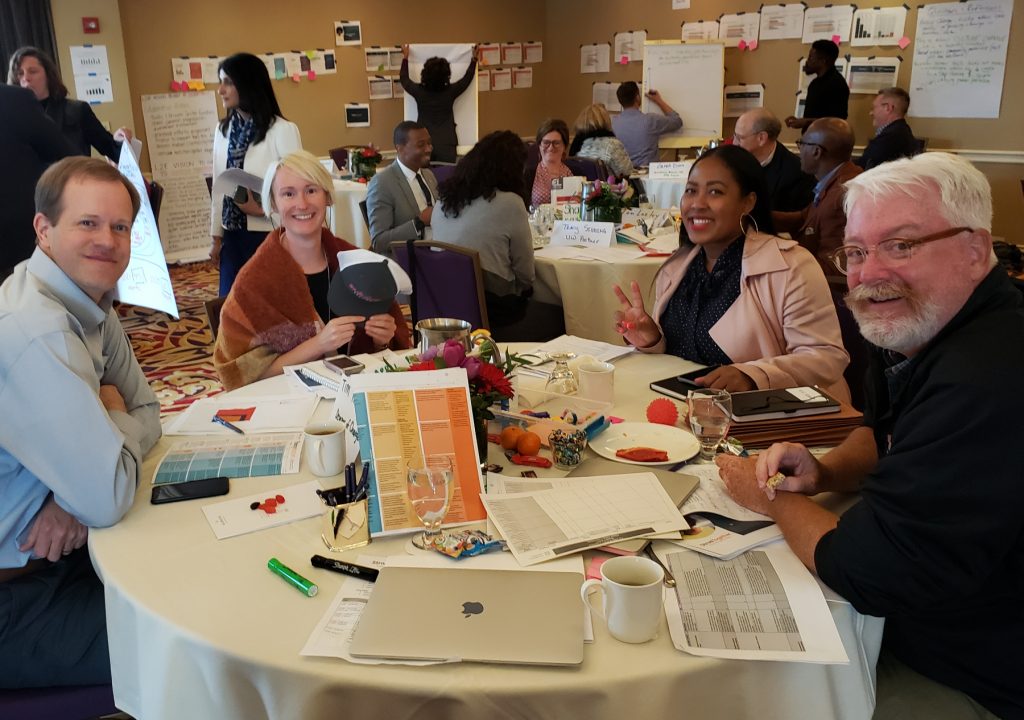
]]>I always find it helpful to get out of my “Tacoma tunnel vision” and see how other communities think differently. I recently had the chance to learn with eight other communities from across the country at a convening of the StriveTogether Opportunity Fund. We came together in Denver to share progress and insights from our work to change systems, including effectively collaborating across the community.
Tacoma Housing Authority commits to helping our customers succeed as parents, students, wage earners, tenants and builders of assets. With StriveTogether Cradle to Career Network member Graduate Tacoma, supported by the Foundation for Tacoma Students, we share a vision of a Tacoma where every child succeeds. We work toward this vision with other organizations in different sectors, like education, health care, transportation and more.
As federal resources continue to decline or remain flat, we look to cross-sector collaboration as the best way to use housing dollars to meet other goals. We invest in helping young people succeed as students. We also help our local school district and colleges succeed in serving low-income students, all of which aligns with the work of the Graduate Tacoma movement.
Here are a few of the ways we use our housing efforts to support kids in every aspect of life:
Hosting a Head Start program
We host a Head Start program at one of our housing properties — the only school district Head Start in Tacoma not hosted at a school. The Head Start model takes a comprehensive approach to meeting the needs of young children, including education, health, parent involvement and social services.
Providing immediate housing for families and students
We partner with Tacoma Public Schools to make housing immediately available to homeless and near-homeless families. Backed by a federal law called the McKinney-Vento Homeless Education Assistance Act, this partnership ensures immediate enrollment and educational stability for homeless children and youth.
We also partner with two Tacoma colleges to make housing immediately available to homeless and near-homeless students. In the first three years of this program, participating students have reached higher persistence rates than other homeless students and higher GPAs and graduation rates than the general campus population. These results have motivated us to expand the program to serve more students.
Building our relationship with the Foundation for Tacoma Students helped me see that we could expand this program to homeless high school seniors who are old enough to sign their own leases. After returning from Denver, we dove into these ideas and are planning to launch the expansion this fall. This expansion shows homeless high school students that there is a path to college and economic mobility. Housing is foundational on that path.
Helping families save for the future
We offer a Children’s Savings Account program to the children at our largest housing property. We open a savings account for each child in kindergarten and continue matching their savings through elementary school. Beginning in middle school, we deposit funds in the account each time a student meets a milestone that will help them graduate from high school and enroll in college. The student has access to their funds after graduating from high school and enrolling in a postsecondary program.
The goal of the program is to plant a seed with parents and children when children are young to let them know that college is for them and we support their goals. We continue to work on building a true college-going culture. The work of our local StriveTogether network is a key to helping us do that.
Attending the Opportunity Fund convening was exciting and reinvigorating for me. Thank you for letting me into your circle. I am motivated by the work to come!
Graduate Tacoma was awarded a grant through the Cradle to Career Community Challenge’s Opportunity Fund, focused on deeper systems change through aligning education with other sectors like health, housing, transportation and more.
The post Starting at home for success at school appeared first on StriveTogether.
]]>The post Validation affirms we’re on the right path appeared first on StriveTogether.
]]>More than 4,000 people from the Cradle to Career Network participated in a three-year evaluation of the StriveTogether Theory of Action , and findings confirm our framework is helping communities change systems and improve outcomes for kids and families. I am so grateful to the 14 communities that participated in the evaluation! Their contributions have not only helped StriveTogether refine our work, but they’ve also helped define quality collective impact for the field.
This validation provides reassurance that the framework we co-developed with our Network is helping to improve outcomes, eliminate disparities and transform the systems that impact the trajectory of youth. The theory of action was not developed in a boardroom by a few. It’s the result of the Network sharing insights, learning and fail forwards as we challenge the status quo.
Collectively, we have hypothesized about the type of work that needs to be done and how that work progresses, but we wanted to see how that was consistent across communities and where there might be differentiation. So, we followed the progress of 14 communities with Equal Measure starting in the spring of 2015. We collected additional outcomes data in 10 communities along with 25 interviews with network members and community stakeholders to qualify the findings.
We are now confident about certain truths in our framework. For example, we know that communities are likely to crawl before they walk — and ultimately run. This means that there might be a more elementary use of data in the early stages of the work — but that doesn’t mean data isn’t important.
We also know that a shared vision and aligned messaging is critical in the early stages. If there is no shared agreement around the work to be done, there is really no work to do.
We also see that communities need different supports at different stages in their evolution. For example, it’s not a major challenge to bring folks to the table in support of better outcomes in the early days. That type of collaborative action, though, becomes more challenging as a partnership evolves and folks actually start changing their behaviors and structures.
Next, the evaluation findings show that the Network is consistently strong in the use of data. This is not surprising because the theory of action is predicated on the use of data. The Cradle to Career Network approach is built off the idea that if communities have more access to data — and can use data differently — we can do better for kids and families. Many years ago, we started talking about the importance of using data as a flashlight, not a hammer. That’s still a guiding value in our approach to this work. We know that there is much more work to be done to enable easy access to data across a community, but this is certainly a bright spot in our network.
Another important principle of the theory of action since the very beginning is community engagement. We’re learning, though, that engagement is not enough — to fundamentally transform systems, community members need authority. Community engagement is often transactional — ask the community what they need and then maybe we go do it. This transactional approach perpetuates the systems that are already delivering abysmal outcomes. Shifting power dynamics has to be at the core of this work.
We have also shifted our approach from just eliminating disparities to one that champions advancing equity. Structural/systemic inequities are rooted in mental models and patterns of behavior that can’t be programmed away.
While we have an explicit commitment to equity externally, we’ve realized the importance of grounding our internal operations in racial equity. It’s easy to stand on the parapet and tell others they need to do better — it’s more important to hold that mirror up to ourselves. We’re building in anti-racist caucuses, racially equitable hiring practices and vendor/contractor practices and supporting our team on their own racial equity journeys.
We are using the evaluation findings to inform our work, including the most recent revision of the theory of action last year. The fourth revision underscores that this is a living document and includes the creation of the Systems Transformation Gateway. This new gateway calls out the practice and behavior changes needed in systems to deliver better and more equitable outcomes. We know our work has to focus on getting to zero disparities. We edited the equity principle to be about advancing equity — going beyond eliminating locally defined disparities. We also inserted policy more explicitly in earlier gateways. Listen here for additional insights from Equal Measure’s podcast.
As we continue to learn together, we will achieve greater clarity on systems transformation. This is new territory for all of us. But we have a road map, our validated framework, to guide us.
The post Validation affirms we’re on the right path appeared first on StriveTogether.
]]>The post The collective impact of collective impact appeared first on StriveTogether.
]]>For three weeks this spring, I was fortunate enough to tour the U.S. visiting a variety of cradle-to-career initiatives on a Winston Churchill Fellowship. The Fellowship enables UK citizens to travel the world looking at innovative solutions to the world’s most pressing problems and bring them back to the UK.
A fitting culmination of my travels was a convening with some of StriveTogether’s most advanced communities in Denver. I was lucky enough to observe two inspiring days with nine StriveTogether partnerships from around the country. I have learned so much from the many people who generously gave their time and expertise, sharing the challenges and opportunities that come with this important work. Here are a few reflections from my time in the States and in particular at the StriveTogether event.
In StriveTogether President and CEO Jennifer Blatz’s opening comments at the convening, she rightly described the work of StriveTogether partnerships as “ground breaking,” which almost by definition means that it is hard because well-established antecedents are few and far between. But it also means that it resonates: As we know, successful collective impact in a community can resonate nationally and, as my visit is testament, it can resonate internationally as well. As we develop our work in the UK, where cradle-to-career efforts are less established, it is incredibly helpful to be able to point to the work of StriveTogether and the Cradle to Career Network as an example of what can be achieved. So, my main duty is to thank those of you doing this pioneering work.
A revelation, in the course of my trip, was that StriveTogether is not only about collective impact in individual communities, but about the collective impact of the Network itself. One participant said to me that his partnership “would not have achieved 1/10th of what it has achieved without the Network.” It is this element of what I saw in the States that I am most envious of — a supportive community of people and organizations that are having comparable experiences across the country and who are happy to pick up the phone or host a visit to share best practices or solve problems collectively.

And a final general reflection on the StriveTogether Cradle to Career Network and indeed cradle-to-career partnerships I observed across the States is the way in which people individually live and breathe a collaborative, collective approach. The openness and honesty with which individuals have been willing to share their victories but also their struggles has been truly humbling. I suppose this must in part be because the work attracts a certain sort of person who is open to collaboration, but I suspect it is also a set of qualities and values that can be trained and learned over time, so that it occurs not only in formal “collective impact” interactions but is instilled in the structural operating values of an organization. In a world where competition is more often the underlying ideology, this collaborative approach was a breath of fresh air.
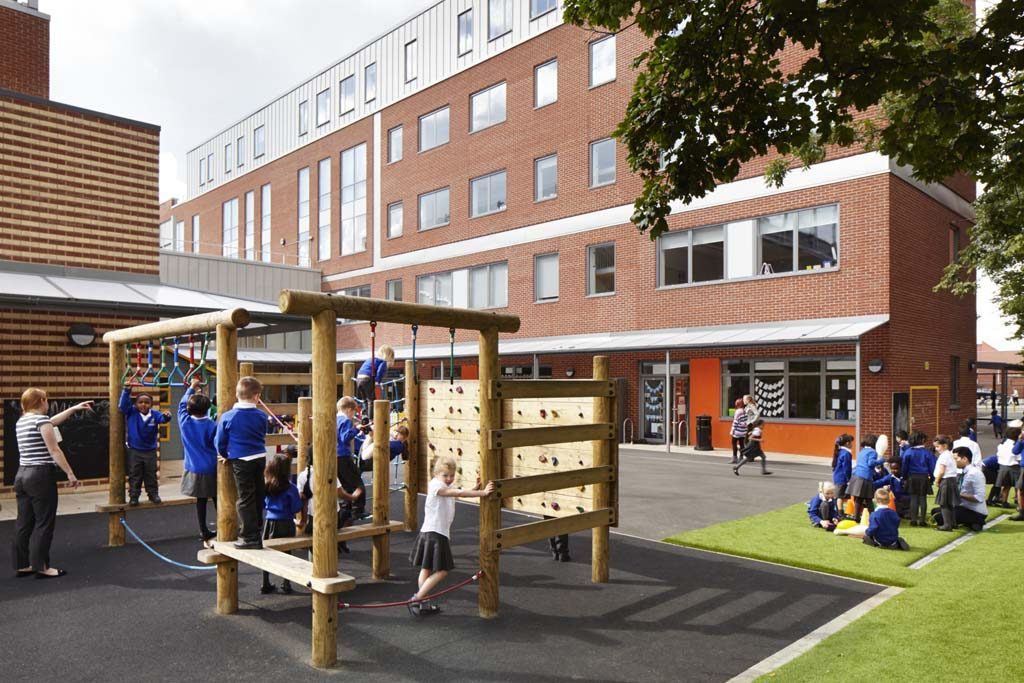
My visit was particularly important to me because of my work with Reach Academy, where I am a trustee. In 2012, I co-founded the school with Ed Vainker and Rebecca Cramer. We are deepening our impact in the community with a new children’s hub offering cradle-to-career support, and a second Reach Academy is due to open in the neighborhood in the next few years.
Thank you to all who shared their experiences with me. Please do visit us in London or reach out over email. I look forward to continuing the conversation.
 Jon McGoh is a trustee and co-founder of Reach Academy in Feltham, England. The school received an “Outstanding” Ofsted rating and achieved the 16th best progress score in the country in its first set of examinations.
McGoh helped to produce the documentary film “H is for Harry,” which is set in the school. The film, which was released earlier this year, is being used nationally and internationally as a call to action for this work, particularly around the need for early intervention.
The post The collective impact of collective impact appeared first on StriveTogether.
]]>The post Witness the Network Effect appeared first on StriveTogether.
]]>If you’re familiar with StriveTogether, you’re probably familiar with this question: What does StriveTogether really do? I get this question all the time, every week, and have for six years. It never gets old because what we do at StriveTogether is so unexpected — and impactful.
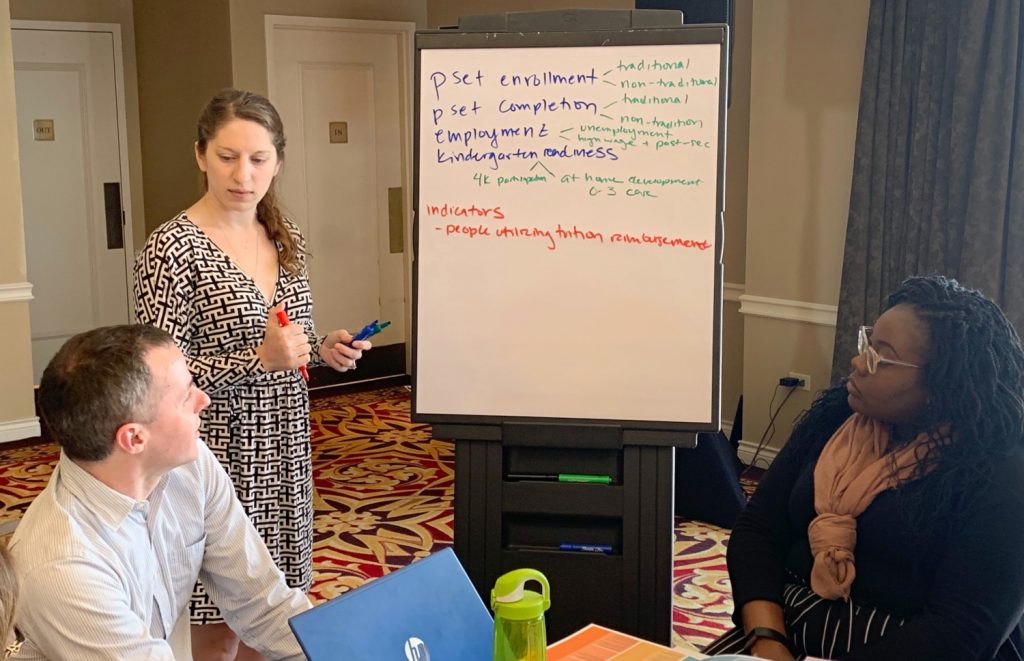 StriveTogether brings together a network of communities tackling similar tough issues and challenges. Then StriveTogether gets out of their way as they challenge, support and learn from each other. We create spaces for Cradle to Career Network members to be the experts in their own work and share their expertise with others.
This Network Effect was extra powerful in Denver earlier this month when our Opportunity Fund communities convened for two days. These nine communities are supported through our Cradle to Career Community Challenge. Each of these communities are on the leading edge of improving outcomes, closing disparity gaps and addressing the root causes limiting economic mobility for children of color and children and families living in poverty. We know these are some of the most complex challenges we face in our country. And we know there is no better time than now to start working on them together.
 Why now? Because the Network is getting stronger as more and more communities are learning and improving cradle-to-career outcomes. The Network impacted the lives of 13.7 million children last year, and we are just getting started.
The Network’s goal is to reach the systems transformation desgination along StriveTogther’s guiding framework, the Theory of ActionTM, in 24 communities by 2023. The nine Opportunity Fund communities that gathered in Denver focused on pathways to economic mobility. They shared insights to better understand the bright spots and challenges along the journey. They know from looking at the disaggregated data in their communities that current systems are failing children of color and children living in poverty. They are building a new civic infrastructure designed around the needs of children by bringing schools, housing, transportation, business and families together. They are witnessing successes like these:
- In Central Texas, the E3 Alliance partnership has helped close racial disparity gaps in kindergarten readiness by understanding and addressing the things that truly support readiness — quality early childhood programming and the frequency and access to services. With this clear set of factors in mind, the partnership has moved 17 percent of low-income students to full-day, pre-K programs, resulting in an increase in kindergarten readiness.
- In Tacoma, Washington, the Graduate Tacoma partnership is working with Degrees of Change to improve postsecondary completion rates. This includes collaborating with the Tacoma Housing Authority on the College Assistance Housing Program. Students experience stable and affordable housing, leading to improvements in their grade point averages and persistence to complete their education.
 The Network Effect is far more than celebrating the successes of partners. The Network Effect pushes communities to challenge their own thinking and iterate on what their peers are learning or testing across the country. After hearing Tacoma’s story, other communities committed to engaging the housing sector to address issues facing youth and families.
A major component of systems transformation is the realization that education strategies alone will not contribute to reducing disparities for children and families. We must engage all of the sectors that touch our children, like health, housing, transportation and human services. We need to work with these sectors as they dismantle their own systemic barriers that limit opportunities.
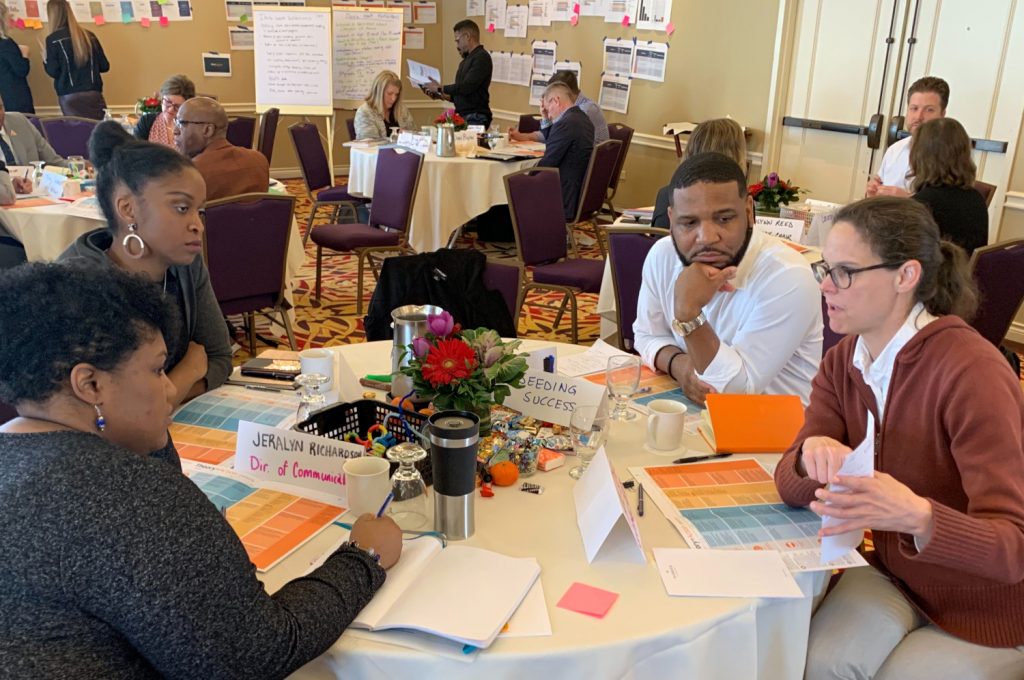 As I sat in Denver, I reflected on the energy, commitment and expertise of the Cradle to Career Network in accelerating progress to achieve zero disparities for kids and families. I know this is possible because they have each other. A colleague recently wrote about the notion of finding your beehive — that moment when you find your people and your purpose. When you see this up close — in the faces of the Network — the effect is powerful. You see commitment to dismantling systems to create better and more equitable outcomes for every child. You see what’s possible.
So, what do we really do at StriveTogether? We bring communities together and get out of the way as they tackle complex problems. We create the space and tools to transform systems. That’s the power of the Network Effect.
The post Witness the Network Effect appeared first on StriveTogether.
]]>The post SXSW EDU: David Brooks on the power of collective impact appeared first on StriveTogether.
]]>The post Networks and American renewal appeared first on StriveTogether.
]]>The post Networks and American renewal appeared first on StriveTogether.
]]>The post Finding solutions through an inclusive process appeared first on StriveTogether.
]]>Historian and writer Jon Meacham shared this thought during his speech at the Southeastern Council of Foundations’ annual meeting on November 8, 2018, in Louisville, Ky. He talked about the work that needs to be done in a political climate where lines are drawn and little compromise seems possible. This approach speaks to the heart of collective impact — the focus of the panel I participated in during the event.
It was an incredible experience to walk past leaders of foundations in the south and hear informal discussions about how they believe their communities were ready to come together to discuss topics like equity — specifically, race equity. In the panel on collective impact, leaders wanted to better understand how this framework could move their communities from conversations to action.
At the panel, leaders heard about its effects firsthand when Alamance Achieves, a partnership in the StriveTogether Cradle to Career Network, shared how keeping results focused on children and cradle-to-career outcomes creates a collaborative environment and allows the community to overcome challenges. Robert Albright of the Collective Impact Forum reminded the room that the ideas behind collective impact are not new. Before StriveTogether started refining this approach, communities had collaborated to improve results. I reminded the room that indeed collective impact has spread across the country because it is proven to be effective.
Collective impact is effective because, at its core, it is designed to unite stakeholders around an intended result to improve outcomes for children. Mental models are challenged when leaders are asked to consider what keeps them from working with other leaders and organizations, and then to think about how working with nontraditional partners can shift the results in their communities. One tool StriveTogether considers essential to the work is a results at the center chart, which shows partnerships who needs to be at the table. This chart is a living document that changes based on the needs of the children in the community, not the preference of one leader or organization.
The work of StriveTogether and the Cradle to Career Network succeeds because of its inclusive approach. Everyone in collective impact and results work should have a voice. We ask partnerships to be willing to fail in their work and learn from what went wrong. When we ask what could have been done differently, the answer often reflects who was not involved. In difficult conversations, we should remember that bringing together multiple stakeholders is crucial in not missing solutions along the way. To improve outcomes for kids, a collective cannot be based on what we want but must be focused on what the community needs.
The post Finding solutions through an inclusive process appeared first on StriveTogether.
]]>The post Salt Lake City’s secrets to collaboration in early childhood development appeared first on StriveTogether.
]]>The prenatal-to-age 3 development landscape is abuzz in Salt Lake City. People from many different organizations are anxiously engaged in making sure parents have the tools, knowledge and support they need to help their children get a great start. When we’re not finding ways to support families and children, we’re finding ways to collaborate and work together. Get us in a room together, and it’s almost electric — you know Utah is going to be a better place when we’re done.
But how did we get here? Is there a secret behind the early development energy in Salt Lake City? The answer is yes. There’s at least one two-step secret most of us have figured out.
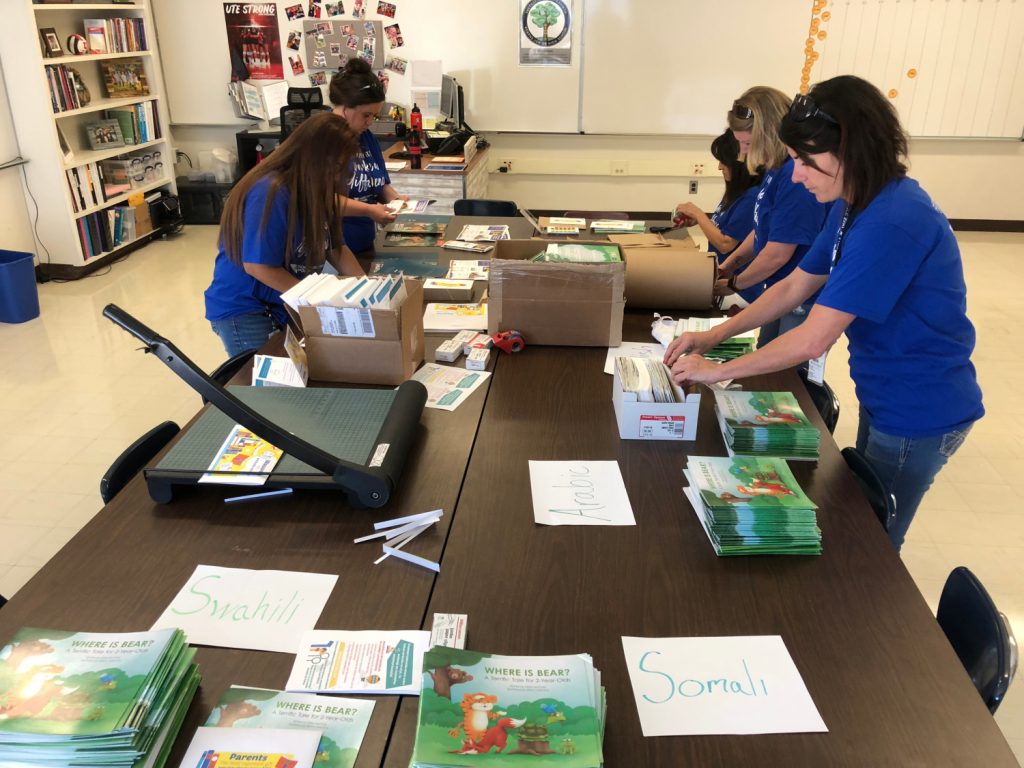 First, think of the perfect early development program — we can all do it. We’ve mapped it out on white boards, memos and one-pagers, or we’ve at least thought through it in the shower. It’s a perfectly planned, coordinated and executed program — running from the state levels through education systems, child-care providers, health-care providers and community organizations — to reach families with tested, culturally appropriate messaging and support. Not to mention an academically rigorous way to evaluate and refine our programming effectiveness at each level. It includes low-cost professional development that no one ever misses. And there’s a simple, effective way to make sure every child and family gets the support they need.
Second, throw this plan out the window.
In the real world, we’re lucky to get a handful of the right partners in the room at the same time — and even luckier if the same handful attend the next meeting. Organizations move at different paces. Some people follow through better than others. And everyone in a major partnership still has their own organization’s other work to deal with.
We don’t have this perfect program. But we still have a bunch of people and organizations who are working together — or at least side by side — to improve early development for children in Utah. And even on the rough days, we know we can make a difference.
So, for real this time, here are a few of the lessons we’ve learned:
Start where you have influence. One of the apparent challenges in prenatal-to-age-3 development is that nothing is centralized. It might be easier if there were a czar of early childhood development who regulated every program and service, but there’s not. Some of us work at nonprofits that serve families, others manage community partnerships or the state’s Ages and Stages Questionnaire (ASQ) programs, but no one has the influence to run every program or reach every family. So, we start small — wherever we have influence. When our StriveTogether prenatal-to-age-3 group was selecting our target population, for example, we zeroed in on children in families who live within the boundaries of Title I schools in the 84115 ZIP code and who also have older siblings enrolled in the Granite School District Preschool. It sounds small, even obscure, but there are still hundreds of families that we can impact. And we all have direct influence there — we didn’t have to convene or convince anybody else to start doing something in that community. Of course, combining efforts and convening partners is essential. But while you’re doing that, there’s a lot that smaller partnerships can start doing.
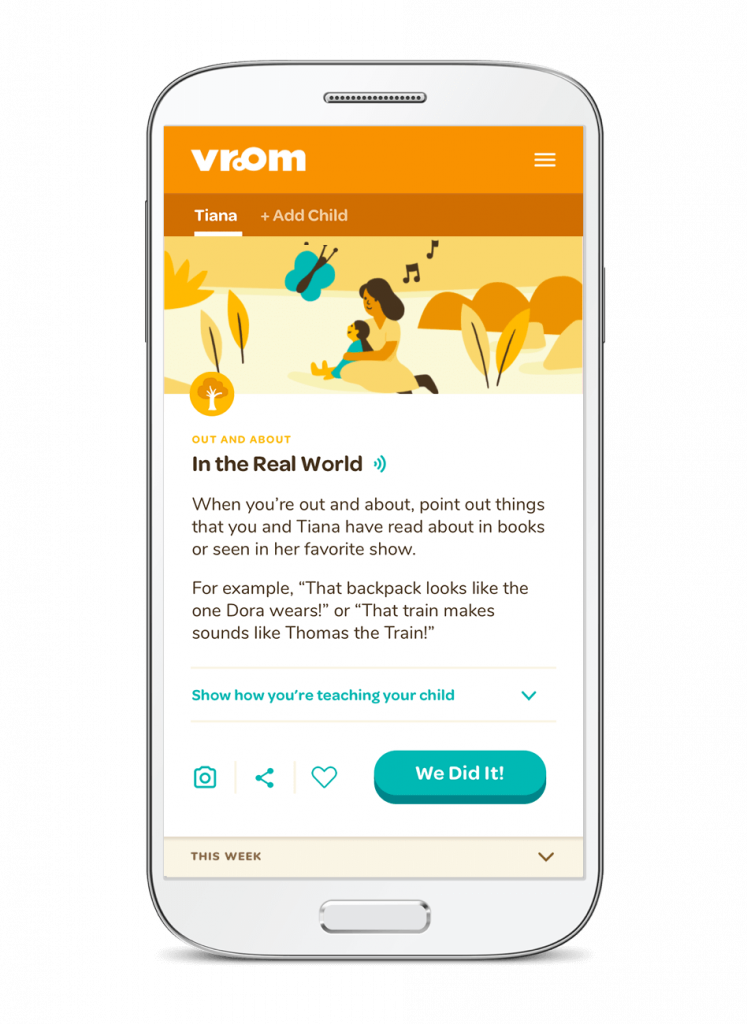 Offer something concrete. It’s easy to figure out what you want to communicate or what support you want to provide to parents. And it’s even pretty easy to find community partners who want to help. But something magical happens when there’s a program or message that you can hold in your hand — somehow having something concrete helps things start to move. In one case, this happened in our community with the Vroom platform. Vroom uses an app or text messages to send parents simple daily tips to help them engage with their children in ways that will promote healthy brain development. The moment some pediatricians, preschools and even religious groups had the Vroom app on their phone and could see the tips that parents would read, they went from saying “This definitely aligns with our values” to “Yes, we can have these conversations with parents!” and “Yes, we’ll encourage parents to download the Vroom app!”
In another case, we wanted the governor to share a message about the importance of early development. He was supportive but didn’t have a clear way to get that message out. Then we asked him to sign a specific note that was going to be handed out with specific children’s books at specific community centers. A week later, we had a note printed with the governor’s signature. All it took was something concrete and tangible.
 There’s room in the sandbox for everyone. You may have noticed the last two examples weren’t just different outreach strategies, but completely different tools. And that’s the next lesson we’ve learned. It’s enticing to envision everyone using and promoting the same platforms, tools and messages. But for all the reasons outlined above and more, that’s just not likely to happen. And even if it could, think of how long it would take to pull that off. Kids grow up fast and parents need support now — not in three years when we have the funding and programming squared away and all the right organizations on board. So maybe you have a statewide ASQ program, or maybe you’re using Vroom, or pushing Bright by Text, or maybe your local district is using ReadyRosie or any number of other early learning tools. Or maybe like us in Salt Lake City, you have all of these and more running in your community! We could waste time (not to mention enthusiasm) by trying to push everyone to the same program, but we’re not. Instead, we’re finding synergy between different programs. A message about Vroom or Bright by Text might lead people to ASQ. Or vice versa. There’s room in the prenatal-to-age-3 sandbox for everyone, and there are plenty of families to go around.
There’s a long way to go in our community — and probably in yours, too. But there’s energy and drive and optimism here. And we’re finding ways to get things done. If there is one secret, it’s this: We don’t let perfect be the enemy of good. We can imagine a perfect program and a perfect way to help our community. But if we spent all our time getting everything perfectly in order, we’d miss out on a lot of opportunities to do good.
Jason Brown is vice president of communications at Envision Utah, an organization that engages people to create and sustain communities that are beautiful, prosperous, healthy and neighborly for current and future residents. Envision Utah is a partner of Promise Partnership of Salt Lake, one of six Cradle to Career Network members participating in the StriveTogether Prenatal to Age 3 Impact and Improvement Network, done in partnership with the National Institute for Children’s Health Quality.
The post Salt Lake City’s secrets to collaboration in early childhood development appeared first on StriveTogether.
]]>