The post Richard Reeves, David Williams share insights for unstoppable economic mobility efforts appeared first on StriveTogether.
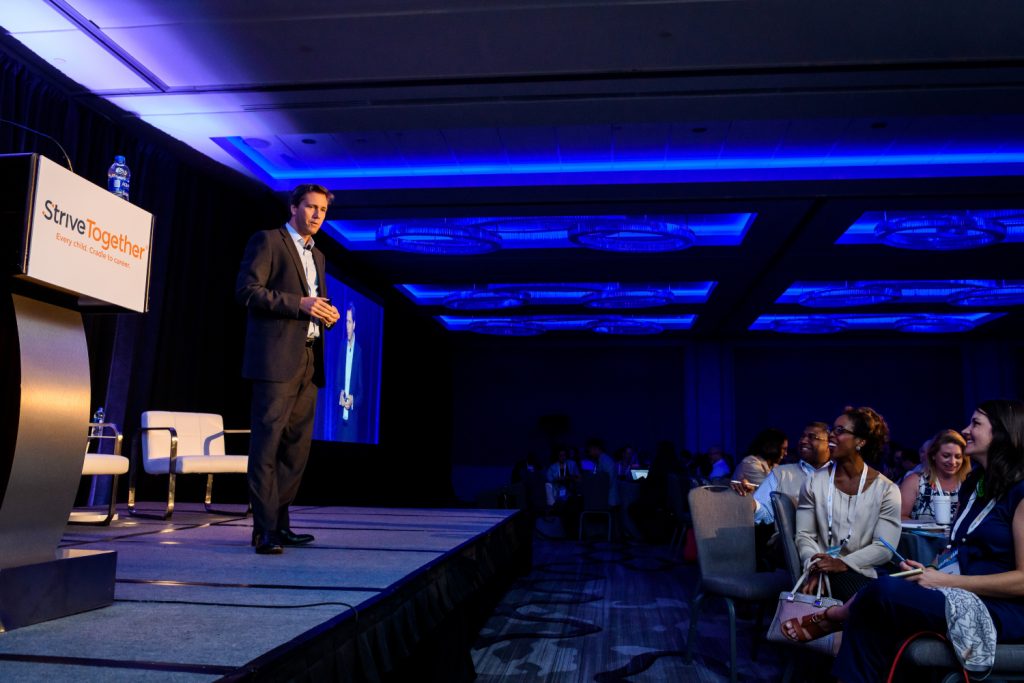
]]>Hearing all of these individual aspirations begs an important question: How do we know if we’re making progress as a system, as a society, in ensuring the success of every child toward economic mobility? At the opening plenary of the Cradle to Career Network Convening, network members heard from two experts on the state of opportunity in America: Richard Reeves, senior fellow at the Brookings Institution, and David Williams, policy director at Opportunity Insights.
Here are a few highlights from their conversation:
“The myth of meritocracy”
Reeves shared a stark perspective on the class system in the U.S. and, as he described it, “the myth of meritocracy.” This myth camouflages the structural inequities of our economic system. As Reeves described the “ruthless machine” of the American class system that produces economic inequity across our country, I was reminded of the idea that there is no such thing as a broken system — all systems are perfectly designed to produce the outcomes they achieve.
Race and place matter.
If you’re black and were born into bottom 20% of the economic ladder, you have a 50% chance of staying there, while white Americans born into same quintile are half as likely to stay. In addition to race, as many of us have suspected, place matters, too. Reeves described this as “the Baltimore effect,” explaining that if you grew up in Baltimore, controlling for all other factors possible, you’re likely to earn 15% less over your lifetime than the average American. This impact is even more pronounced for boys.
Data from Raj Chetty and Opportunity Insights shows the impact of the place where you grow up. While this insight represents a huge shift in social science, we still don’t understand the “what” or “why” of how place affects outcomes. I believe Cradle to Career Network members are ready to dig into the data and answer these questions for their own communities.
Investigate the factors specific to the neighborhoods that have provided opportunity in your community. What are the challenges and what have been the bright spots in those neighborhoods?
Disrupting education inequality
Reeves highlighted that education inequality is passed on even more strongly than wealth. Standardized tests like the SAT are often used to perpetuate these inequities over generations. We as a network have an opportunity to identify equitable system measures — like equitable funding flows, diversity of the educator workforce and more — to measure not only child-level outcomes but system performance to address disrupt this accrual of privilege over time.
Our work must involve elevating the human capital in the education and economic mobility space and ensuring that talent is representative of the communities we seek to serve. Watch how Cradle to Career Network members Generation Next and Milwaukee Succeeds are collaborating with partners to take on this challenge:
Measuring effective solutions
Put simply, there is NO correlation between employment growth and economic mobility. In fact, in places like Charlotte, N.C., economic growth is actually exacerbating mobility challenges. You simply can’t count on job growth to drive economic mobility.
So, what does work? One proven solution is supporting and expanding integrated early childhood systems that include evidence-based home visitation support. Learn how Cradle to Career Network member Norwalk ACTS is supporting this effort:
So, what does this mean for the work of our movement?
Put eloquently by David Williams, “StriveTogether partnerships are uniquely positioned to build the political will to operationalize these research insights into action.”
Here are some ways we can work toward sharing the American Dream:
- Define your success metrics very clearly.
- Start with the evidence. What promotes mobility at different stages of the cradle-to- career continuum?
- Measure and evaluate progress so you can make informed adjustments and improve over time.
- Engage with housing partners to improve housing opportunities, which impact many other factors.
- Use the Opportunity Insights’ Opportunity Atlas to dig into the data in YOUR community and target your work to local issues for those marginalized by systems and structures.
We, as a movement, have an opportunity to measure and demonstrate what works for kids and families. Across the country, people are eager for solutions, and we can provide them.
The post Richard Reeves, David Williams share insights for unstoppable economic mobility efforts appeared first on StriveTogether.
]]>The post Discovering another path to prosperity appeared first on StriveTogether.
]]>Why All Hands Raised is challenging how educators think about skilled trade professions
I still vividly recall the heart-to-heart conversation my father had with me long ago about college. He never went to college or graduated from high school. Yet he was convinced that I would go to college to have more opportunities.
It all made sense as I listened to him and gazed at his hands. They were the hands of a working man who picked up a mop at 11 years old to earn his first paycheck. He started mopping floors at the local funeral home and then graduated to cleaning up at an auto repair shop. His hard work paid off when a senior mechanic took him under his wings and taught him the trade. My father was a quick study and became a sought-after mechanic, advancing and eventually opening his own business. His skilled hands created lots of opportunities for our family.
But my father firmly believed that a college education would be best for me, and I obliged. I have no regrets because college opened doors for me.
However, college is not the only way to a successful career. My father’s story and financial success prove this. And in communities like Portland, Oregon, companies big and small are vying for talent. They’re not always looking for college-educated professionals. They’re searching high and low for skilled professionals. Trade careers are lucrative in Portland, with high school graduates earning up to $60,000 a year while they learn as apprentices.
Helping students, parents and educators see that college is not the only path to cradle-to-career success has been a three-year effort led by Cradle to Career Network member All Hands Raised. Portland is witnessing a recent dramatic increase in students taking advanced coursework needed for in-demand construction and manufacturing careers. That includes the launch of the state’s first HVAC (heating, ventilation and air conditioning) pre-apprenticeship to be embedded within a high school.
Nate Waas Shull, vice president of partnerships for All Hands Raised, says, “The data was showing us that 78% of high school graduates in Multnomah County go college, but just 37% of them graduate. A key driver of that is that the kids are overwhelmed by college. They need to make money. So, they drop out with huge debt.”
Waas Shull works with partners like the Pacific Northwest Carpenters Institute and manufacturing partners like Boeing to host Industry for a Day. Nearly 40 employers provide educators with hands-on experience in construction and manufacturing jobs, so they have a greater appreciation of the options available for their students.
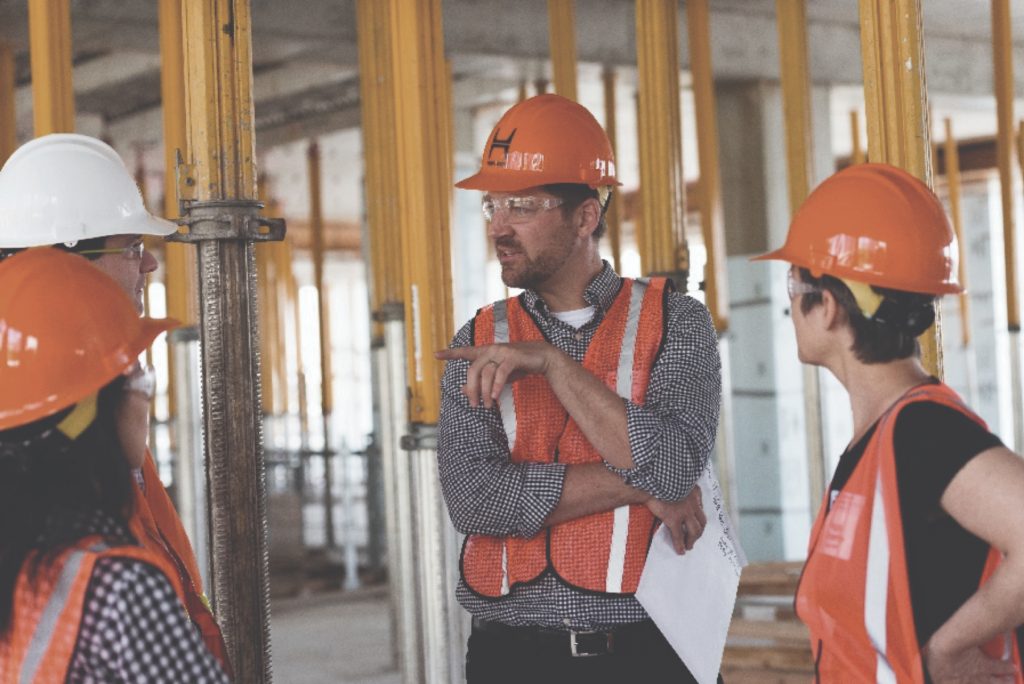
All Hands Raised’s Nate Waas Shull talks with educators at Industry for a Day. Photo by Beth Conyers.
“It’s not hard to turn the light bulb on, but it does take exposure and that’s where our signature event, Industry for a Day, comes in. We’ve taken 350 teachers out to active construction and manufacturing sites. Once they have hands-on exposure, it turns the light on. That’s the head level. But at the heart level, there’s still this deeply held believe that, if it were my kid, I’d rather they go to college,” Waas Shull says.
Emi Donis, general counsel at Senior Aerospace SSP, is working with All Hands Raised at Centennial High School in Portland. She says, “Industry is desperate for workers. At the same time, you’ve got kids in high school — and not everybody’s going to college. But in the schools, all they hear about is college. So, the kids go to college, leave after a year or two and get stuck working in fast food with a bunch of debt. We’re trying to help those kids.”
Donis helps high school students apply for jobs, and she is working with All Hands Raised to help employers improve access to trade professions.
Now, as a mother, it’s my turn to have heart-to-heart conversations with my teenage twin daughters while they weigh the opportunities ahead. As I encourage them to think about career possibilities, I ask them to consider what they enjoy doing and the earning potential. College may end up being their path to success, but it is not the only option available.
Kelly, left, with her family enjoying a vacation on Singer Island, Florida.
The post Discovering another path to prosperity appeared first on StriveTogether.
]]>The post Being unstoppable in pursuit of greater upward mobility for every child appeared first on StriveTogether.
]]>Last week, I painstakingly bent over my computer to write a blog on economic mobility. This is, after all, the north star of the StriveTogether Cradle to Career Network. I was mulling over a few research papers, each with different sets of indicators, when I was struck by a seemingly simple idea (and one I can’t believe I didn’t think of earlier!). I asked my 11-year-old daughter, Audrey, “What does success look like for you as a grownup?” Her answer nearly brought me to tears.
Audrey said, “Success looks like having a job, where I get decent money and I have a family and I have a normal house and my kids go to a good school and um … I’m just, happy.” That’s it. Our young people don’t care about moving quintiles — that’s just technical jargon. As I picked my chin up off the floor, I thought about how profound this statement was. And I would be willing to bet that Audrey’s answer is the same for millions of other kids across the country.
I want my kids to experience success in whatever way they define it. Every parent wants the same for their own children. We all hope for the components that lead to overall well-being:
- Financial stability
- Fulfilling employment that provides an adequate quality of life
- Opportunities for education
- Stable housing
- Social supports
- Accessible and affordable health care
I also asked Audrey if she thought she would be able to achieve that goal. She said she thought she could if she worked hard. But then I asked if she thought every kid would have that same opportunity and her answer was “probably not.” We have been talking a lot about privilege in our house lately. It was clear to me in that moment that Audrey recognized hers.
And there’s data to back it up. Economist Raj Chetty and his team show that 70 percent of Americans born in the lowest income quintile will never reach the middle class, and black households are more likely than their white peers to experience downward mobility. These outcomes are the result of discriminatory policies and practices with origins in systemic, structural and institutional racism.
These outcomes are unacceptable. At StriveTogether, we refuse to settle for a world in which a child’s potential is dictated by the conditions in which the child is born. The Cradle to Career Network is a national movement unified by a clear purpose: helping every child succeed in school and in life, regardless of race, zip code or circumstance. Putting children on the path toward economic mobility is our north star. Our ambitious five-year strategic plan, which we officially launched this year with the Network, is focused on putting every single one of the 13.7 million children we reach on the path to middle class by middle age. We especially want to improve outcomes for the 8.6 million children of color in our communities.
This is why StriveTogether is committed to transforming systems and eliminating disparities across the cradle-to-career continuum, with the overarching goal of economic mobility. One of the first steps was adding employment as the seventh outcome in our cradle-to-career roadmap. This addition was a long time coming and finally put a stake in the ground around measuring career in cradle to career. But employment does not equal economic mobility, nor is employment how we measure economic mobility. Many Americans with jobs are not earning more than their parents did, relative to today’s standards. Rather, employment, like the other six cradle-to-career outcomes, is one interim (but very important) measure of upward mobility.
As we go on this journey as a network, I feel reassured that we are not alone. Recently we engaged in some conversations with experts and thought leaders from Brookings Institution, Opportunity Insights, Results for America, Urban Institute and Enterprise, all of whom are working to identify a set of interim measures for economic mobility. Although a number of hypotheses exist and are being tested, no one has quite figured this out. Still, I’d posit the Network is a leader in making sense of this complexity because we are doing the work on the ground and learning as we do it in 67 communities across the country.
Our evolving approach was essentially validated when I sat in the audience at one of Raj Chetty’s recent speeches and he put up a slide that included our cradle-to-career roadmap (in StriveTogether brand colors and all!), with additional indicators such as family stability, social capital and affordable housing layered beneath the educational outcome areas. For more than a decade, our Network of partnerships has measured progress across the cradle-to-career continuum, and now it’s a core part of every outcomes framework I’ve seen from these experts so far.
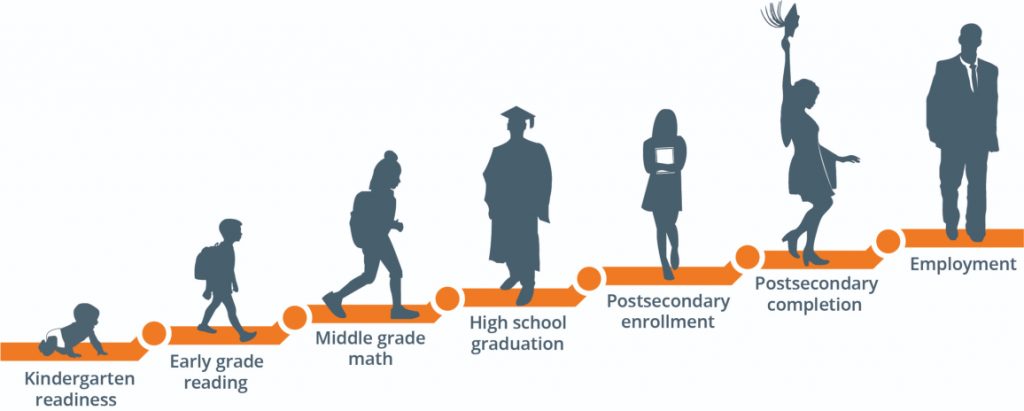
The bottom line is this: The only true path to mobility for every child is zero disparities. The only way we will get to zero disparities is to transform systems. And to transform systems, we must center equity and work with adjacent sectors like health, housing and transportation. We are on the right path, but it won’t be easy. This Network is leading the charge on this important and groundbreaking work.
Every child, regardless of the quintile into which they’re born, should have every opportunity to achieve their definition of success. That’s the American Dream, right? We cannot and will not stop until every one of the 13.7 million children impacted by this Network is on that path. We will be unstoppable until every child succeeds from cradle to career.
The post Being unstoppable in pursuit of greater upward mobility for every child appeared first on StriveTogether.
]]>