The post The path to American renewal starts in our communities appeared first on StriveTogether.
]]> Guest post by Cecilia Muñoz, vice president for public interest technology and local initiatives at New America
One of the many lessons I learned working for President Obama comes from his insistence that cynicism is one of the biggest threats our democracy faces. We believe that the system is broken so we back away, taking our hands off of the very levers that give us the capacity to make the changes that we seek.
There may be plenty of reason for cynicism in these challenging times. But there is also plenty of reason for hope, especially if you turn your head away from the dysfunction in Washington and focus on what good people are doing all over the country to address our public problems.
Those problems are grave indeed. Recent studies from Raj Chetty’s team at Harvard tell us that 70% of Americans born in the lowest income quintile will never reach the middle class, and that African American, Latinx and Indigenous children are more likely to experience downward mobility than their white peers. Too often, solutions aimed at young people focus on only one stage of a child’s education — such as early childhood, K-12 and higher education — at the expense of their broader life experience.
But there are promising signs that skillful hands and hearts are using data and other innovative tools to drive impact in small towns and big cities across the country. For example, StriveTogether, a national network committed to supporting the success of every child, offers a framework that is generating impressive impact in nearly 70 communities. In Memphis, Tennessee, a StriveTogether community partner worked with other nonprofits and a local children’s hospital to expand the Parent as Teachers program using an evidence-based curriculum to empower parents and connect families with community resources. Early results indicate that enrollment in home visiting programs has already increased by 9%. They also recently scored a policy win by making the case to city and county government to collaboratively invest $11 million to provide about 1,400 4-year-olds living in poverty access to full-day pre-K. The approved legislation also commits to expanding the program to full enrollment over the next two years, for a total investment of $40 million.
In Salt Lake City, Utah, nonprofit leaders, teachers, business owners and other community members gathered to tackle chronic absences among students at eight local elementary schools — the success has been remarkable. In one school, absence rates dropped from 16% to 2% among a group of chronically absent first-graders over a 10-month period of targeted interventions. At another school, 7% of special education students tested above reading benchmarks — a new high. This StriveTogether community is also advocating for public policy change, which has resulted in some important strides forward for early childhood funding, including the creation of the Governor’s Early Childhood Commission.
StriveTogether’s collective impact approach is already impacting the lives of 13.7 million youth across the nation — 8.6 million of whom are children of color. In the last year alone, 59% of their partnerships reported successes in three out of the six outcomes they measure for improvement, which include kindergarten readiness; early-grade reading and middle-grade math; high school graduation; postsecondary enrollment; and postsecondary completion to getting a good job that provides economic mobility.
These successful practices offer proof that we have the tools available to solve big challenges if we use them wisely and dare to measure our results. The next big challenge is to bring these changes to scale, which will take innovative new public policies. It’s not enough to increase the number of people who get to college in a single community; we need to replicate this success throughout the country. That means translating lessons learned from these localized experiences into policies to benefit children everywhere.
I say this as a policymaker — government doesn’t have to be broken. It can deliver the results it was designed to deliver. Good people with great ideas are making it happen locally, and there’s no reason that it can’t happen at a national scale. We don’t need Washington to give us the answers; our communities already have them. We should bring those ideas to our policymakers rather than the other way around. All we need to achieve collective impact are some proven strategies and the desire to make a difference in the lives of our kids.
The post The path to American renewal starts in our communities appeared first on StriveTogether.
]]>The post Policy wins made simple: Insights from communities and Cecilia Muñoz appeared first on StriveTogether.
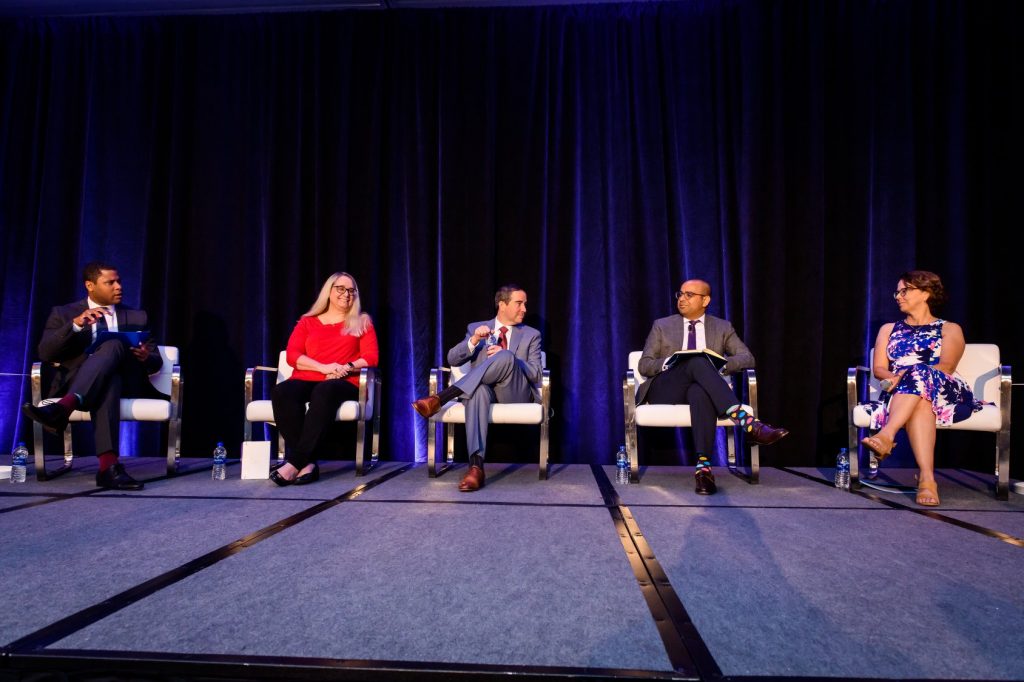
]]>On stage at the 2019 Cradle to Career Network Convening sits a panel of leaders from network communities celebrating recent policy successes. Joining them is Cecilia Muñoz, vice president for public interest technology and local initiatives at New America and a former senior staff member in the Obama administration. The panelists’ composure and passion carries the weight of distinctive expertise, yet on this stage, the prevailing narrative seems remarkably simple: Effective policy change, as convoluted and overwhelming as it can seem, can be achieved through a strategic blending of common sense and practical problem solving with communities.
This simplistic perspective is groundbreaking in a time when policy work is hard to conceptualize. Moderated by StriveTogether’s own senior manager of policy and partnerships, Christian Motley, this panel of network members from Kentucky (Partners for Education at Berea College), Texas (The Commit Partnership) and New Mexico (Mission: Graduate) shared that to achieve policy wins, you don’t necessarily have to be a political expert.
Policy change as continuous improvement
Before the panel, in her opening statement, Muñoz introduced something she calls “the new practice of public problem solving.” This concept builds on the idea that the traditional way of working in policy is inefficient and, ultimately, too distant from those it claims to help.
In this new practice of policy, problem solving must exhibit these four characteristics:
- People-centered: It puts people with needs and capabilities at the center of programs and policies using human-centered design.
- Experimental: It starts small and scouts for local solutions, testing ideas and concepts before spreading them nationally.
- Data-enabled: It leverages big data and small data to access problems, monitor progress and evaluate what works.
- Designed to scale: It includes a plan for how to expand and react when scaled
After listing these elements, Muñoz pauses, looking out into the convening audience with a knowing smile. “Sound familiar?” she asks. It does, demonstrated by how the room fills with laughter and head nods. The new practice of public problem solving is similar to the iterative build of the StriveTogether continuous improvement method that network members use to get better results for children and families.
Continuous improvement is the common thread through the panel’s experiences, from the success shared by Sagar Desai from The Commit Partnership of securing over $6.5 billion in education funding, to the work described by Angelo Gonzales from Mission: Graduate to introduce a competition model for school funding that aligns with closing disparity gaps.
Policy change as systems change
Around the room, convening participants lean forward in genuine engagement with the panel, but some have looks of slight skepticism. It’s as if they wonder, “If policy change is continuous improvement, what is the point of doing both? Aren’t strategies enough for real change?” Sensing this curiosity, Muñoz continues discussing the current progress of network members working to close disparity gaps.
“The doing is not enough,” she says. “In order to get to scale, you have to make policy to bring innovation to policy making. As important as it is to improve outcomes in communities, we cannot be done if we are not accomplishing this, for one county or even a whole state.” Shifting from doing to policy making is the heart of the difference between temporary fixes and lasting systems shifts.
Policy changers as strategic empathizers
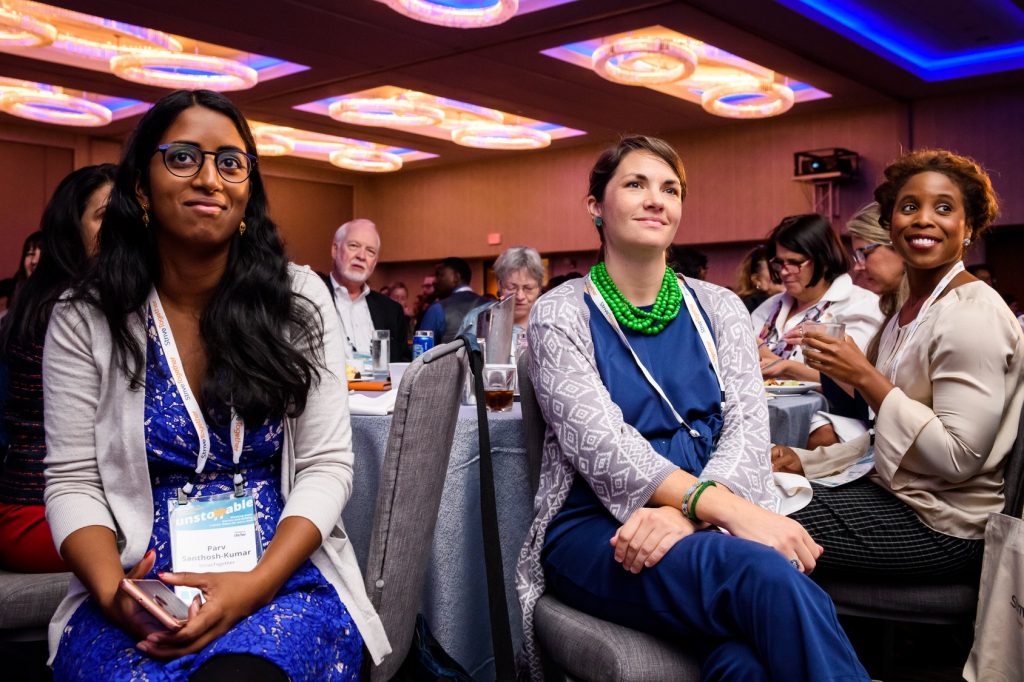
To achieve policy wins, listening is as important as speaking, according to the panelists. Build connections to turn opposers into allies rather than writing people off because of differences. In Berea, Kentucky, Dreama Gentry says, work is underway to help policy makers listen to the needs of rural communities and to support community members to become local policy makers themselves.
Muñoz reminds the audience that at the end of the day, we are all “innovators and problem solvers and good neighbors.” Yes, she’s referring to all policymakers — even those we disagree with. The challenge is to work together toward results for children and families.
“At the end of the day, everybody is human and they come in the room with interests, loyalties and mental models,” Motley says. He suggests understanding who you’re working with before the conversation begins, so you’re ready to leverage their passions for the results you seek. Using metrics, data, common sense and process design to understand a problem really well to drive for solutions is what policy work is all about. The good news is that the Cradle to Career Network is full of innovators with the tools needed to engage policy work across the country. These tools are common sense, ingenuity and a community full of others who desire success for their children.
As a policy maker, Muñoz has seen innovators in action time and time again. As the panel closes and she looks out at the room of over 500 leaders engaged in this work, she shares words of encouragement: “Change is possible. We can do this, and the reason I know this is because you’re already doing it, every day.”
The post Policy wins made simple: Insights from communities and Cecilia Muñoz appeared first on StriveTogether.
]]>The post Statewide collaboration for Minnesota’s kids and families appeared first on StriveTogether.
]]>When communities work together at a state level, they can get powerful results for kids and families. Recent policy work in Minnesota demonstrated this effect with a win for education.
Minnesota began the 2019 state legislative session with the only divided government in the nation — with a Democratic governor, Tim Walz, and a House of Representatives with a Democratic majority alongside a Senate controlled by Republicans. The focus of the session was to pass the nearly $50 billion state budget, determining what funding would be available for education, human services and more.
Ensuring children and families can succeed is not a partisan issue. This goal is shared across Minnesota by members of the Education Partnerships Coalition, collective impact organizations that include six members of the StriveTogether Cradle to Career Network and two members of the Promise Neighborhood Institute. The group is supported by a grant from StriveTogether’s Cradle to Career Community Challenge.
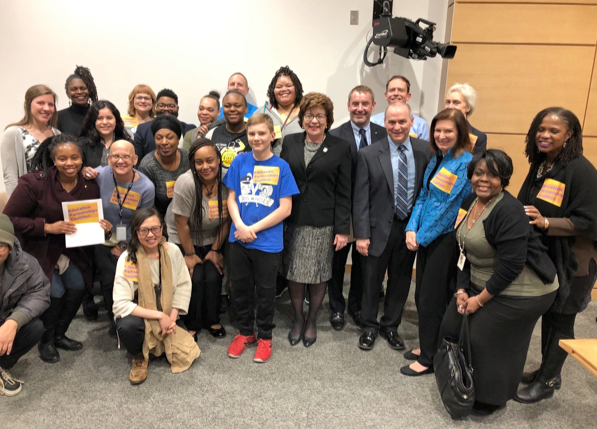
Senate Chief Author Carla Nelson with members of the Education Partnerships Coalition after the education committee hearing.
With a mission to eliminate some of the nation’s worst opportunity gaps, the Education Partnerships Coalition sought state funding to provide deeper support to more families across Minnesota. The EPC’s bill (House File 1056/Senate File 939) added additional rigor and requirements to the EPC’s existing state statute (124D.99) in addition to funding for Coalition members and planning grants to expand collective impact to new communities.
Throughout the legislative session, the Education Partnership Coalition supported parents to share their experiences and advocate for their families and communities. During the House and Senate committee hearings, legislators heard parents, students and school officials share why the StriveTogether framework is a key solution to eliminating educational disparities and enabling children and parents to thrive.
After a contentious special session, the Education Partnership Coalition was successful in passing its legislation and securing nearly $3 million in new state appropriations, in addition to $5.2 million in existing base funding. This marks an increase of $1.54 million from the state for this work over the next two years. In addition to legislative leadership, this victory is a result of powerful parent advocacy.
The Education Partnerships Coalition is made up of collective impact organizations from across Minnesota, including six members of the StriveTogether Cradle to Career Network: Austin Aspires, Generation Next in the Twin Cities, Every Hand Joined in Red Wing, Northfield Promise, Partner for Student Success in the St. Cloud area, and Cradle to Career in Rochester. The other Coalition members — Saint Paul Promise Neighborhood and the Northside Achievement Zone in Minneapolis — are members of the Promise Neighborhood Institute.
 Sarah Clarke is director of government affairs at Hylden Advocacy & Law. She is project manager for the Education Partnerships Coalition.
The post Statewide collaboration for Minnesota’s kids and families appeared first on StriveTogether.
]]>The post Mission: Graduate scores state policy win appeared first on StriveTogether.
]]>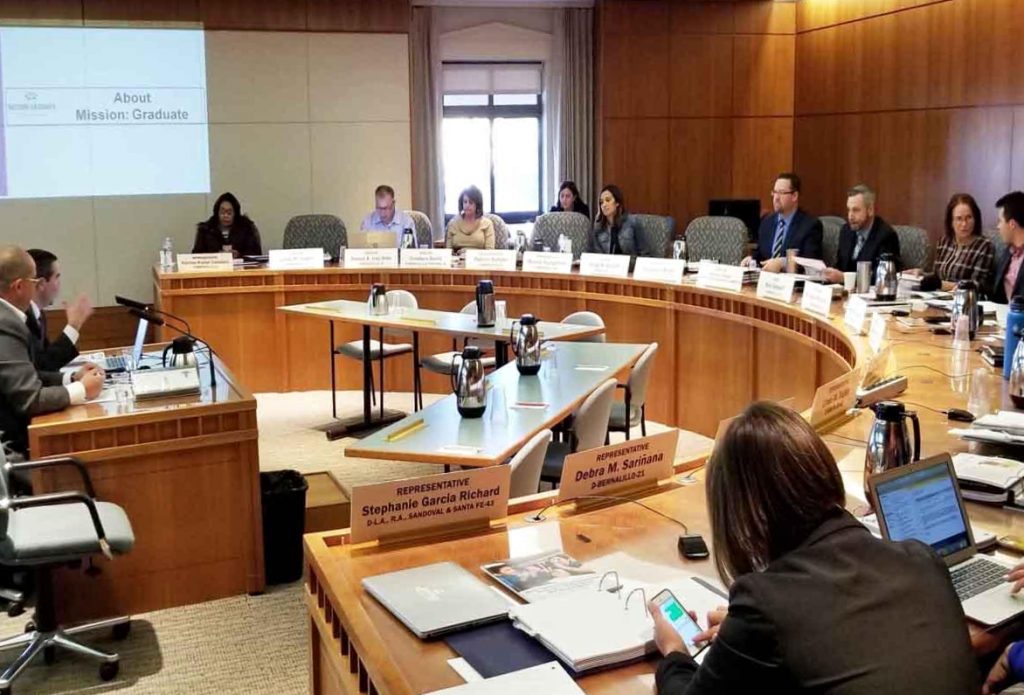 This policy win comes after five years spent on the issue by Mission: Graduate, a Cradle to Career Network member in Albuquerque.In partnership with a state representative, Mission: Graduate helped to draft the legislation, served as an expert witness during a legislative session and worked with executive and legislative staff to improve the bill to ensure passage.
“Our efforts finally paid off in a big way,” said Angelo Gonzales, chief strategy officer at United Way of Central New Mexico, which supports Mission: Graduate.“We are excited about the new changes to state law, and we are already planning to work with the New Mexico Public Education Department to help schools and districts understand what this will mean for them practically.”
Fast factsThe U.S. Department of Education defines chronic absence as missing 15 or more days during the school year. It’s a big barrier to high school graduation and students with too many absences may fall behind. But students who improve their attendance are more likely to graduate. In 2018, the four-year graduation rate for New Mexico students was 73.9 percent — 11 points lower than the national average. During the 2016-17 school year, 17.5 percent of New Mexico students were chronically absent. The disaggregated data also showed a disparity between students of color and their white peers. |
The law proposes that all schools collect and report chronic absence data, using the 10 percent threshold recommended by Attendance Works. Schools with chronic absence rates higher than a certain threshold will have to create attendance improvement plans. These are all practices that came from Mission: Graduate partners testing strategies with over 40 school-based teams over the last two years.
“The factors involving chronic absenteeism manifest through lack of communication, awareness and collaboration,” said Rep. Patricio Ruiloba, a state legislator from Albuquerque’s South Valley. “Families, students and staff are the school-based resources and can work together to navigate the social issues, fear and conflicts occurring in our schools. Remove these barriers, and have real communication and reduced consequences.”
Here are some key insights learned by Mission: Graduate during this work:
-
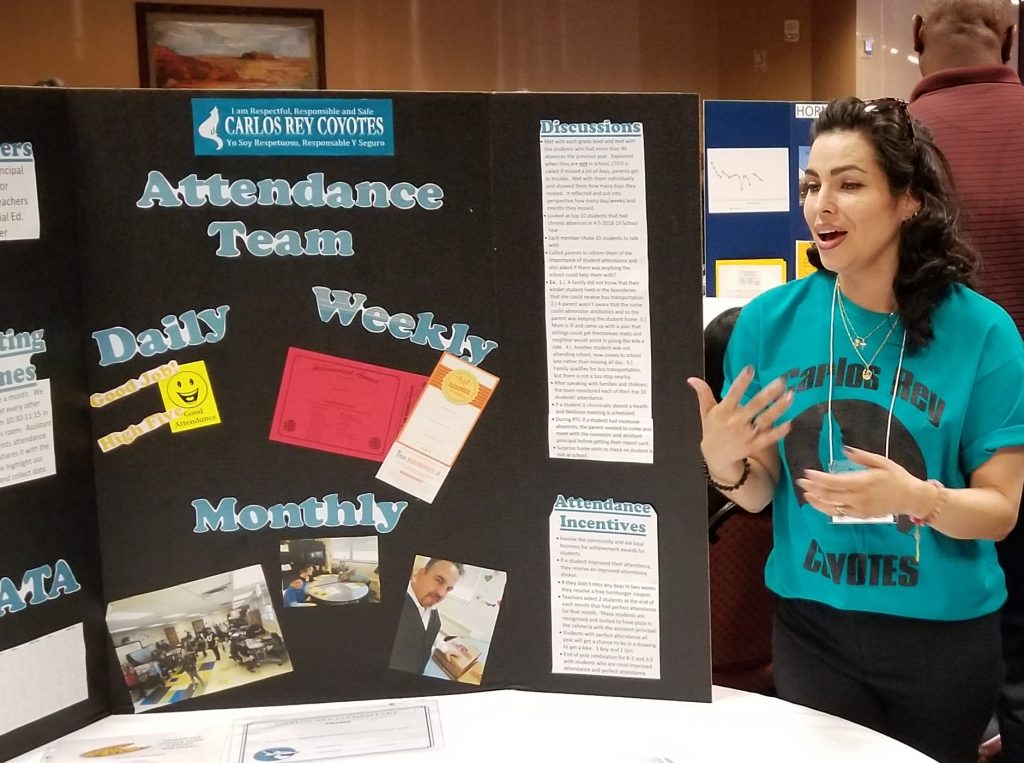 Support your position with research. In 2018, Mission: Graduate released a research brief on chronic absence, with causes, data and evidence, and policy recommendations. The research brief made clear what they needed in Albuquerque — a positive, diverse and inclusive school climate where all students feel they can belong. The policy recommendations were based on proven strategies from over 40 school-based teams.
- Find a legislator who shares your cause. Ruiloba had also been working to convince his colleagues to make chronic absence a priority. A former police officer, he leads restorative justice work in schools and sees the impact of missed class time on students every day. Ruiloba invited Gonzales as an expert witness to present findings with the Legislative Education Study Committee. Gonzales highlighted Mission: Graduate’s Every Day Matters campaign, identified potential gaps in current law and made data-informed recommendations.
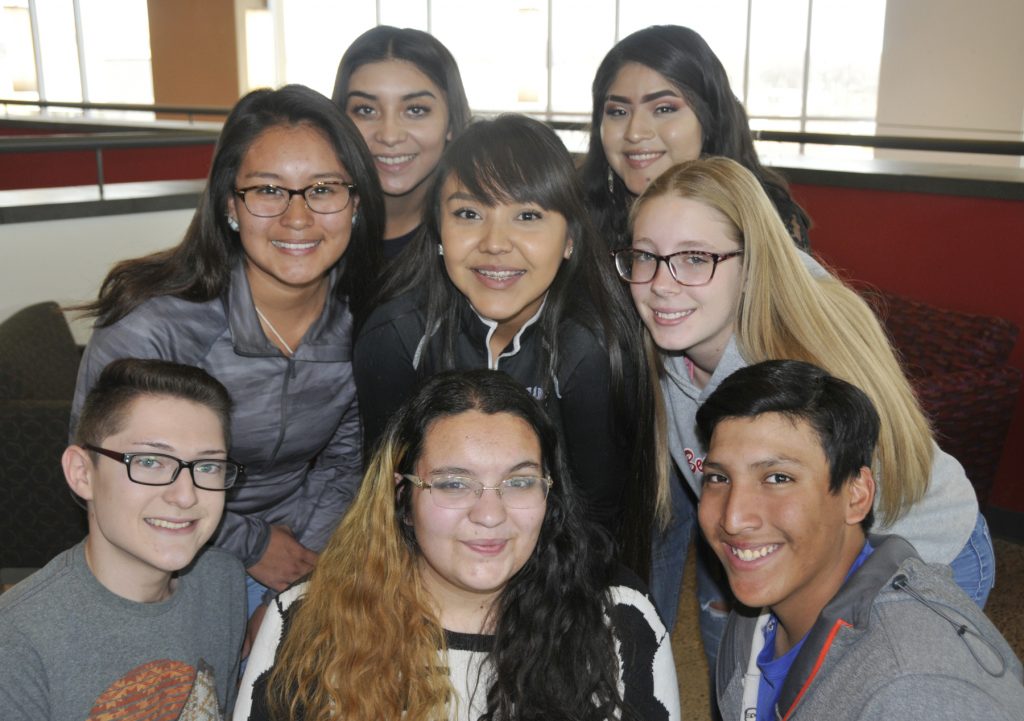 If at first you don’t succeed, try again. Ruiloba’s first bill to address chronic absence did not make it to the governor last year. Once the 2018 session was over, he and Gonzales began meeting immediately to improve language, share data and provide community voice. When legislators returned for the 2019 session, the Attendance for Success Act, sponsored by Ruiloba, sailed through both the House and the Senate.
“This is a probably the single greatest accomplishment of my time with Mission: Graduate,” Gonzales said. “We are all very excited about this first venture into public policy, and I’m hopeful that this is just the beginning of what we can achieve in the policy domain.”
To read more about this policy win, view the full case study at this link.
The post Mission: Graduate scores state policy win appeared first on StriveTogether.
]]>The post Why StriveTogether, a national network improving outcomes for kids, supports the National Housing Trust Fund appeared first on StriveTogether.
]]>The post Why StriveTogether, a national network improving outcomes for kids, supports the National Housing Trust Fund appeared first on StriveTogether.
]]>The post ‘A cradle-to-career promise for the next generation’ and other policy wins from Tuesday appeared first on StriveTogether.
]]>After looking at Tuesday’s election results throughout the country, it’s great to see the community support and policy wins for kids and families, both at the state and local levels. Below are a few examples of these wins that I wanted to share to bring you some of the optimism I feel moving into 2019 and beyond.
How fantastic that the next California governor shares our vision of getting better results for kids and understands the role that data plays in identifying what works! A self-described fan of “big, hairy, audacious goals” — a phrase that resonates with those of us in this work — Gavin Newsom supports universal preschool and more quality, affordable child care. He’s been outspoken about making public investments in children younger than 3 to close gaps for low-income children. Newsom also sees higher education as the culmination of a cradle-to-career journey toward upward mobility.
Newsom, a former mayor in San Francisco, also understands the importance of aligning all the different sectors and systems that shape opportunity for youth and families. Other priorities include providing universal health care, offering more affordable housing and reducing the state’s homelessness problem.
Here are other exciting wins to celebrate as well:
- In Wisconsin, by electing State Superintendent of Public Instruction Tony Evers as governor, voters have ensured someone in office who will focus on education policy and improvement. His agenda calls for investments in early childhood and quality childcare, educators and postsecondary institutions.
- The people of Minneapolis and St. Paul “voted yes for kids” Tuesday by approving high-stakes school levies. Voters backed $30 million a year in new funding for Minneapolis Public Schools and are likely to approve spending $18.6 million a year in St. Paul Public Schools.
- A $600 million-plus education levy passed by a wide margin in Seattle. At last count, almost 70 percent of voters approved the city’s largest-ever education tax. The seven-year levy, which will support preschool expansion and free community college among other initiatives, is intended to curb disparities for students of color and low-income students that can appear before kindergarten.
- Thanks to the support and advocacy of the Commit Partnership, Dallas voters approved giving more money to the Dallas Independent School District, according to unofficial results. By raising their maintenance and operations tax rate, residents will generate nearly $125 million each year to pay for prekindergarten, specialty school programs and employee raises as well as address racial equity.
- Residents in Oregon approved only one state constitutional amendment Tuesday. With 56 percent of the vote, they said yes to allowing local bond measures to pay for private, affordable housing. A whole state supporting adjacent sector work to make things better for kids and families — that’s amazing! We know that supportive policies in sectors like housing have huge potential to improve the lives of kids and families.
As identified in our new strategic plan, we know policy, advocacy and mobilization are key components for getting better results for youth and families in the coming years as we continue our cradle-to-career efforts. Hopefully, Tuesday’s election results are a sign of the support we will continue to receive from elected officials and policymakers as we strive to advance equity and close gaps for kids. If you saw other terrific policy wins that you’d like to share, please leave a comment below!
The post ‘A cradle-to-career promise for the next generation’ and other policy wins from Tuesday appeared first on StriveTogether.
]]>The post The effects of repealing net neutrality on our most vulnerable students appeared first on StriveTogether.
]]>This was partly made possible by the net neutrality policy put in place by President Barack Obama in 2015 requiring that internet service providers, or ISPs, treat all online content the same. This rule was rolled back in late 2017 with the “Restoring Internet Freedom Order.” The decision to reverse net neutrality impacts online speed and access to content, allowing ISPs now to block or slow down certain websites or types of content and show preferential treatment to others.
After voting to overturn the law in December, the Federal Communications Commission (FCC) has officially declared that net neutrality will come to an end April 23. Soon ISPs will be able to sell the internet in bundles like cable television, forcing people to pay extra for individual sites and potentially censoring information.
The net neutrality debate has been looked at as a business issue and a consumer concern. Startups and entrepreneurs might not be able to afford higher fees; the smallest voices may no longer be heard and able to thrive. But the recent decision to repeal net neutrality also has potential implications on education that should be addressed at local and national levels.
For a school system facing budget constraints, paying extra for increased speed or the guarantee that students have access to open source tools (e.g., Mozilla, Inkscape, RedNoteBook, etc.) may not be feasible. The removal of net neutrality does not take into consideration the local monopolies maintained by internet service providers. Many of our school districts can receive broadband services from only one or two providers, looking for a rate that fits within the budget of a cash-strapped-school in a market that does not have enough business to provide services at a competitive rate. This may become a growing problem for school administrators.
Additionally, the family who can’t access a simple internet resource such as Wikipedia — an online service that cannot compete within a digital marketplace — may be limited to the preferred knowledge content of the provider. The implications of the “Restoring Internet Freedom Order” on families with fewer resources are the most concerning. The family who lives miles from the closest library is at the mercy of what its provider allows in terms of access and speed.
Supporters in the state and federal government have expressed plans to continue fighting for it. Dozens of state attorneys general are now expected to join private net neutrality advocacy groups to file lawsuits against the order. Here are some ideas for local partnerships to strive to maintain an open and free internet:
- Meet with local internet service providers to express concerns on behalf of schools and families
- Partner with consumer advocacy groups, specifically on this issue
- Lobby local and state officials for their support
- Connect with other partnerships within the network to discuss how to address student needs at a national level
“It’s hard to imagine that ISPs would block access to educational resources, or require districts to pay more for quicker access,” writes Getting Smart coordinator Erik Day in a blog (Day, 2018). However, with the removal of net neutrality, that possibility exists. It is important to have an understanding and eventually agreements in place with local internet service providers to maintain current levels of access to knowledge for schools and families.
Recommended reading
How repealing net neutrality could affect schools’ internet access
Net neutrality: Removal and its potential effects on education
The FCC announces the last days of net neutrality
What the end of net neutrality would mean for education
The post The effects of repealing net neutrality on our most vulnerable students appeared first on StriveTogether.
]]>The post ‘Connecting the dots’: Advocating for policy change in Ohio appeared first on StriveTogether.
]]>Peggy Lehner, chair of the Senate Education Committee; Jim Tressel, Youngstown University president; Paolo DeMaria, Ohio’s superintendent of public instruction; and economist Eric Hanushek of Stanford University added their expertise to the event.
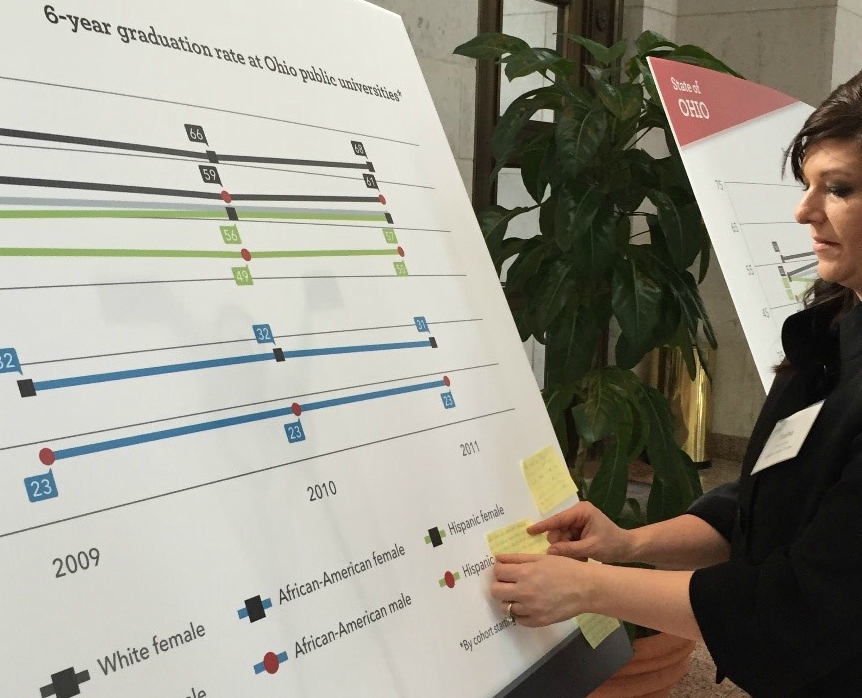 The day started with a data walk organized by the cradle-to-career initiatives. Attendees explored displays highlighting the state’s progress on its 2025 postsecondary credential goal and other critical milestones. The data emphasized the direct link between the milestones and postsecondary attainment.
The data around the room was a powerful visual reminder of the immediate change needed at multiple levels to reach and sustain the state’s vision. The Ohio Department of Education’s goal is that by 2025, 65 percent of Ohioans will have a 2- or 4-year degree or a certificate for a marketable career. Currently at 44 percent attainment, Ohio ranks 33rd in the country.
Reaching 65 percent is “not a pie-in-the-sky goal. It is an economic imperative,” State Senator Sue Lehner said. Economists estimate that in 2 years, two-thirds of jobs nationally will require a postsecondary credential. Ohio’s 44 percent attainment rate falls well short of the target, and this deficit will continue to have a significant economic impact on the state. It’s not surprising that Ohio also currently ranks 33rd in gross state product and 42nd in the nation in growth rate in income per capita. These economic health measures are intrinsically linked to Ohio’s graduates.
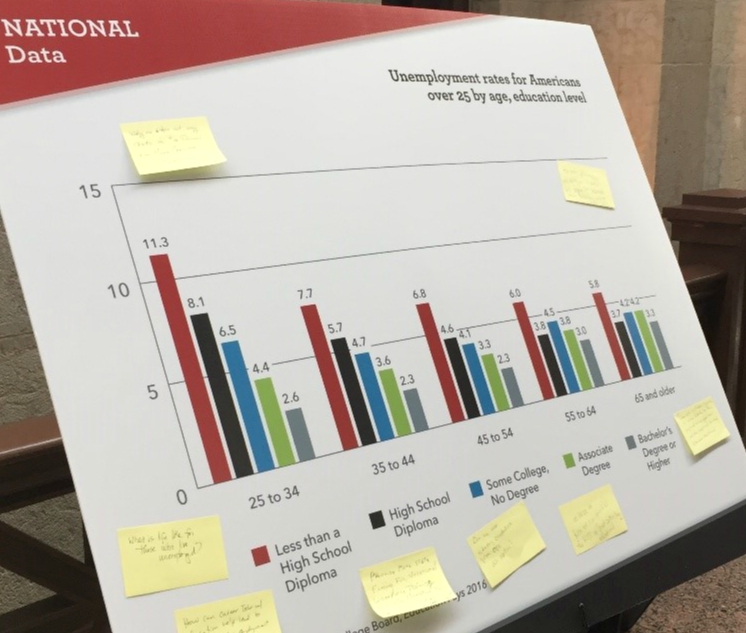 Organizers of the event conveyed the importance of education in today’s fiercely competitive global economy. Those who get a good education are healthier and happier. They live longer. They earn more money. They’re less likely to lose their jobs, and they’re more likely to be able to support their own children. Creating a 21st-century workforce requires delivering a quality education to every child and especially children of marginalized communities. To ensure equity, states need to examine disaggregated data and look at sub-populations of student success rates. Educating just some of the state’s young people is not good enough. If all citizens prosper, so will the state.
This is not a uniquely Ohio problem. So far, only nine states have achieved 50 percent attainment of degrees or certificates. Massachusetts and Colorado, the current national leaders at 55 percent, understand that there is much more work to do to reach 65 percent in the next few years. They also know that 65 percent is not enough unless they close disparity gaps for communities of color and low-income populations.
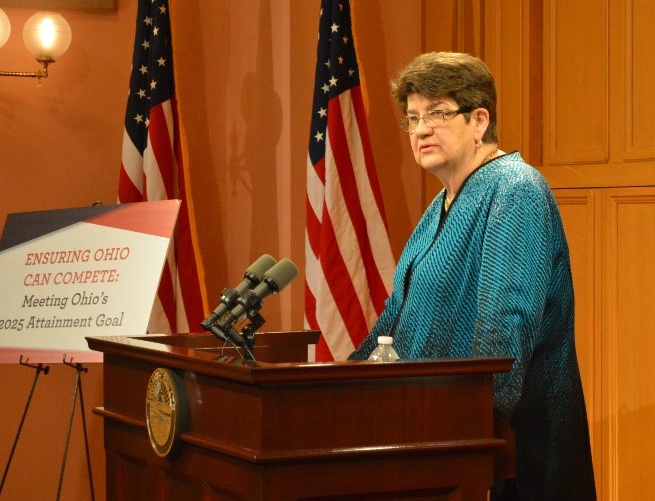 The entities who convened the event in Ohio laid out their roadmap to accomplish Ohio’s vision, including the commitment needed from all stakeholders. The report and their testimonials note three key components of this plan:
- Local place-based collaboratives must use disaggregated data to diagnose local problems and develop localized solutions that will close disparity gaps and raise achievement.
- Ohio’s employers need to work the state’s education system to prepare graduates with the necessary technical and soft skills for the high need jobs of today and the jobs of tomorrow.
- Policies must change at the state and local levels to support student success and create an environment that allows for systemic change.
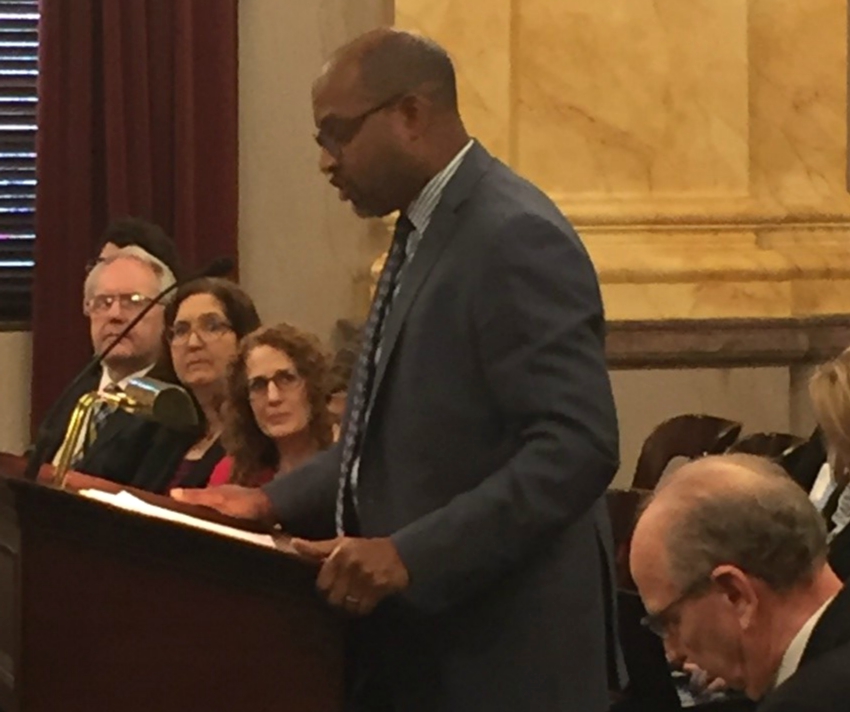
The day ended with a hearing of the Senate Education Committee. Dr. Hanushek, cradle-to-career partnership directors and state business officials testified about what it will take to “connect the dots from cradle to career.” The message of these testimonials was clear: To create results, state policies need to change. Their testimonials echoed the recommendations outlined in the report they jointly published, including Ohio’s need to:
- expand access to high quality early childhood experiences for Ohio’s most at-risk young children so they start school ready to learn;
- ensure that all teachers have the academic and clinical preparation they’ll need to teach all children, especially children from low-income backgrounds and underrepresented students;
- ensure school counselors and other staff are trained to help students know their career and post-high school educational choices; and
- ensure that all school districts have access to, and use, National Student Clearinghouse data to know their students’ success in earning a degree or credential.
 Events like the one on January 31 show that Ohio is creating programs to support students, but more needs to be done in changing policy. The state has created a “Step Up to Quality” initiative to support preschool improvement and is expanding career recognition programs earlier in the elementary years. The Department of Education is working with high schools to make sure every student graduates with an education plan and has adopted College Credit Plus to help students save money and get a head start on earning college credit. But the event also showed that what is being done is not enough.
According to Dr. Hanushek, improving schools should be Ohio’s top policy objective. “Improving schools takes effort, improving student performance takes effort. And it’s not about how much money is spent. It’s much more important how that money is spent,” Dr. Hanushek said.
The post ‘Connecting the dots’: Advocating for policy change in Ohio appeared first on StriveTogether.
]]>The post Partnerships and public policy appeared first on StriveTogether.
]]>Our board recently challenged us to consider ways we could use public policy engagement to support our investment in the community and programmatic work. The timing of this request and the StriveTogether Policy & Advocacy 101 training was perfect. I was able to gain valuable knowledge and skills to help me respond to our Board’s challenge. United Way of Central New Mexico (UWCNM) intends to engage in public policy to support and protect our grant making and programmatic work, like our cradle-to-career education initiative, Mission: Graduate.
This year we are launching three multi-year grants that will fund projects that work to implement three of Mission: Graduate’s collaborative strategies: summer learning loss, reduction in chronic absences and adult transitions to college. As a first step toward advocacy, UWCNM and Mission: Graduate recently partnered with the city of Albuquerque, the Early Childhood Accountability Partnership and the University of New Mexico Center for Education Policy Research to provide an opportunity for our donors, volunteers, community members and lawmakers to learn about summer learning initiatives in our community. The event focused on the findings of the Utah State University five-year study on New Mexico’s K-3 Plus program, a program that seeks to reduce summer learning by providing qualifying students an additional 25 school days during the summer.
Educational events like this will be the flagship public policy offerings of UWCNM as we explore our capacity for further advocacy. We hope to use our access to research and the lived experiences of our agency partners and their consumers to provide valuable policy-related information to our donors, volunteers, lawmakers and community members.
We are in the early stages of public policy engagement, but as we deepen that engagement, the training’s effective mix of technical and legal information, coupled with capacity-building materials, will serve as a valuable resource. I have used the knowledge I gained at the training to facilitate the foundational process work, while keeping in mind the elements that will help drive our work forward in a meaningful and thoughtful manner. I will use both the technical information and capacity-building resources as we move from the planning phase into action and advocacy. I strongly encourage organizations seeking to increase their understanding of public policy, and their capacity for public policy-related work, to consider attending a future training.
 Heba Atwa-Kramer is the director of community impact at United Way of Central New Mexico (UWCNM). She is part of the team that thinks about how to maximize the impact of UWCNM investments in her community and staffs the organization’s complementary public policy work. In this role, Heba has the opportunity to spend every day working to improve the health, education and financial stability of central New Mexico.
The post Partnerships and public policy appeared first on StriveTogether.
]]>